
Could San Diego’s notoriously hard water, which averages about 16 grains per gallon, be the silent culprit behind your weak shower and sluggish dishwasher? Dealing with a sudden drop in flow is more than just an inconvenience; it’s a disruption to your home’s peace of mind. We understand the anxiety that comes with wondering if a hidden slab leak is driving up your tiered water rates, especially following the 14.7% rate increase that took effect in January 2026. If you’re struggling to pinpoint the causes of low water pressure in whole house San Diego residences, you’re likely facing a “perfect storm” of aging infrastructure and mineral buildup.
Our team is here to provide the clarity you need to restore your home’s functionality with total transparency. In this guide, we’ll help you identify the root cause of your pressure loss and explain specific local factors, such as the city’s 80 PSI regulator requirements and available PRV rebates of up to $2,000. You’ll learn exactly when to contact the city and when a professional diagnostic is the most reliable path to getting your water flow back to an optimal, consistent level.
Key Takeaways
- Learn to differentiate between a simple fixture clog and systemic pressure loss that impacts every tap in your home.
- Identify the leading causes of low water pressure in whole house San Diego residences, including failing PRVs and mineral-heavy pipe corrosion.
- Master a simple DIY water meter test to quickly determine if the flow issue lies with the city or within your own property lines.
- Recognize the subtle indicators of underground slab leaks that can silently diminish your pressure while driving up tiered water costs.
- Discover how professional solutions like hydro jetting and advanced leak detection can efficiently restore your home’s plumbing performance.
Identifying Whole House Low Water Pressure in San Diego
Waking up to a weak shower is a frustrating way to start any morning. When you notice a drop in flow, the first step is determining if the problem is isolated or systemic. Identifying the specific causes of low water pressure in whole house San Diego properties often begins with a simple diagnostic walk-through of your home. We believe that providing you with the right information helps alleviate the anxiety of a plumbing mystery. Once you understand whether the issue is a single fixture or your entire system, you can move forward with confidence and a clear plan of action.
Systemic pressure loss affects every tap, appliance, and hose bib on your property. It isn’t just a minor annoyance; it can signal that your main line or a critical valve is struggling. In San Diego, our unique combination of aging infrastructure and specific water chemistry makes this a common challenge for homeowners. Pinpointing the issue early often prevents a manageable repair from turning into a late-night emergency. We prioritize this diagnostic phase to ensure we’re solving the root problem rather than just treating a symptom.
The Difference Between a Clog and a Systemic Issue
To confirm a whole-house issue, you should perform a simultaneous fixture test. Turn on the kitchen faucet, the bathroom sink, and the shower at the same time. If the flow at each location drops significantly, the problem is systemic. It’s also vital to check both hot and cold water lines. If the pressure is only low when using hot water, the issue likely resides within your water heater. However, if both temperatures are equally weak across all fixtures, the cause is almost certainly located before the water splits into your home’s internal branches. Plumbing is any system that conveys fluids, and a restriction in the main delivery point will starve every outlet in the house.
San Diego’s Water Profile and Your Pipes
San Diego is known for its “hard” water, which averages about 16 grains per gallon or 276 parts per million of mineral content. While these minerals are safe to drink, they’re tough on your pipes. Over time, calcium and magnesium create a rock-hard scale inside your plumbing. This buildup acts like cholesterol in an artery, narrowing the path for water to flow. If your home features older galvanized steel pipes, this mineral scale can lead to internal corrosion. This isn’t just a cosmetic issue for your dishes; it’s a primary driver for the gradual decline in pressure that many local homeowners experience. We often find that homes in historic neighborhoods are particularly susceptible to this type of mineral-driven restriction.
Recognizing these signs gives you the upper hand. Instead of wondering why your dishwasher is taking twice as long to cycle, you can identify the trend and address it. We find that our customers feel much more at ease once they have a professional explanation for the “why” behind their plumbing frustrations.
The 3 Most Common Causes of Pressure Loss in San Diego Homes
When the water flow in your home suddenly weakens, the culprit is usually found within one of three specific areas. Understanding these causes of low water pressure in whole house San Diego residences allows you to move from a state of frustration to one of informed action. While municipal issues occasionally occur, most systemic pressure drops are linked to your home’s internal regulation, the age of your plumbing, or hidden breaches in your main line. We aim to help you identify these triggers so you can restore your home’s comfort without unnecessary guesswork.
Failing Pressure Reducing Valves (PRV)
The most common reason for a sudden or erratic drop in pressure is a failing Pressure Reducing Valve, or PRV. Because the City of San Diego often delivers water at a very high PSI to navigate our hilly terrain, local code requires these regulators on properties where pressure exceeds 80 PSI. A PRV acts as a protective gatekeeper for your appliances, fixtures, and even safety systems like fire sprinklers; specialists like Firemex Solutions Inc. emphasize that maintaining consistent pressure is vital for the integrity of such fire protection installations. However, these valves have a typical lifespan of 5 to 15 years in Southern California. When they begin to fail, you might hear a distinct humming or vibrating sound from your pipes. You may also notice that your pressure swings wildly, starting strong and then tapering off to a trickle within seconds. Replacing a worn regulator is one of the most cost-effective ways to stabilize your entire system.
Aging Pipes and Neighborhood-Specific Risks
Your home’s location in San Diego plays a significant role in your plumbing’s health. If you live in historic neighborhoods like North Park, Hillcrest, or Kensington, your home may still rely on original galvanized steel pipes. Over decades, these pipes suffer from internal rust and mineral “tuberculation.” This process creates a thick layer of corrosion that chokes the water flow, much like a clogged artery. Unlike a PRV failure, this type of pressure loss is usually a slow, multi-year decline. If you suspect your older home is suffering from decades of buildup, a professional plumbing service in San Diego can perform a camera inspection to verify the internal condition of your lines.
Hidden Leaks and Valve Malfunctions
San Diego’s concrete-foundation homes are uniquely susceptible to slab leaks. A pinhole leak in the copper main line beneath your floor can divert a massive amount of water before it ever reaches your shower head. This not only kills your pressure but also risks structural damage and drives up your tiered water bill. Additionally, don’t overlook your main shut-off valve. These valves can sometimes vibrate partially closed or suffer from internal handle failure, restricting the volume of water entering your home. If you’ve recently had work done or find your pressure has vanished overnight, checking the position of this valve is a vital first step. If the valve is fully open and pressure remains low, our team can provide expert leak detection to find the hidden source of the problem before it escalates.
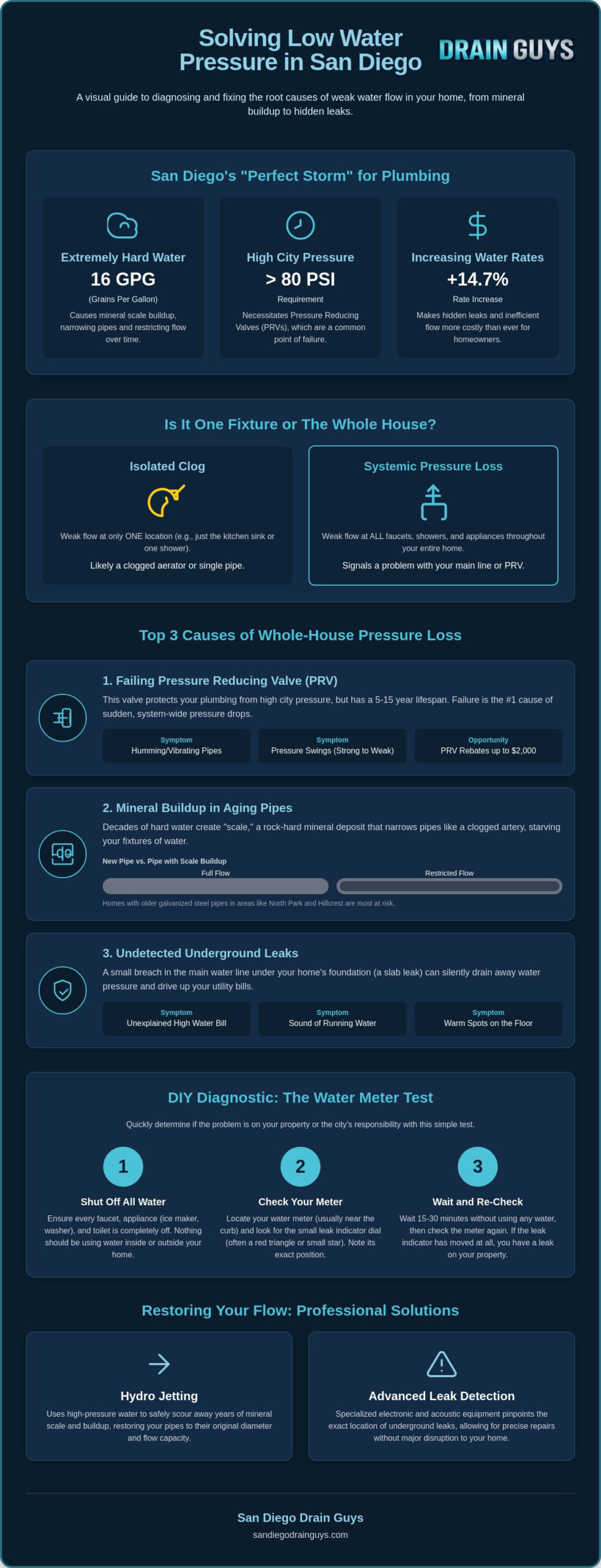
Is it the City or You? The San Diego Water Meter Test
Before you commit to a repair, it’s essential to determine if the drop in flow originates on your property or within the municipal supply. One of the most common causes of low water pressure in whole house San Diego homes is a city-side main break or hydrant flushing, but you shouldn’t assume the city is at fault without a quick check. Your water meter is the most reliable tool for this diagnostic. It serves as the boundary between your private plumbing and the public infrastructure. By performing a simple DIY test, you can gain immediate clarity and peace of mind.
Step-by-Step Meter Reading Guide
Locating your meter is usually straightforward; it’s typically housed in a concrete box near the sidewalk or curb. Use a large screwdriver to carefully lift the lid, being mindful of any local insects or debris that might be inside. Once you have access to the meter face, follow these steps to check for hidden issues:
- Ensure every water-using device in your home is off, including ice makers, dishwashers, and irrigation timers.
- Wipe the meter face clean and look for the “low-flow indicator,” which is usually a small red or silver triangle or star-shaped dial.
- If this indicator is spinning even slightly while all faucets are closed, water is moving through the meter, confirming a leak on your property.
- If the dial is stationary but your pressure remains poor, you are likely dealing with a physical blockage, a failed PRV, or a city-side supply issue.
Recording your meter reading and checking it again after two hours of no water use is an excellent way to calculate “silent” water loss. This is particularly important given the 2026 water rate increases, where every gallon lost contributes to higher tiered costs that can quickly impact your monthly budget.
City Responsibility vs. Homeowner Responsibility
Understanding the “curb stop” rule is vital for managing your expectations and potential costs. The City of San Diego Public Utilities Department is responsible for the water main in the street and the service line leading up to and including the meter itself. Everything from the house-side of the meter to your indoor fixtures falls under your responsibility. If your neighbors are also experiencing weak flow, the issue is likely a block-wide main break or scheduled maintenance in your area.
If you’ve ruled out a leak and your neighbors have strong flow, it’s time to call the city’s emergency line at 619-515-3525. A city crew can test the pressure at the nearest fire hydrant to verify if the municipal supply meets the recommended residential range of 45 to 75 PSI. If the city confirms their supply is adequate, you can be certain that the causes of low water pressure in whole house San Diego properties in your specific case are internal. This diagnostic step allows us to move forward with professional leak detection or descaling, knowing exactly where the problem lies.
Hidden Leaks: Why Your Pressure is Vanishing Underground
If your meter test confirmed water movement but your walls and ceilings remain dry, the problem is likely subterranean. One of the most overlooked causes of low water pressure in whole house San Diego properties is the “slab leak.” Because most Southern California homes are built on concrete slab foundations, your main supply lines run directly beneath the floor. Over time, friction against the soil or chemical reactions in the copper can create pinhole breaches. These leaks divert a significant volume of water into the ground, starving your fixtures and leaving you with a weak, unsatisfying flow.
You should look for subtle environmental clues that indicate an underground failure. Homeowners often report finding a single warm tile in a bathroom or kitchen, which suggests a leak in the hot water line beneath the concrete. In your yard, look for patches of grass that are unusually lush or damp spots that never dry out, even in our arid climate. While we focus on San Diego plumbing, professionals in similar desert environments like Sonora Sprinkler Inc. specialize in identifying how irrigation leaks can silently drain your system’s pressure. Beyond the physical signs, your bill is a major indicator. With San Diego’s tiered water rates increasing in 2026, a hidden leak can cause a sudden, inexplicable spike in your monthly costs. We recommend monitoring your usage closely to catch these “silent” pressure thieves early.
Professional Leak Detection Technology
We use non-invasive technology to find these hidden issues without tearing up your flooring. Acoustic equipment allows us to “hear” the specific frequency of water escaping a pipe through layers of concrete and soil. In some cases, sewer scope inspections are necessary to ensure that broader line issues aren’t contributing to the instability of your plumbing system. This methodical approach ensures we identify the exact location of the breach, saving you from the high cost and mess of unnecessary demolition. We believe in being thorough so that you don’t have to worry about recurring issues.
Main Water Line Failures
Underground pressure loss isn’t always caused by a slab leak; sometimes, the main line from the meter to the house is the problem. San Diego’s soil can shift significantly during dry periods, putting immense stress on PVC or older copper lines. Additionally, the roots of local trees are persistent and can crush or penetrate supply lines in search of moisture. If a failure is found, trenchless sewer repair and similar pipe-lining methods can often be adapted to resolve drainage issues that arise from these ground shifts. If you suspect your pressure is vanishing into the earth, we can help you with expert leak detection to find and fix the problem efficiently.
Restoring Your Flow: Professional Solutions and Next Steps
Once you’ve identified the likely causes of low water pressure in whole house San Diego plumbing systems, the focus shifts toward the most efficient path to restoration. Moving from a state of frustration to a fully functional home requires a methodical approach that prioritizes long-term reliability over temporary patches. We believe in providing clear, actionable solutions that address the root of the problem, whether it’s a simple valve replacement or a more comprehensive system cleaning. Our goal is to return your home to a state of comfort with total transparency regarding the work required.
A failing Pressure Reducing Valve (PRV) is often the most straightforward fix. If your diagnostic tests pointed toward a faulty regulator, replacing it is a quick and cost-effective way to stabilize your entire system. This small device plays a massive role in protecting your appliances from the high-pressure surges common in our local municipal supply. By installing a high-quality, modern PRV, you ensure that your showers are consistent and your pipes are protected from the stress of fluctuating PSI levels.
Targeted Repairs vs. System Upgrades
For homes struggling with the “arterial” buildup of minerals mentioned earlier, hydro jetting and professional descaling offer a powerful path forward. While many homeowners associate these methods with clearing major clogs, specialized drain cleaning in San Diego techniques can be adapted to improve the overall health and flow of your system. If your pipes have reached the end of their lifespan, we may discuss partial or whole-house repiping. When moving past old galvanized steel or failing copper, we often recommend modern materials like PEX. These options are specifically chosen for their resistance to the corrosive soil and hard water conditions found throughout San Diego County.
Why Trust San Diego Drain Guys for Your Pressure Issues?
We understand that inviting a service professional into your home requires a high level of trust. Our team is committed to a “calm expert” approach that respects your domestic environment and your privacy. We utilize a transparent, flat-rate pricing model for our diagnostics. This eliminates the “hidden surprise” anxiety that often accompanies plumbing repairs, allowing you to make informed decisions about your home’s infrastructure without financial uncertainty.
Restoring strong, consistent water flow doesn’t have to be a stressful ordeal. Our methodical diagnostic process and specialized equipment ensure that we find the exact source of your pressure loss quickly and accurately. We are proud to be a dependable partner for local homeowners, providing the niche expertise needed to navigate San Diego’s unique plumbing challenges. Don’t let a weak shower or sluggish appliances disrupt your routine any longer. Schedule your professional water pressure diagnostic today!
Take Control of Your Home’s Water Flow Today
Understanding the boundary between city responsibility and your private plumbing is the first step toward a permanent resolution. Whether your issue stems from a failing 15-year-old PRV or mineral buildup from San Diego’s hard water, you now have the diagnostic tools to move forward with confidence. Pinpointing the specific causes of low water pressure in whole house San Diego residences doesn’t have to be a stressful guessing game for you and your family.
We’ve been locally owned and operated since 2018, and our team specializes in using non-invasive technology to solve these exact frustrations. As acoustic leak detection specialists, we identify hidden breaches beneath your slab without the need for unnecessary demolition. We believe in building trust through total transparency; that’s why we utilize specific, flat-rate diagnostic fees to eliminate any financial uncertainty. You deserve a home where the plumbing works efficiently and reliably every single day. Restore Your Water Pressure with San Diego Drain Guys and enjoy the relief that comes with a strong, consistent flow. We’re ready to help you get your home back to normal.
Frequently Asked Questions
Can a bad water heater cause low water pressure in the whole house?
A failing water heater typically only impacts the hot water side of your plumbing system. If you’re experiencing a drop in flow at every tap for both hot and cold water, the heater is likely not the primary culprit. Whole house issues usually point toward the main supply line or a failed pressure regulator. However, extreme sediment buildup inside the tank can severely restrict hot water volume throughout the entire property.
How much does it cost to replace a water pressure regulator in San Diego?
The cost to replace a water pressure regulator depends on the valve’s size and the accessibility of your main water line. While we don’t provide fixed quotes without a professional diagnostic, the City of San Diego offers a rebate of up to $2,000 for properties with pressure at or above 80 PSI. This rebate can significantly offset the investment required to protect your home’s appliances and internal plumbing from high-pressure surges.
Why is my water pressure low only on the hot water side?
Low pressure isolated to the hot water side usually indicates heavy sediment accumulation inside the water heater or a failing heat trap nipple. Over time, San Diego’s hard water minerals settle at the bottom of the tank, obstructing the outlet. You should also check the shut-off valve on the cold water inlet pipe above the heater to ensure it is fully open and hasn’t suffered an internal mechanical failure.
Can the City of San Diego increase the water pressure to my house?
The City of San Diego generally cannot increase the pressure specifically for one residence as they maintain standardized municipal levels for the entire neighborhood. If a city crew tests the nearest hydrant and finds the pressure is within the standard range, any remaining flow issues are considered a private matter. In these cases, the causes of low water pressure in whole house San Diego homes are almost always found within the property’s own regulator or pipes.
Will hydro jetting fix my low water pressure issues?
Hydro jetting is highly effective if your pressure loss is caused by heavy mineral scaling or debris inside your pipes. This process uses high-pressure water to scrub the internal walls of your plumbing, restoring the original diameter of the line. While it won’t fix a mechanical failure like a broken PRV, it is a primary solution for older homes suffering from decades of hard water buildup that chokes the flow.
How do I know if I have a slab leak causing my pressure drop?
You can identify a potential slab leak by checking your water meter’s low-flow indicator while all faucets are turned off. If the dial is moving, water is escaping somewhere on your property. Physical signs like unusually warm floor tiles or damp spots in your yard also point toward an underground breach. These leaks are common causes of low water pressure in whole house San Diego residences built on concrete foundations.
What is the ideal water pressure for a San Diego home?
The City of San Diego recommends a residential water pressure setting between 45 and 75 PSI. While the California Plumbing Code allows for up to 80 PSI, staying within the city’s recommended range helps prevent unnecessary wear on your appliances and reduces the risk of pipe bursts. If your pressure exceeds 80 PSI, installing a regulator is a legal requirement to protect your home’s plumbing infrastructure and ensure long-term reliability.
Does San Diego’s hard water permanently damage my pipes?
San Diego’s hard water, which averages 16 grains per gallon, can cause long-term damage through a process called mineral tuberculation. This creates a rock-hard scale that narrows the internal diameter of your pipes and can lead to pinhole leaks in copper or internal rust in galvanized steel. While regular descaling can prolong the life of your system, extreme cases of mineral damage may eventually require a partial or whole house repipe.