
Did you know that root intrusion in private laterals causes nearly 40% of sewer overflows across San Diego? It’s a stressful discovery for any homeowner, especially when you start picturing your driveway or expensive landscaping being torn apart by heavy machinery. We know you want a permanent fix, but the technical debate of cipp vs pipe bursting often feels like a wall of jargon designed to hide the final bill. You’re looking for a way to restore your plumbing without the chaos of a traditional trench.
We’ve helped many of your neighbors navigate these high-stress repairs with transparency and local expertise. This guide compares these two leading no-dig technologies to find the most cost-effective and durable solution for your property’s specific needs. We’ll examine how CIPP lining reinforces your current pipes and when pipe bursting is the better choice for a total replacement. By the end, you’ll have the technical justification and clarity needed to protect your home and your budget with confidence.
Key Takeaways
- Compare the core mechanics of cipp vs pipe bursting to decide between rehabilitating your existing pipe or installing a completely new one.
- Learn how CIPP creates a seamless, jointless barrier that effectively prevents future root intrusion in San Diego’s older neighborhoods.
- Discover why pipe bursting is the superior choice for severely damaged or collapsed lines that require a full replacement with HDPE pipe.
- Understand how local soil conditions and a thorough camera inspection dictate which trenchless method provides the best long-term value.
- Evaluate the lifespan and maintenance requirements of both technologies to ensure your sewer repair is a one-time investment.
The Trenchless Revolution: CIPP vs. Pipe Bursting in San Diego
Many homes in San Diego’s mature neighborhoods, such as North Park, Kensington, or La Jolla, rely on sewer lines installed over half a century ago. These pipes are often made of clay or cast iron, materials that eventually succumb to relentless root intrusion or structural corrosion. Traditionally, fixing these issues meant digging a massive, destructive trench through your yard. Today, Trenchless technology offers a “no-dig” alternative that preserves your property while providing a permanent fix. We specialize in these advanced methods because they allow us to solve complex plumbing problems with minimal disruption to your daily life.
Why ‘No-Dig’ Technology is Essential for San Diego Properties
San Diego homeowners invest significant time and resources into their curb appeal. Whether it’s a meticulously paved historic driveway or the mature palm trees that define your landscape, traditional excavation can be devastating to your property’s value. No-dig methods allow us to access your sewer line through existing cleanouts or small, strategic access points. This approach offers several advantages for local residents:
- Property Preservation: It protects expensive hardscaping, tile walkways, and historic San Diego driveways from being demolished.
- Neighborhood Respect: It reduces the impact on local traffic and street parking, which is particularly vital in densely populated areas.
- Efficiency: We often complete these repairs in a single day, saving you the weeks of restoration work required after traditional trenching.
CIPP vs. Pipe Bursting: The Core Engineering Difference
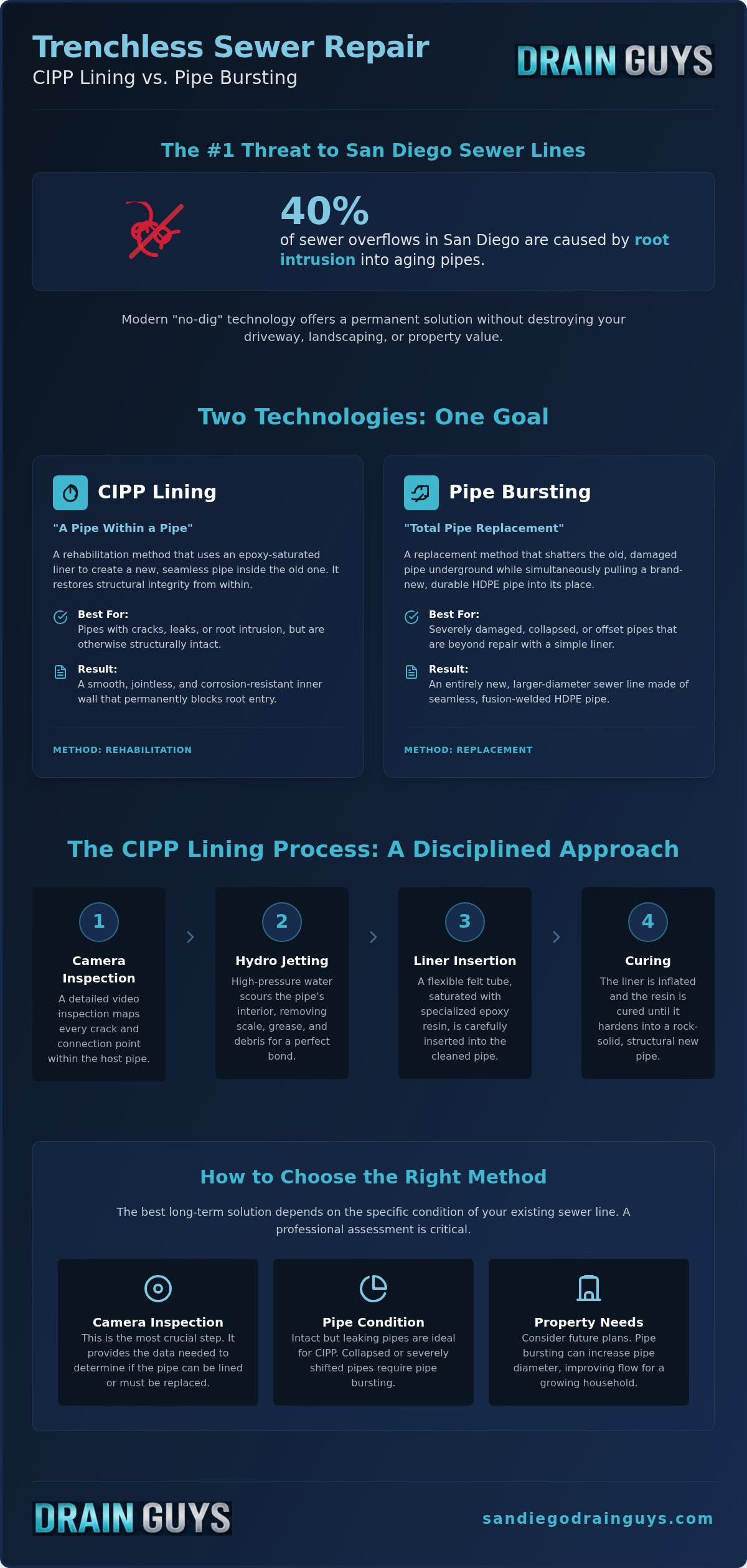
When we evaluate a failing sewer line, we’re looking at two distinct paths: rehabilitation or total replacement. Understanding the mechanics of cipp vs pipe bursting helps you make an informed decision for your specific property needs. CIPP, or Cured-In-Place Pipe, is a rehabilitation method. We use your existing pipe as a host or mold for a new epoxy liner. A flexible tube saturated with resin is inserted into the pipe and then cured until it hardens into a seamless, jointless sleeve. It’s an elegant way to restore structural integrity from the inside out.
Pipe bursting is a replacement method rather than a repair. Instead of lining the old pipe, we use a powerful mechanical bursting head to physically shatter the host pipe from the inside. As the old line is destroyed and pushed into the surrounding soil, we simultaneously pull a brand-new High-Density Polyethylene (HDPE) pipe into its place. This creates an entirely new sewer system without the need for a trench.
The primary choice between cipp vs pipe bursting often comes down to the condition of your current infrastructure. If the pipe is mostly intact but leaking, CIPP is a fantastic restorative tool. If the pipe has collapsed or shifted significantly in San Diego’s expansive clay soil, pipe bursting provides the necessary structural reset. We prioritize a methodical camera inspection first to ensure we justify the technical choice for your specific repair.
CIPP Lining: Creating a Seamless New Pipe Within Your Old One
CIPP lining is often described as a “pipe within a pipe,” but this simple description doesn’t do justice to the sophisticated engineering involved. When comparing cipp vs pipe bursting, CIPP stands out for its ability to create a completely seamless barrier within your existing infrastructure. Because the finished product has no joints, it eliminates the entry points that roots typically exploit to cause blockages. This is a critical advantage in San Diego, where root intrusion causes approximately 40% of sewer overflows. Once the epoxy cures, it forms a rock-hard structural shell that is chemically inert and highly resistant to the corrosive environment of a sewer line.
The Step-by-Step CIPP Process
We follow a disciplined, methodical approach to ensure every liner succeeds. The process begins with a detailed sewer camera inspection to map every crack and identify the exact location of branch connections. This diagnostic phase is essential for precision. After the inspection, we use high-pressure hydro jetting to scrub the interior of the host pipe. Unlike some competitors who might rush this stage, we know that a perfect bond requires a surface free of scale, grease, and debris.
Once the line is clean, we saturate a felt tube with a specialized epoxy resin. Using compressed air, we “invert” this tube into the old pipe, pressing the resin firmly against the walls. Finally, the liner is cured using steam or ambient air, a chemical reaction that transforms the flexible tube into a rigid pipe that meets strict industry standards. Modern epoxy liners are designed for extreme longevity. According to the EPA Trenchless Rehabilitation Fact Sheet, CIPP systems have a design life of approximately 50 years. This makes it a permanent solution for homeowners who want to fix their plumbing issues once and for all. If you are unsure which method fits your home, our team can help you evaluate trenchless sewer repair options that prioritize your property’s privacy and integrity.
Best Use Cases for CIPP in San Diego
CIPP is particularly effective for specific San Diego infrastructure challenges. It is the ideal choice for sealing cracks and stopping leaks in the cast iron lines found in older homes throughout neighborhoods like Hillcrest or Point Loma. Since the process is entirely internal, it allows us to repair pipes that run directly under swimming pools, expensive patio tiles, or home foundations without any surface disruption. While the debate of cipp vs pipe bursting often centers on the state of the pipe, the ability of CIPP to navigate bends and preserve existing structures often makes it the most logical choice for residential rehabilitation.
Pipe Bursting: Full Sewer Replacement Without the Trench
While CIPP works by reinforcing the host pipe, pipe bursting is the preferred choice when the existing line is too far gone to save. It’s a complete structural replacement that doesn’t require the massive excavation of years past. We consider this the “heavy hitter” of trenchless technology because it doesn’t just repair a problem; it installs an entirely new system. When weighing cipp vs pipe bursting, the decision often centers on whether you want to rehabilitate what you have or start fresh with modern materials.
The new pipe used in this process is made of High-Density Polyethylene (HDPE). This material is exceptionally durable and flexible, allowing it to withstand the natural movement of San Diego’s expansive clay soils without cracking. HDPE has a verified lifespan of 75 years or more, providing a level of long-term security that traditional materials simply can’t match. It’s also fused into one continuous piece, meaning there are no joints or seams for roots to penetrate in the future.
One unique advantage in the cipp vs pipe bursting debate is the ability to increase your sewer’s capacity, a process known as “upsizing.” Because the bursting head is slightly larger than the old pipe, we can often expand a standard 4-inch line into a 6-inch line. This is a significant benefit for San Diego homeowners adding Accessory Dwelling Units (ADUs). Increased wastewater flow is often a requirement for these additions, and pipe bursting allows you to meet those needs without digging up your entire property to install larger pipes.
How Pipe Bursting Works
We begin the process by excavating two small, strategic access pits at either end of the sewer run. A heavy-duty steel cable is fed through the damaged line and attached to a conical bursting head. As a hydraulic ram pulls the cable back toward the exit pit, the head fractures the old clay or cast iron pipe, pushing the fragments into the surrounding soil. Simultaneously, the new HDPE pipe is pulled into the void created by the bursting head. This methodical approach ensures the new line is placed exactly where the old one sat, maintaining the proper grade and flow.
When Pipe Bursting is the Only Solution
There are specific scenarios where a liner simply isn’t an option. If a camera inspection reveals a completely collapsed section, a CIPP liner cannot pass through the obstruction to create a seal. Pipe bursting is also the only viable trenchless fix for “Orangeburg” pipes, which are essentially tar-paper tubes common in some older San Diego developments. These pipes lack the structural integrity to support a liner. By choosing bursting, we provide a brand-new system that fully complies with the 2025 California Plumbing Code standards for polyethylene pipe insertion, giving you total peace of mind.
CIPP vs. Pipe Bursting: Cost, Longevity, and Performance
Choosing between cipp vs pipe bursting requires a balance of immediate needs and long-term goals. While both technologies are significantly less invasive than traditional trenching, they differ in their physical footprint. CIPP is often considered a “zero-dig” solution because we can typically access the line through an existing cleanout. Pipe bursting is a “low-dig” method, requiring two small access pits to pull the new HDPE line through. Performance also varies regarding flow capacity. CIPP slightly reduces the internal diameter of the pipe, though its smooth resin surface often improves flow efficiency. Conversely, pipe bursting allows us to maintain or even increase the pipe’s diameter to handle higher volumes of wastewater.
Cost Factors for San Diego Homeowners
The total investment for trenchless sewer repair in San Diego is frequently lower than traditional excavation when you factor in the cost of property restoration. You won’t have to pay for new concrete, expensive landscaping, or driveway repairs that can otherwise double the price of a project. Several variables influence the final quote, including the depth of the pipe and the density of San Diego’s soil. For CIPP projects, the number of lateral connections is a primary factor; each branch must be robotically “reinstated” after the liner cures to restore service to the rest of the home. Additionally, we account for local permitting fees and inspection requirements mandated by San Diego County to ensure every job is fully compliant with the California Plumbing Code.
Longevity and Warranty Expectations
Both methods provide decades of reliability. Modern epoxy resins used in cipp pipe lining meet rigorous ASTM standards and are designed for a 50-year service life. HDPE pipe used in bursting is even more robust, often lasting 75 years or more. These materials are specifically chosen for their resistance to chemical corrosion and root intrusion, which are the leading causes of failure in older clay and cast iron systems. In a seismic zone like San Diego, the flexibility of these materials is a major advantage, as they can shift with the ground without snapping or cracking. To ensure these benefits are realized, it’s vital to work with a team that has specific experience in trenchless applications. If you’re ready to secure your property’s future, contact our San Diego sewer experts for a transparent evaluation of your line.
We believe in providing technical justification for every recommendation we make. Whether we’re reinforcing an existing structure or replacing it entirely, our goal is to provide a permanent fix with minimal disruption to your daily life. By comparing the specific nuances of cipp vs pipe bursting, we can help you select the method that offers the best value for your home’s unique terrain and plumbing infrastructure.
Choosing the Right Method for Your San Diego Property
Deciding on the best course of action for your sewer line shouldn’t be a guessing game. While we’ve explored the technical merits of cipp vs pipe bursting, the final choice always begins with a “Diagnostic Decision.” We don’t rely on assumptions; we let the visual evidence from our high-definition cameras lead the way. Every property in San Diego has a unique footprint, and what worked for a neighbor in Pacific Beach might not be the right fit for a home perched on a canyon in Mission Hills. Our goal is to provide a recommendation based on the specific structural state of your pipes and the geological reality of your land.
San Diego Soil and Your Sewer Line
The ground beneath our feet plays a larger role in plumbing health than many homeowners realize. San Diego is known for its expansive clay soil, which behaves like a sponge. It expands significantly when wet and shrinks as it dries. This constant movement puts immense pressure on rigid, older materials like vitrified clay or cast iron. Over decades, this shifting often creates “bellies” or sags in the line where waste can pool and cause frequent backups. If your pipe has a severe belly, CIPP lining might not be the ideal solution because the resin liner simply follows the existing shape of the host pipe. In these scenarios, pipe bursting is often the superior choice because the process of pulling a new, rigid HDPE line can help reset the grade and stabilize the flow.
We also have to consider our region’s seismic activity. While we don’t experience major shifts every day, the constant micro-movements of the earth favor materials that can “give” without breaking. The HDPE pipe used in bursting offers exceptional flexibility, making it highly resilient against the ground shifts that often snap older, brittle pipes. Whether we’re dealing with the corrosion-prone cast iron of a 1950s ranch home or the root-choked clay of a historic estate, we match the technology to the material and the movement of the soil.
Why Consult with San Diego Drain Guys?
Our commitment to your home starts with absolute transparency. We utilize a detailed plumbing camera inspection to give you a clear, narrated view of your sewer’s interior. We don’t just tell you there’s a problem; we show you exactly where the cracks, roots, or collapses are located. Because we specialize in both CIPP and pipe bursting, our recommendations are completely unbiased. We aren’t limited by our equipment, so we can suggest the method that truly offers the best technical justification for your property.
We understand that a sewer emergency is a high-stress event. That’s why we prioritize a “calm expert” approach, providing flat-rate diagnostic pricing so you don’t have to worry about hidden costs during the evaluation phase. We treat your property with the same privacy and respect we’d expect for our own homes, ensuring that your daily life is disrupted as little as possible while we implement a permanent, professional fix. When you’re weighing the options of cipp vs pipe bursting, you deserve a partner who understands the local terrain and the long-term value of a job done correctly.
Securing Your Home’s Infrastructure with Confidence
Navigating a sewer failure is challenging, but you don’t have to face it alone. We’ve seen how trenchless technology preserves your property’s value while providing a permanent fix that lasts for decades. The decision between cipp vs pipe bursting ultimately rests on the structural integrity of your current line and your future capacity needs. Whether you’re rehabilitating a historic cast iron line or replacing a collapsed clay pipe, a modern solution exists that avoids the destruction of traditional trenching.
As locally owned and operated experts in San Diego, we pride ourselves on providing the technical justification you need to make an informed choice. We offer transparent, flat-rate diagnostic fees to ensure you have a clear understanding of the project before any work begins. Our team consists of expert CIPP and pipe bursting specialists who prioritize the privacy and integrity of your domestic environment.
Don’t let plumbing anxiety disrupt your peace of mind. Schedule your San Diego sewer camera inspection today to find the right trenchless solution. We are here to handle the hard work so you can get back to enjoying your home with total confidence.
Frequently Asked Questions
Is CIPP lining cheaper than pipe bursting in San Diego?
CIPP is generally more cost-effective for straightforward repairs because it avoids the excavation of access pits required for bursting. However, the final choice between cipp vs pipe bursting depends on the specific layout of your property and the depth of your sewer line. We focus on providing a transparent fee structure that accounts for these variables without hidden surprises or financial uncertainty.
How long does a trenchless sewer repair take to complete?
Most trenchless repairs are completed within one to two business days. This is a significant improvement over traditional digging, which can leave your yard in disarray for a week or more. Because we use existing access points or small pits, we can restore your service quickly and let you get back to your normal routine with minimal disruption to your daily life.
Can pipe bursting damage my neighbor’s utility lines?
Pipe bursting is a controlled process that follows the path of your existing sewer line, so it typically poses no risk to neighboring utilities. We always coordinate with local utility marking services before we begin any work. This ensures we have a clear map of the underground environment and protects both your property and your neighbor’s privacy throughout the installation process.
Will CIPP lining reduce the water flow from my house?
CIPP lining does not negatively affect your water flow; it often improves it. While the liner slightly reduces the internal diameter of the pipe, the new epoxy surface is much smoother than old clay or cast iron. This reduction in friction allows wastewater to move more efficiently, even with a slightly smaller opening, preventing the buildup of debris that causes clogs.
Do I need a permit for trenchless sewer repair in San Diego?
Yes, the City of San Diego requires permits for installing, altering, or repairing any drainage piping. We handle the permitting process for you to ensure your project complies with the California Plumbing Code. This includes the required inspections that verify the structural integrity and safety of your new sewer system, providing you with documented proof of a professional repair.
Can you use CIPP lining on a pipe that has already collapsed?
You cannot use CIPP lining on a pipe that has already collapsed. The liner requires a host pipe to maintain its shape as the resin cures. If a section is fully collapsed, we will likely recommend pipe bursting or a strategic spot repair to clear the path. We use our initial camera inspection to identify these issues before suggesting a specific methodology.
What is the life expectancy of an HDPE pipe installed via bursting?
HDPE pipe installed via pipe bursting has a life expectancy of 75 years or more. This material is incredibly durable and resistant to the chemical corrosion that often destroys traditional metal pipes. Its flexibility is also a major advantage in San Diego’s expansive clay soil, as it can withstand ground movement and micro seismic shifts without cracking or leaking.
How do I know if my sewer line is a candidate for trenchless repair?
The only way to know for sure is through a professional camera inspection. We use high-definition cameras to map your sewer line and identify cracks, root intrusion, or structural shifts. This diagnostic step allows us to provide an honest, technical justification for whether cipp vs pipe bursting is the right choice for your home’s unique terrain and plumbing needs.