
The median home in San Diego is now nearly 50 years old, meaning many underground pipes are reaching their breaking point just as city utility rates see a 6% wastewater increase in 2026. We know that the moment you notice a slow drain or a strange odor, your mind jumps to the worst-case scenario. It’s stressful to worry about sewage backups or the high cost of tearing up your yard, especially when you’re getting conflicting advice from different sources.
Recognizing the early signs of a broken sewer line is the best way to protect your property and your peace of mind. Our goal is to provide clarity and help you determine if you’re dealing with a minor clog or a structural failure that requires professional attention. By acting quickly, you can often utilize modern, non-invasive solutions like CIPP lining instead of traditional excavation.
In this guide, we’ll detail ten critical red flags every San Diego homeowner should know. We’ll also explain how local factors like clay pipes and invasive tree roots impact your home’s health, and why a high-tech camera inspection is the only way to get the honest answers you deserve.
Key Takeaways
- Learn to distinguish between a simple, localized clog and a main line failure by monitoring how multiple fixtures drain simultaneously.
- Identify the subtle outdoor signs of a broken sewer line, including unusually lush patches of grass or soggy soil in San Diego’s typically dry climate.
- Understand the impact of local “Adobe” clay soil and seismic activity on the structural integrity of your home’s underground pipes.
- Discover why a professional sewer camera inspection is the only way to get a visual confirmation of damage without unnecessary digging.
- Explore how modern trenchless technologies like CIPP lining can permanently repair your sewer system while keeping your yard and driveway intact.
Internal Warning Signs: How Your Drains Signal a Sewer Failure
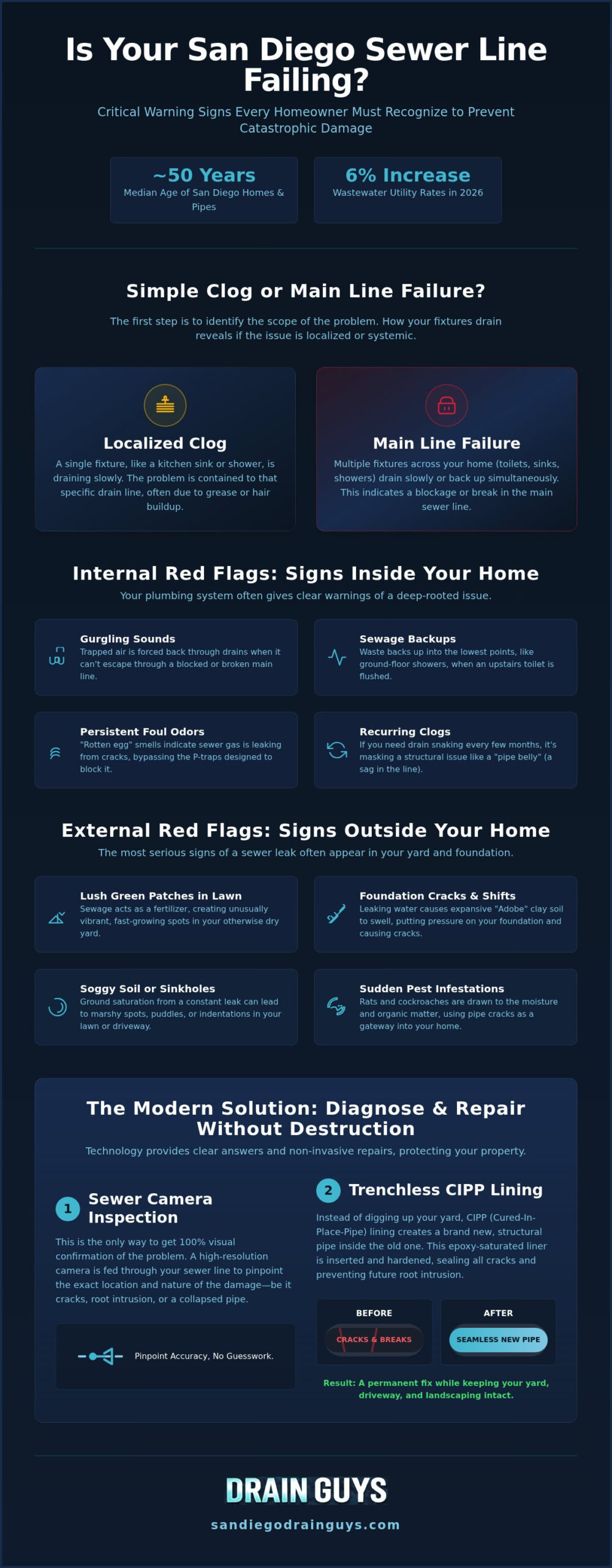
Your home often provides subtle warnings before a total system collapse occurs. Understanding these internal signs of a broken sewer line helps you avoid the sudden stress of a major backup. The first thing we look for is the scope of the problem. If only your kitchen sink is slow, it’s likely a localized grease clog. However, when multiple fixtures like sinks, tubs, and toilets all struggle to drain at once, the issue is almost certainly deep within your main sewer line.
We often hear homeowners describe a strange “gurgling” sound coming from their pipes. This phenomenon happens when trapped air is forced back through your fixtures because it can’t move freely through the main line. It’s a clear signal that an obstruction or break is displacing the air. You might also notice sewage backing up into low-level drains, such as ground-floor showers or tubs, whenever you run the dishwasher or flush an upstairs toilet. Because these are the lowest points in your home’s plumbing, they are the first to show symptoms of a main line failure.
The Recurring Clog Trap
Many homeowners fall into a frustrating cycle of calling for a drain snake every few months. If you’ve had to clear the same line twice in a six-month window, you aren’t dealing with a simple obstruction. These temporary fixes often mask underlying structural damage. A common culprit we find during inspections is a pipe belly. A pipe belly is a sag where debris collects due to soil shifts. Over time, these sags become permanent collection points for waste, leading to chronic blockages that a standard cable cannot resolve.
Unpleasant Odors and Sewer Gas
A healthy plumbing system is designed to be airtight. You should never smell “rotten eggs” or raw sewage inside your living space. Every fixture in your home utilizes a P-trap, which is a U-shaped pipe that holds a small amount of water to block sewer gases from entering. If these odors persist, a broken line may be bypassing these protections or creating a vacuum that pulls water out of your traps. Identifying the internal signs of a broken sewer line early can prevent these toxic gases from entering your home. While a dried-out trap can sometimes be fixed by running water for a minute, a persistent smell usually indicates a cracked vent stack or a failing sewer main that needs professional diagnostic tools to locate.
Beyond the Pipes: Outdoor and Structural Indicators
While internal clogs are frustrating, the most telling signs of a broken sewer line often appear in your yard. In San Diego’s Mediterranean climate, we expect our lawns to be uniform and relatively dry. If you notice a patch of grass that is suddenly taller, greener, and more vibrant than the rest of your landscaping, it’s a major red flag. Sewage acts as a potent fertilizer, providing a constant source of moisture and nutrients to the roots that the rest of your yard isn’t receiving.
Finding soggy spots or standing water when it hasn’t rained is another clear indication of an underground leak. As the escaping water saturates the earth, it can lead to sinkholes or visible indentations in your lawn or driveway. This happens because the leaking fluid displaces the supporting soil, creating a void that eventually collapses under the weight of the surface. These depressions are more than just an eyesore; they represent a significant safety hazard for anyone walking across your property.
Pest Infestations and Hygiene Risks
A cracked sewer line acts like a beacon for urban pests. Rats and cockroaches are naturally drawn to the moisture and organic matter found in wastewater. These pests can use even a hairline fracture as an entry point to move from the city’s main infrastructure into your home’s foundation. Ignoring a sewage leak doesn’t just damage your property. It introduces significant health risks as these vectors carry bacteria and pathogens directly into your living environment. We’ve seen many cases where a sudden pest problem was actually one of the first signs of a broken sewer line.
Structural Foundation Shifts
San Diego’s unique geology, specifically the prevalence of “Adobe” clay soil, makes underground leaks particularly dangerous. This soil is highly expansive. It swells significantly when it absorbs moisture and shrinks as it dries. When a pipe breaks near your foundation, the constant influx of water causes the clay to expand unevenly, exerting thousands of pounds of pressure against your concrete slab. You might notice “ghost” signs like doors that suddenly stick in their frames or new, stair-step cracks in your exterior stucco. Eventually, the water erodes the supporting earth, leaving your foundation to settle into the resulting void. If you notice these shifts, consulting a specialist at San Diego Drain Guys for a camera inspection can help you identify the leak before it leads to total structural failure.
Why San Diego Sewer Lines Break: Local Causes and Soil Factors
San Diego’s unique geography presents a specific set of challenges for underground utilities. While homeowners in other regions might blame simple wear and tear, we see local environmental factors as the primary drivers behind the signs of a broken sewer line in Southern California. The most significant factor is our “Adobe” clay soil. This earth is highly expansive, meaning it swells when wet and shrinks during our long dry spells. This constant movement puts immense physical stress on rigid pipe materials, often leading to shear breaks or collapsed sections.
Our region’s seismic activity also plays a quiet but destructive role. Even minor tremors that you don’t feel can cause old pipe joints to shift and separate over time. This is particularly common in historic neighborhoods like North Park, La Jolla, and Hillcrest, where aging infrastructure often consists of vitrified clay pipes. These pipes are brittle and lack the flexibility to handle soil shifts or tremors, making them prone to cracking and root intrusion. When these joints separate, they create the perfect entry point for moisture and debris.
The ‘Orangeburg’ and Cast Iron Legacy
If your home was built between 1940 and 1970, it might contain Orangeburg pipes. These are made of bituminized fiber, essentially layers of wood pulp sealed with tar. Over decades, these pipes lose their structural integrity and flatten under the weight of the soil. Similarly, cast iron pipes were a standard for many years but face severe challenges in our coastal environment. Salt air can accelerate pipe degradation even underground by increasing the salinity of the groundwater, which triggers rapid oxidation in metallic lines. This corrosion eventually leads to “channeling,” where the bottom of the pipe completely rots away, leaving nothing but a dirt tunnel for waste to flow through.
Invasive Roots in the Coastal Desert
In our semi-arid climate, trees are desperate for a reliable water source. Species like Eucalyptus and various Palm trees have aggressive root systems that act as “sewer seekers.” They can detect the moisture and warmth of a sewer line from a distance. Once they find a microscopic crack or a loose joint, they enter and expand, eventually filling the pipe with a dense root ball. It’s a common misconception that chemicals can solve this. While foaming root control might clear a path for water, it cannot repair the structural breach that allowed the roots in. Identifying these signs of a broken sewer line early is the only way to prevent a total system failure caused by these invasive local species.
Professional Diagnostics: The Role of Sewer Camera Inspections
While internal gurgling or lush grass are strong signs of a broken sewer line, they don’t tell the whole story. We don’t believe in guessing when your property’s integrity is on the line. A professional Sewer Camera Inspection is the only way to verify what’s happening underground without traditional digging. By using high-definition fiber-optic cameras, we can see exactly where the pipe has failed. This visual evidence allows us to differentiate between a simple grease clog and a structural collapse that requires more intensive repair. Utilizing sewer scope near me services provides the data needed to map out a trenchless solution, potentially saving you thousands of dollars in unnecessary excavation.
The Step-by-Step Inspection Process
Our process is methodical and transparent. We begin by locating an existing “cleanout” or access point, usually found in your yard or near the foundation. If an access point isn’t available, we may temporarily remove a toilet to enter the system. Our flat-rate diagnostic approach ensures you know the cost of the inspection upfront, eliminating financial uncertainty. We then navigate the camera through the entire length of the line until it reaches the city main connection. During this journey, we look for specific structural defects:
- Offsets: Where two pipe sections have shifted and no longer align.
- Cracks and Fractures: Visible breaks in the pipe wall, often caused by soil movement or seismic tremors.
- Root Balls: Dense clusters of invasive roots that have expanded through joints.
- Bellies: Low spots where water and debris pool, signaling a loss of proper slope.
We review the live, high-definition footage with you on-site. This immediate feedback ensures you understand the situation before we discuss repair options. Seeing the interior of your pipes in real-time transforms a stressful mystery into a manageable project with a clear path forward.
Mapping the Damage
Seeing the break is only the first step. We also need to know exactly where it sits in your yard. We use electromagnetic locators that communicate with a transmitter on the camera head. This allows us to pinpoint the depth and precise location of the damage above ground. This level of accuracy is essential for planning a CIPP lining or pipe bursting project. It ensures we only address the damaged section without disturbing the rest of your property.
We provide a written report and a digital video link for every inspection. These documents are vital for insurance claims or real estate disclosures. If you’ve noticed signs of a broken sewer line, you can schedule a Sewer Camera Inspection today to get the honest answers you need from a local expert who values your privacy and property.
From Diagnosis to Restoration: San Diego’s Trenchless Repair Options
Once you’ve identified the signs of a broken sewer line through a camera inspection, the next step is choosing a restoration method that respects your property. We know the prospect of a destroyed yard or a torn-up driveway can be overwhelming. That’s why we prioritize technology over shovels. Modern trenchless sewer repair San Diego allows us to rehabilitate your system from the inside out, often completing the work in a fraction of the time required for traditional excavation.
Before any structural work begins, we use Hydro Jetting to scour the pipe walls. This high-pressure water treatment removes the root balls, grease, and scale we identified during the diagnostic phase. This ensures a clean, smooth surface for our permanent repair solutions to bond with. If you’ve noticed the signs of a broken sewer line, acting while the pipe is still intact allows us to use these less invasive methods before a total collapse occurs.
CIPP Lining: A New Pipe Within the Old One
We often recommend cipp for pipes that are cracked but still structurally sound. This process involves inserting an epoxy-saturated liner into the existing pipe through a single access point. Once in place, the liner is inflated and cured until it hardens into a seamless, jointless pipe. It essentially creates a brand-new pipe within your old one without disturbing your landscaping. These liners come with a 50-year life expectancy, providing long-term peace of mind and protection against future root intrusion.
When to Choose Pipe Bursting
In cases where a line has completely collapsed or has severe offsets from seismic shifts, CIPP might not be the right fit. This is where pipe bursting excels. We pull a high-density polyethylene (HDPE) pipe through the old, fractured line using a specialized bursting head. As the new pipe moves forward, it breaks the old pipe apart and replaces it instantly. This method is superior for handling the severe damage often found in older San Diego neighborhoods. Our “calm expert” approach means we always analyze your specific situation to choose the most efficient method possible. We take pride in being a dependable partner, ensuring your home maintenance issues are resolved with transparency and neighborly care.
Protect Your San Diego Home with Expert Diagnostics
Your home’s sewer system is its most vital, yet often overlooked, utility. By staying vigilant for the signs of a broken sewer line, such as recurring clogs or lush patches in your lawn, you can address issues before they lead to expensive foundation repairs or health risks. San Diego’s unique “Adobe” clay soil and seismic activity mean that even well-maintained homes are susceptible to underground shifts. However, a broken pipe no longer means a destroyed yard. With modern trenchless technology, we can restore your infrastructure with minimal disruption to your daily life.
Since 2018, our team has served as local problem-solvers for homeowners across the county. We provide transparent, flat-rate pricing with no hidden surprises, ensuring you have the clarity needed to make informed decisions. Don’t let anxiety over potential damage keep you from seeking help. Schedule your professional San Diego sewer camera inspection today with San Diego Drain Guys to get an honest assessment from experts who prioritize your property’s privacy and long-term health. We’re here to help you regain your peace of mind.
Frequently Asked Questions
How do I know if my main sewer line is clogged or broken?
A main line is likely broken if multiple fixtures back up simultaneously and the issue returns shortly after professional cleaning. While a simple clog is a one-time obstruction that a drain snake can resolve, structural failures cause persistent problems. We use camera inspections to distinguish between these scenarios, ensuring you don’t waste money on temporary fixes for a permanent structural issue that requires a more robust solution.
Will homeowners insurance cover a broken sewer line in San Diego?
Standard homeowners insurance policies typically don’t cover sewer line failures caused by wear and tear, age, or root intrusion. However, you might be covered if the damage was caused by a specific peril named in your policy or if you’ve added a service line endorsement. We recommend reviewing your policy’s “Sewer Backup” and “Service Line” sections to understand your specific level of protection before a plumbing crisis occurs.
Can tree roots really break a thick sewer pipe?
Tree roots are a primary cause of sewer failure in San Diego’s semi-arid environment. Roots can detect moisture from a distance and will enter through microscopic cracks or loose joints in older clay or cast iron pipes. Once inside, they expand and exert enough pressure to shatter the pipe walls. This is why species like Eucalyptus or certain Palms are particularly dangerous to aging underground infrastructure in Southern California.
What is the average cost to fix a broken sewer line near me?
The cost of sewer repair varies significantly based on the depth of the line and the method used. Traditional excavation in San Diego often ranges between $3,000 and $12,000 depending on the complexity of the project and the amount of concrete that needs removal. Trenchless options like CIPP lining can often save homeowners 20% to 50% compared to traditional methods because they eliminate the need for expensive landscape and driveway restoration.
How long does a typical sewer line repair take with trenchless technology?
Most trenchless sewer repairs are completed in just one or two days. Unlike traditional dig and replace methods that can leave your yard in disarray for a week or more, technologies like CIPP lining or pipe bursting are highly efficient. Because we don’t have to excavate long trenches, your home’s plumbing is typically back in service much faster, minimizing the disruption to your family’s daily routine and personal environment.
Is a smelly drain always a sign of a broken sewer line?
A smelly drain isn’t always one of the signs of a broken sewer line, but it should never be ignored. Foul odors can sometimes be caused by a dried out P-trap or a simple buildup of organic matter in the sink’s drain. However, if the smell of raw sewage persists throughout the house or near the foundation, it often indicates a cracked vent stack or a structural breach in the main sewer line.
What happens if I ignore the signs of a failing sewer pipe?
Ignoring sewer issues leads to catastrophic property damage and potential health hazards. Escaping wastewater can erode the soil beneath your home, causing foundation shifts and structural cracks in your drywall. Additionally, stagnant sewage attracts pests and creates an environment for mold and toxic gases to thrive. Addressing the problem early prevents a manageable repair from turning into a total system collapse that requires expensive emergency intervention.
How often should I have a sewer camera inspection performed?
We recommend a professional sewer camera inspection every one to two years for homes older than 40 years. This proactive approach allows us to catch minor root intrusions or small cracks before they evolve into major failures. Regular monitoring is especially important in San Diego neighborhoods with mature trees and expansive clay soil, as these local factors can accelerate the aging process of underground pipes without warning.