
In California, you aren’t just paying for a new appliance; you’re paying for state-mandated efficiency and long-term seismic safety. If you’ve started looking into the electric water heater replacement cost california homeowners are facing in 2026, you might feel a bit of sticker shock compared to the national average. We understand the frustration of balancing a sudden home repair with unclear permit requirements and shifting heat pump mandates. It’s a lot to manage when you just want reliable hot water back in your home without any hidden complications.
We agree that you deserve a clear, honest breakdown of your investment so you can make a decision with confidence. This guide will show you exactly how to navigate the current landscape, including the impact of the 2025 Title 24 standards and how to secure up to $2,000 in federal tax credits for ENERGY STAR models. We’ll explain the reality of local labor rates, the specific $122.97 permit fee for San Diego residents, and the current status of state rebates now that programs like TECH Clean California are waitlisted. We’ll provide a transparent look at the factors driving your total costs and help you determine if a 120-volt plug-in model is the right solution for your space.
Key Takeaways
- Understand why the electric water heater replacement cost california homeowners face includes specific state-mandated seismic safety measures and 2026 energy standards.
- Learn how the latest California Energy Code (Title 24) favors heat pump technology and whether the long-term utility savings justify the initial investment.
- Identify the ideal tank capacity and recovery rate for your household size to ensure you have consistent hot water during peak morning hours.
- Navigate local San Diego permit requirements and safety codes to ensure your new system is fully compliant and legally installed.
- Discover how a transparent, methodical approach to installation eliminates hidden fees and provides peace of mind during a high-stress home emergency.
The Reality of Electric Water Heater Replacement Costs in California (2026)
Replacing a water heater in California is a different experience than in most other states. When you begin researching the electric water heater replacement cost california residents are currently seeing, you might notice a gap between the price of the hardware and the final installation quote. This “California Premium” isn’t just about higher labor rates. It reflects the state’s commitment to some of the most rigorous energy efficiency and safety standards in the nation. You aren’t just paying for a tank; you’re paying for a system that meets 2026 legal mandates and protects your home against seismic activity.
The total investment for a replacement covers a complete lifecycle that begins with a professional diagnostic and ends with a municipal inspection. Many homeowners start their journey by looking at Conventional storage water heaters at big-box retailers, but the unit price is only one piece of the puzzle. A compliant installation includes the unit, specialized labor, updated venting or drainage, and the mandatory permit process. We believe in providing a transparent look at these factors so you can plan your budget without the anxiety of surprise fees.
California Title 24 and Your Electric Water Heater
As of January 1, 2026, the updated Title 24 Building Energy Efficiency Standards have fundamentally changed how we approach water heating. These regulations favor high-efficiency systems, particularly heat pump technology, to support the state’s decarbonization goals. If you live in a newer single-family home, the law now requires your property to be “electric-ready,” which can influence the complexity of your replacement. Traditional “like-for-like” swaps are becoming rare because modern standards often require upgrades to the surrounding infrastructure to accommodate higher efficiency ratings. This shift ensures your home is future-proofed, but it does add layers to the initial planning phase.
The ‘Hidden’ Components of a California Quote
Beyond the water heater itself, several non-negotiable factors influence your final estimate. In San Diego, for example, the plumbing permit fee for a single-family water heater replacement is $122.97 as of May 2026. This permit is vital because it triggers a safety inspection that verifies the work was done to code. Other essential components include:
- Seismic Strapping: California law requires water heaters to be braced and anchored to resist falling or horizontal displacement during an earthquake.
- Expansion Tanks: These are often required by local codes to handle thermal expansion and protect your plumbing system from pressure spikes.
- Labor Trends: The San Diego labor market reflects a high demand for skilled technicians who understand these specific regional requirements.
Our goal is to handle these complexities for you. We focus on a methodical, no-nonsense approach that ensures your home stays compliant while providing the long-term reliability you expect from a professional installation.
Key Factors Influencing Your Replacement Estimate
Every home has a unique footprint that dictates the final electric water heater replacement cost california residents should expect. While the unit itself is a major factor, the specific infrastructure of your house determines the labor and material requirements. We look at your household’s actual hot water usage rather than just swapping out a tank for the same size. A 40-gallon tank might work for a couple, but a family of four typically requires a 50-gallon unit. For larger properties or homes with high-flow fixtures, an 80-gallon model provides the necessary buffer to prevent cold showers during peak morning hours.
Another critical technical factor is the recovery rate. This is the amount of water the heater can raise by 90 degrees Fahrenheit in one hour. If your household frequently runs back-to-back showers or uses a dishwasher and laundry simultaneously, a high-recovery model is essential. These units often carry a higher upfront price, but they prevent the frustration of waiting for hot water to return. We also evaluate your electrical infrastructure. Older homes often rely on 30-amp circuits designed for 120-volt units. If you’re upgrading to a high-performance 240-volt system, you’ll need to account for the necessary electrical modifications to ensure your home remains safe and compliant.
Sizing Your Unit for Modern California Living
San Diego families often struggle with peak-hour demand. We calculate your “First Hour Rating” to ensure your system can handle the heaviest usage period of your day. Oversizing your tank is a common mistake that leads to “standby loss,” where you pay to keep 80 gallons of water hot when you only need 40. This waste quickly adds up on monthly utility bills. To offset the cost of high-efficiency models that match your home’s needs, we recommend checking available California efficiency rebates, which specifically reward homeowners for choosing right-sized, energy-saving technology.
Installation Complexity and Accessibility
The physical location of your water heater significantly impacts labor hours. A unit in an open garage is a straightforward project. However, many San Diego bungalows feature water heaters tucked into tight interior closets or even attic spaces. These restricted areas require extra care to protect your floors and walls during the removal of the old, heavy tank. We often find that older installations lack modern safety features like expansion tanks or proper seismic bracing. Bringing these systems up to code is a non-negotiable part of our Professional Plumbing Services in San Diego. If you’re concerned about how your home’s layout might affect your estimate, we suggest a methodical on-site evaluation to identify any potential plumbing modifications early in the process.
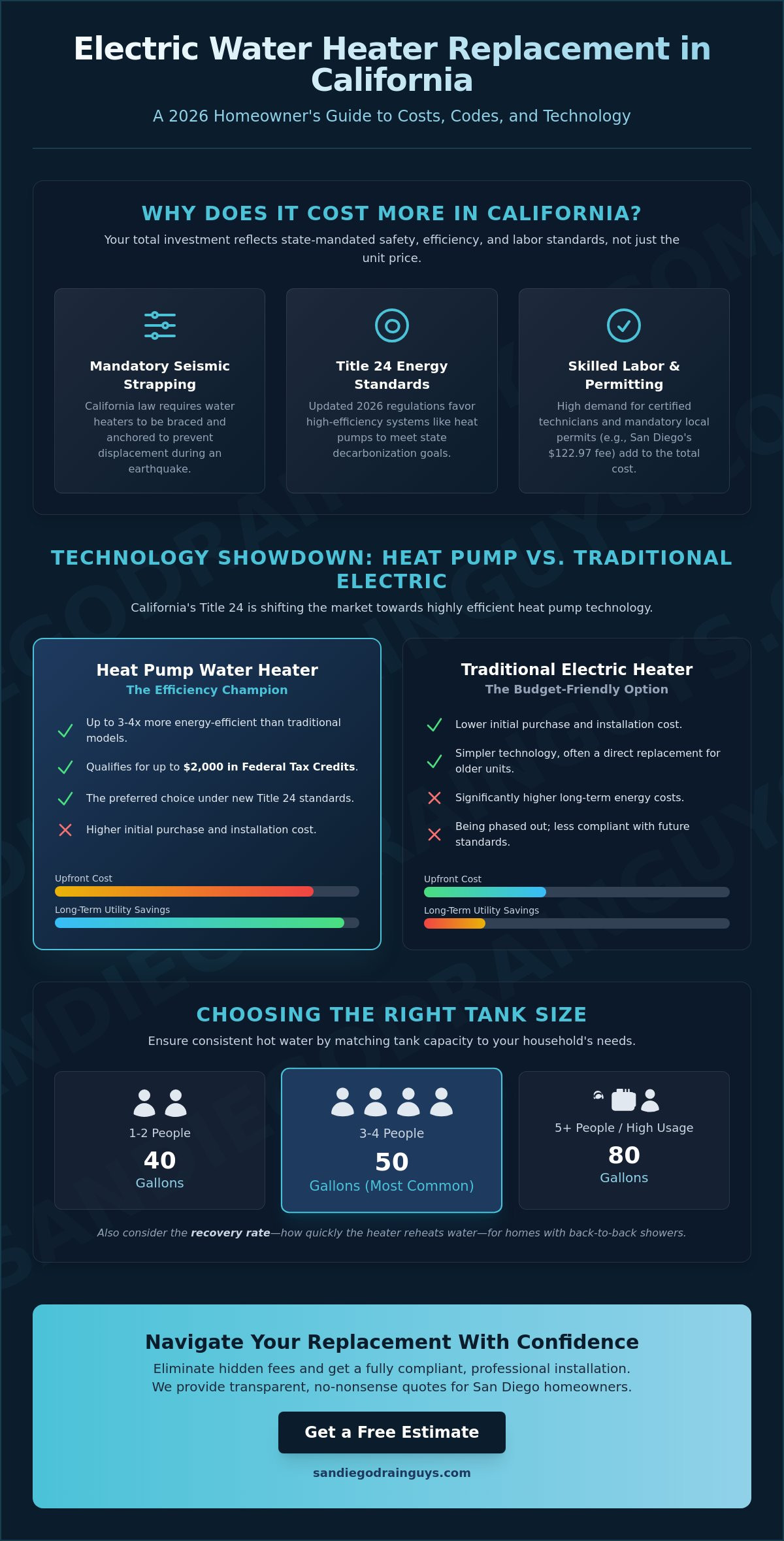
Traditional Electric vs. Heat Pump: The California Efficiency Shift
The choice between a traditional tank and a heat pump model is the most significant decision impacting the electric water heater replacement cost california residents will manage over the next decade. While traditional units use electric resistance elements to create warmth, heat pumps move existing heat from the surrounding air into the water. This process results in significant energy savings that often offset the higher initial purchase price within just a few years. We focus on helping you understand the “total cost of ownership” rather than just the day-one price tag.
Heat pump water heaters (HPWH) are quickly becoming the state standard because they align with California’s aggressive decarbonization goals. If your current unit is in a garage or a large utility room, you likely have the ideal setup for this technology. In high-utility-rate areas like San Diego, the operational savings can be substantial compared to a standard electric resistance heater. We believe in providing a clear comparison so you can choose a system that fits both your home’s infrastructure and your long-term financial goals.
How Heat Pump Water Heaters Work in San Diego’s Climate
Our local climate is a perfect match for heat pump technology. Since these units pull heat from the air, the consistently mild temperatures in San Diego allow them to operate at peak efficiency year-round. There are a few unique installation requirements to consider. HPWHs need about 1,000 cubic feet of air space to breathe, or they must be properly vented. They also produce a small amount of condensate, which requires a dedicated drainage line. One unexpected benefit for many homeowners is the “cool air” byproduct. A heat pump can actually help lower the temperature in a hot San Diego garage during the summer months, providing a small but welcome relief.
The Financial Math: Rebates and ROI
The upfront cost of a heat pump can be intimidating, but the current incentive landscape changes the math significantly. As of 2026, federal tax credits through the Inflation Reduction Act offer 30% of the total cost, up to $2,000, for qualifying ENERGY STAR models. When you combine this with the Golden State Rebate program, the price gap between traditional and high-efficiency units narrows considerably. It’s important to act quickly on these opportunities, as funding for programs like TECH Clean California is currently waitlisted.
We believe in a no-nonsense approach to these calculations. While the “cheapest” unit might save you money today, it often ends up costing the most over its lifespan due to higher monthly energy bills. We’ll help you navigate the available local utility incentives to ensure you’re maximizing every available dollar. Choosing a system that pays for itself through efficiency is a disciplined way to protect your household budget from rising energy rates while ensuring your home stays compliant with evolving state laws.
Beyond the Unit: Labor, Permits, and San Diego Code Compliance
When calculating the electric water heater replacement cost california residents must account for more than just the appliance in the garage. Local codes in San Diego are among the strictest in the nation. These rules exist to protect your family and your property from preventable disasters. We see many DIY attempts that fail because they ignore the nuances of municipal code. Our team prioritizes a methodical approach to ensure every component meets the current 2026 standards. We believe that transparency about these requirements helps alleviate the anxiety of the inspection process.
Every modern installation we perform includes a thermal expansion tank. As water heats up, it expands. Without an expansion tank, this extra volume creates pressure spikes that stress your entire San Diego Plumbing Services. Over time, these spikes lead to pinhole leaks and premature appliance failure. We also ensure the Temperature and Pressure (T&P) relief valve has a dedicated discharge pipe. This pipe must lead to a safe location, usually the exterior of the home, to prevent scalding or water damage if the valve ever needs to release excess pressure. These aren’t optional add-ons; they are essential safety features required by law.
Seismic Safety and Earthquake Preparedness
California is earthquake country, and your water heater is a heavy, top-heavy appliance. The state requires a specific double-strap system for all installations. One strap must be placed in the upper one-third of the tank, and the second must be in the lower one-third. This setup prevents the unit from toppling during a tremor. If a tank falls, it doesn’t just cut off your hot water. It can rupture water and electrical lines, leading to thousands of dollars in flood damage or fire risks. Improper strapping is the most common reason we see for failed city inspections. We take this step seriously to ensure your home remains a safe environment.
The Permitting and Inspection Process
We handle the paperwork with the San Diego Development Services Department so you don’t have to worry about the bureaucracy. The permit fee, which is $122.97 for a single-family home as of May 2026, is a small price for the peace of mind that comes with a formal city inspection. During the final walkthrough, a city inspector will verify the strapping, the expansion tank, and the electrical connections. Skipping this step is risky. If you ever sell your home, unpermitted work can stall the closing process or lead to expensive retrofits. We believe in doing the job right the first time to protect your investment. To ensure your home meets every local safety standard, schedule a professional water heater installation with our expert team today.
Navigating Your Replacement with San Diego Drain Guys
When a water heater fails, the immediate pressure to restore hot water can lead to rushed decisions and financial uncertainty. We approach every service call with a calm expert persona designed to lower your stress and provide immediate clarity. Our team understands that the electric water heater replacement cost california residents manage should be met with total transparency and a methodical installation process. We don’t believe in hidden surcharges or surprise fees. Instead, we provide honest, upfront descriptors that reflect the real world labor and material requirements for your specific San Diego home.
A new water heater is a significant investment in your home’s infrastructure. To protect that investment, we often look at the bigger picture of your plumbing system’s health. Sediment buildup or pressure imbalances can sometimes signal issues elsewhere in your lines. Maintaining your system with Professional Drain Cleaning in San Diego is a proactive way to ensure your pipes remain clear and your new heater operates at peak efficiency. We believe a healthy home starts with a disciplined maintenance plan that prevents high-stress emergencies before they happen.
The San Diego Drain Guys Difference
We treat your property with the privacy and respect we would expect in our own homes. Beyond acting as a basic utility provider, we position ourselves as your protective partner in home maintenance. This means we frequently exceed standard California safety levels to ensure your system is robust and reliable for the long term. Whether you’re interested in a traditional storage tank or the latest high-efficiency heat pump technology, we have the niche expertise to guide you. Our disciplined approach ensures that every seismic strap is secure and every electrical connection is verified before we consider the project complete.
Ready for Hot Water? Contact Us Today
Our diagnostic process is the foundation of a successful replacement. We don’t just guess at what you need; we perform a detailed load calculation and sizing analysis based on your household’s actual peak demand. This methodical step ensures you don’t pay for more capacity than you need while still enjoying consistent hot water during busy mornings. We walk you through every step of the process, from the initial permit application to the final city walkthrough. When you are ready for a stress-free experience and a dependable solution, schedule your water heater consultation with San Diego Drain Guys and let our team handle the complexities for you.
Securing Your Home’s Hot Water Future
Navigating the shifting landscape of state energy mandates and safety codes doesn’t have to be a source of anxiety. We’ve explored how 2026 regulations and seismic requirements influence the electric water heater replacement cost california residents face today. By weighing the long term utility savings of heat pump technology against the simpler infrastructure of traditional tanks, you can make a disciplined choice that fits your household’s specific needs. Proper sizing and professional permitting remain the most effective ways to protect your investment and ensure your home stays compliant with local laws.
Since 2018, we’ve served as a locally owned and operated partner for homeowners throughout the region. We provide deep expertise in California Title 24 compliance and utilize transparent flat-rate pricing models to eliminate financial uncertainty. Our team is committed to a methodical, respectful approach that prioritizes your family’s safety and privacy. When you’re ready to move forward with a reliable, code-compliant system, Schedule Your San Diego Water Heater Replacement Estimate. We look forward to helping you restore peace of mind and consistent hot water to your home.
Frequently Asked Questions
Is it worth replacing an electric water heater before it leaks?
Yes, replacing an aging unit before it fails prevents the high stress and property damage associated with a sudden leak. Proactive replacement allows you to manage the electric water heater replacement cost california residents face on your own terms. You can take the time to research high-efficiency models and secure available rebates rather than making a rushed decision during a plumbing emergency.
How long does a professional water heater replacement take in San Diego?
A standard water heater installation typically takes between three to five hours to complete. This timeframe includes draining the old tank, securing the new unit with seismic bracing, and installing required safety components like expansion tanks. If your home needs electrical modifications or plumbing line updates to meet 2026 codes, the process may require additional time for a methodical setup.
Can I switch from a standard electric water heater to a heat pump model?
You can switch to a heat pump model if your installation site has enough air volume and a proper drainage path for condensate. These units are the new standard for California efficiency and offer significant long-term utility savings. We evaluate your specific space to ensure the unit has the 1,000 cubic feet of air required to operate at peak performance.
Why does California require seismic strapping for water heaters?
California law requires seismic strapping to prevent water heaters from toppling or moving during an earthquake. A fallen unit can rupture water lines and electrical connections, creating immediate flood and fire risks. Code requires two heavy-duty straps anchored into wall studs, which provides essential protection for your home and family during seismic activity.
Are there rebates available for electric water heaters in California in 2026?
Several incentives remain active in 2026, including a federal tax credit of up to $2,000 for ENERGY STAR certified heat pump models. State programs like Golden State Rebates also provide financial support for residents upgrading to high-efficiency systems. These programs help offset the electric water heater replacement cost california homeowners invest to meet modern energy standards.
Do I really need a permit for a simple water heater swap in San Diego?
Yes, San Diego requires a plumbing permit for every water heater replacement to ensure the installation meets safety and energy codes. The permit process includes a mandatory inspection to verify that seismic straps, pressure relief valves, and electrical connections are correct. Skipping a permit can create liability issues during a home sale or insurance claim.
What happens if my new water heater doesn’t pass the city inspection?
If an inspection fails, the identified code violations must be corrected before the city provides final approval. Common failures often involve improper strapping or issues with the Temperature and Pressure relief valve discharge piping. We handle the entire correction process and coordinate with city inspectors to ensure your system is fully compliant and safe for use.
How much more does a heat pump water heater cost compared to standard electric?
Heat pump water heaters generally have a higher upfront purchase price for the hardware than traditional electric resistance models. However, the total investment often becomes comparable after factoring in federal tax credits and state rebates. Because these units are much more efficient, they typically pay for themselves through lower monthly utility bills over their lifespan.