
Did you know San Diego’s water averages 270 parts per million of mineral hardness? That is officially classified as “very hard” water, and it is likely attacking your home’s most hard-working appliance right now. If you have noticed strange noises or lukewarm water, you are probably searching for the signs my water heater is failing before a minor leak turns into a major flood in your garage or basement.
We understand the frustration of stepping into a freezing shower or the anxiety of checking for puddles every morning. You deserve a clear, professional diagnosis of your system’s health without the pressure of aggressive sales tactics. Our guide helps you decode these symptoms so you can protect your home and your peace of mind. We will walk through the seven critical indicators of a dying unit, explain how our local mineral-heavy water accelerates the process, and provide a framework to help you decide if a repair or a full replacement is your most cost-effective path forward.
Key Takeaways
- Identify the specific physical symptoms, such as rusty water and temperature swings, that act as the primary signs my water heater is failing.
- Understand how San Diego’s uniquely hard water accelerates mineral buildup, creating a thermal barrier that forces your unit to work harder and fail sooner.
- Use the simple “paper towel test” to accurately diagnose whether a puddle is just harmless condensation or a sign of a catastrophic tank leak.
- Master the “50% Rule” and age milestones to decide if it’s smarter to invest in a repair or move toward a more efficient new installation.
- Learn why upfront, transparent pricing is the key to finding a dependable local expert who respects your home and your budget without high-pressure tactics.
The 5 Most Common Signs Your Water Heater is Failing
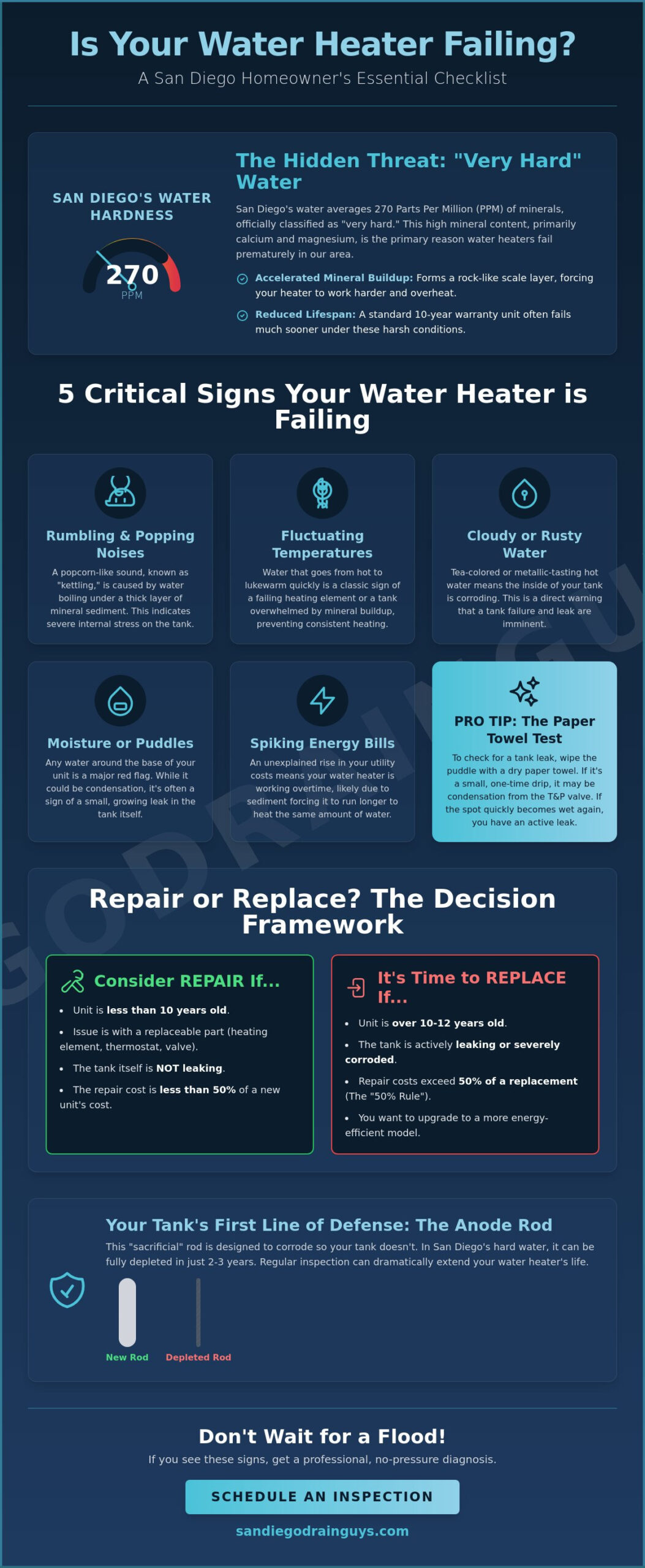
Recognizing the signs my water heater is failing is the first step in preventing a major home maintenance crisis. In San Diego, where our water is exceptionally hard, these symptoms often appear more aggressively than in other regions. One of the most frustrating early indicators is fluctuating water temperatures. If your morning shower starts hot but quickly turns lukewarm, your unit is likely struggling to maintain a consistent heat level due to internal component wear or significant mineral buildup.
Beyond temperature issues, pay close attention to your monthly utility statements. A sudden, unexplained spike in your energy bill often suggests that your heater is working overtime to compensate for a thick layer of sediment. This inefficiency doesn’t just cost you money; it places immense strain on the tank itself. You might also notice a metallic taste or a faint iron smell in your hot water supply. These are clear warnings that the internal lining of your tank is beginning to break down. Finally, any visible moisture or pooling water around the base of the unit is a red flag that requires immediate attention to avoid a potential flood.
The Telltale Sound of Sediment: Popping and Rumbling
If your utility closet sounds like a popcorn machine, you are hearing a phenomenon called kettling. This happens when water becomes trapped beneath a layer of hardened mineral scale at the bottom of the tank. As the burner or element heats the water, it turns to steam and bursts through the sediment layer, creating a distinct popping or rumbling noise. In a gas unit, this sound is often a heavy thumping. In electric models, it might be a high-pitched hiss or sizzle. These sounds are undeniable signs my water heater is failing, as they indicate the tank is overheating and the metal is under constant stress.
Cloudy or Rusty Water: Internal Corrosion Warnings
Discolored water is a visual alarm for internal corrosion. To understand the severity, perform the Sink Test. Fill a clear glass with cold water first; if it’s clear, the issue isn’t your main water line. Then, fill a second glass with hot water. If the hot water appears tea-colored or rusty, the corrosion is likely happening inside your tank. Understanding How a Storage Water Heater Works helps clarify why this happens. Most tanks rely on a sacrificial anode rod to attract corrosive elements. When this rod is fully depleted, the water begins to eat away at the steel tank itself. Once the tank begins to rust, a leak is inevitably on the horizon.
Why San Diego’s Hard Water Accelerates Heater Failure
We often see that San Diego’s water is officially classified as “very hard,” averaging 270 parts per million (PPM) of mineral content. While these minerals are safe to drink, they are incredibly destructive to our home appliances. According to the U.S. Geological Survey’s data on San Diego’s Hard Water, this high concentration of calcium and magnesium creates a relentless chemical environment inside your tank. As the water heats up, these minerals crystallize and settle at the bottom, forming a thick thermal barrier. This layer insulates the water from the heat source, which forces your unit to work significantly harder and longer. This extra stress is a primary reason why we find many standard 10-year warranties fail to reach their full term in Southern California.
We’ve observed that the chemical reaction between our local water and the internal glass lining of a tank is another critical factor. Over time, the constant expansion and contraction of the tank causes tiny cracks in the lining. Hard water minerals then penetrate these cracks, leading to rapid tank failure. If you are already seeing the physical signs my water heater is failing, it is usually because this internal degradation has reached a tipping point. Our water heater installation services often include recommendations for water treatment to combat these specific local conditions.
The Role of the Sacrificial Anode Rod
We consider the sacrificial anode rod to be the “heart” of your tank’s defense system. This magnesium or aluminum rod is designed to corrode so your tank doesn’t have to. In San Diego, the aggressive nature of our water means we often see these rods fully deplete in just 2 or 3 years. Once the rod is gone, the water begins attacking the steel tank itself. We recommend checking this rod regularly to extend your unit’s lifespan before a total replacement becomes necessary.
Visible Corrosion at the Inlet and Outlet Nipples
The connection points at the top of your unit, known as nipples, are often where we spot the first external warnings. These points utilize a dielectric union to prevent electrolysis, but our hard water can cause these seals to fail prematurely. If you see white, crusty buildup or orange rust around these pipes, it is more than just an aesthetic issue. This usually indicates a slow, “silent” leak that is eating through the threads. We help you distinguish between a simple pipe leak and a terminal tank breach to ensure you aren’t replacing a unit that only needs a minor repair.
Is It a Leak or Just Condensation? Diagnosing the Puddle
Discovering a puddle at the base of your unit is a stressful moment for any homeowner. Before you assume the worst, we suggest determining if the moisture is a terminal tank breach or simple condensation. In many uninsulated San Diego garages, the temperature difference between incoming cold water and the humid coastal air can cause “sweat” to form on the exterior of the tank. This is a natural process and doesn’t always mean your system is broken. However, if the water is consistent or growing in volume, you are likely witnessing one of the physical signs my water heater is failing.
We use a methodical “Paper Towel Test” to track the origin of a slow drip. First, dry the entire unit and the floor completely with a towel. Place dry paper towels under the drain valve, the T&P discharge pipe, and around the very bottom of the jacket. Check these towels after an hour. If the moisture is coming from a specific valve or a connection point, the issue might be a replaceable component. We also look for “silent” leaks in high-efficiency power-vent units. These systems have internal condensate lines that can clog or crack, causing water to pool inside the cabinet where it isn’t immediately visible.
Failing Temperature and Pressure (T&P) Relief Valves
The T&P valve is a critical safety device designed to release water if the internal pressure or temperature reaches dangerous levels. If you see water dripping from the discharge pipe connected to this valve, it isn’t always a sign of a dead heater. It often indicates that your home’s water pressure is exceeding safe limits, which places unnecessary stress on your plumbing. You can safely test the valve by briefly lifting the silver lever and letting it snap back. If the dripping continues after the test, the valve’s seal has likely failed. Replacing a valve is a minor, routine fix that is far less expensive than a full tank replacement.
The “Terminal” Leak: When the Inner Tank Breaches
A breach in the inner steel tank is the one scenario where a repair is no longer an option. We often find that these catastrophic cracks occur in the middle of the night. This happens because municipal water pressure tends to peak when city-wide usage is at its lowest, putting maximum strain on a tank already weakened by San Diego’s hard water. If water is seeping from the bottom of the outer jacket or if the internal insulation feels soaked, the tank’s integrity is gone. In these high-pressure situations, we provide professional plumbing services in San Diego to help you quickly identify the source and secure your home against flood damage. Recognizing these terminal signs my water heater is failing early is the only way to prevent a sudden, costly disaster.
The 2026 “Repair vs. Replace” Decision Framework
Deciding whether to fix your current unit or invest in a new one is often the most stressful part of home maintenance. We use the “50% Rule” as a primary guide for our customers. If the cost of a single repair exceeds half the price of a total replacement, the investment rarely pays off in the long run. This is especially true when you already see the signs my water heater is failing, such as consistent sediment buildup or erratic temperatures. Investing in an aging system often leads to “throwing good money after bad” as other components begin to fail in quick succession due to the stress of our local water conditions.
Age is your next major factor. While manufacturers often claim a 12-year lifespan, San Diego’s hard water reality usually shortens that window to 8-10 years. If your unit is approaching a decade of service, even a minor repair might just be delaying the inevitable. We also suggest checking your warranty status before making a final decision. Most major brands provide a 6-year or 10-year warranty on the tank itself. If you’re still within that window, the manufacturer might cover the cost of a replacement unit. Keep in mind that all local replacements require a plumbing permit from the City of San Diego, which is a necessary step for any legal installation in 2026.
When a Repair Makes Sense
We often find that “peripheral” failures are worth fixing if the tank itself is still structurally sound. Components like thermostats, heating elements, or thermocouples are relatively simple to swap and don’t require opening the tank’s pressurized environment. If your unit is under five years old and the water remains clear, a single part replacement is a sensible, cost-effective choice. This keeps your system running without the higher cost of a full overhaul. We always recommend performing a full tank flush after any repair. This helps clear out the minerals we discussed earlier and ensures your new parts don’t have to fight against existing sediment layers.
When Replacement is the Only Safe Option
When the inner tank breaches, there’s no such thing as a temporary fix. A leaking tank in a finished garage or a closet near living areas represents a massive flood risk that can cause thousands in secondary damage. Modern water heater installation San Diego projects now offer significantly higher efficiency than models from just a decade ago. You might also consider switching to a tankless system, which eliminates the risk of a massive tank burst entirely. If you aren’t sure which path is right for your home, schedule a diagnostic consultation with us to get a transparent, flat-rate evaluation of your system’s current health.
Dependable Water Heater Solutions with San Diego Drain Guys
We understand that identifying the signs my water heater is failing can be an anxiety-inducing experience for any homeowner. Our role is to step in as your dependable partner, providing the clarity you need to make an informed decision about your home’s plumbing. We take pride in our local San Diego roots and treat every call as an opportunity to serve our neighbors with honesty and precision. Whether you are managing a traditional storage tank or considering a transition to a modern tankless system, our team approaches every project with methodical, no-nonsense discipline.
We believe that trust begins with financial transparency. This is why we utilize a specific, transparent fee structure for our diagnostic calls. You will never face high-pressure sales tactics or hidden surprises when we evaluate your unit’s health. By providing a clear, upfront descriptor for our services, we aim to alleviate the financial uncertainty that often accompanies home maintenance issues. Our “calm expert” persona is designed to move you from a state of concern to a state of informed confidence, ensuring the job is done correctly without unnecessary complications.
What to Expect During a Professional Inspection
We perform a comprehensive 12-point health check during every water heater evaluation to ensure no detail is overlooked. This process involves examining the anode rod, testing the T&P valve, and inspecting all connection points for the microscopic leaks we discussed earlier. If we suspect that external factors are contributing to your unit’s struggle, we can utilize our advanced Sewer Camera Inspection technology to check for broader infrastructure issues. Throughout the entire process, we maintain a high degree of privacy and empathy. We recognize that we are guests in your domestic environment and work with the utmost respect for your personal space.
Ready for Peace of Mind? Schedule Your Diagnostic Today
We are here to help you navigate the 2026 service standards and local permit requirements with ease. If you have noticed the signs my water heater is failing, acting now can prevent the high-stress scenario of a sudden garage flood. We offer professional Water Heater Installation and Leak Detection services that prioritize long-term reliability over quick, temporary fixes. Our team is ready to provide a clear diagnosis and a straightforward path toward restoring your home’s hot water supply. Contact us today to experience a service level that exceeds the standard and restores your peace of mind.
Secure Your Home Against San Diego’s Hard Water Challenges
Protecting your property from a sudden appliance failure starts with awareness and proactive maintenance. We’ve seen how San Diego’s 270 PPM mineral hardness creates a unique chemical environment that shortens the lifespan of even the best units. By staying vigilant for the physical signs my water heater is failing, such as metallic odors or rumbling sediment, you can address issues before they lead to a costly garage flood. Remember to use the 50% Rule and the 10-year age milestone to guide your decision between a simple repair and a high-efficiency installation.
We are a locally owned team that has served our community since 2018, and we specialize in solving the specific problems caused by our region’s water quality. Our goal is to provide you with a clear diagnosis and total peace of mind through a methodical approach and a high degree of respect for your home. You don’t have to guess about the state of your plumbing system. Get a Transparent, Flat-Rate Water Heater Diagnostic from San Diego Drain Guys today. We look forward to helping you maintain a safe, efficient, and comfortable home for years to come.
Frequently Asked Questions
How many years does a water heater typically last in San Diego?
A water heater in San Diego typically lasts between 8 and 10 years. While manufacturers often suggest a 12-year lifespan, our local water hardness of 270 parts per million significantly accelerates internal wear. This mineral concentration causes sediment to build up faster than in other regions, which places extra stress on the tank and components. Regular maintenance can help you reach the upper end of this range.
Why is my water heater making a loud popping or banging sound?
Loud popping or banging sounds are caused by a phenomenon called kettling, where water gets trapped under a layer of mineral sediment. As the burner heats the tank, this trapped water turns into steam and “pops” through the sediment layer. These noises are definitive signs my water heater is failing, as they indicate the unit is overheating and the tank metal is under constant, damaging stress.
Can a leaking water heater be repaired, or do I need a replacement?
A leaking water heater can only be repaired if the moisture originates from a replaceable component like a valve or a pipe connection. If the leak is coming from the inner steel tank itself, a full replacement is your only safe option. Internal tank breaches cannot be patched or welded effectively. Continuing to use a unit with a compromised tank creates a high risk of a catastrophic flood in your home.
Is it normal to see a small amount of water in the water heater pan?
Seeing water in the drain pan is rarely normal and usually indicates an active leak or a failing safety valve. While uninsulated garages in San Diego can occasionally cause external condensation, a puddle in the pan is more likely a signal of a hardware issue. We recommend performing the paper towel test mentioned earlier in this guide to determine if the moisture is a slow drip from a connection or a terminal tank failure.
What should I do immediately if I find my water heater is leaking?
You should immediately turn off the power at the circuit breaker for electric models or set the gas valve to “pilot” or “off” for gas units. Next, close the cold water shut-off valve located at the top of the heater to stop more water from entering the tank. These steps help prevent electrical hazards and limit the amount of water that can escape into your home while you wait for a professional.
How much does it cost to have a professional diagnose a water heater issue?
Professional diagnostic costs vary across San Diego, but we recommend choosing a provider that offers a transparent, flat-rate fee structure. This model prevents financial uncertainty and ensures you aren’t surprised by hidden costs after the inspection is complete. A professional evaluation provides a clear framework for deciding between a repair and a replacement, helping you avoid unnecessary expenses and high-pressure sales tactics.
Should I switch to a tankless water heater if my current tank is failing?
Switching to a tankless water heater is an excellent choice if you want to eliminate the risk of a massive tank breach and reduce your energy bills. These modern units only heat water on demand, which removes the need for a large storage tank that can rust or leak over time. While the initial installation involves different requirements, the long-term benefits of endless hot water and increased efficiency make it a popular upgrade for San Diego homeowners.
How often should I flush my water heater to prevent early failure?
You should flush your water heater at least once every year to remove the mineral sediment that accumulates in our local hard water. Regular flushing prevents the “kettling” noises and thermal barriers that lead to premature tank failure. If you haven’t maintained your unit for several years, we suggest a professional evaluation first. This ensures that flushing won’t accidentally dislodge large mineral deposits that could clog your home’s plumbing.