
Did you know that as of January 1, 2026, City of San Diego water rates jumped by 14.7 percent? It is incredibly stressful to open your mail and see a balance that looks more like a mortgage payment than a utility bill. We understand the frustration of feeling like you’re being overcharged while trying to navigate a complex system of tiered pricing and customer service hurdles. If you are currently staring at a high water bill san diego what to do is likely the only question on your mind.
We are here to help you regain control and find peace of mind. In this guide, you’ll learn how to identify hidden leaks that standard DIY checks often miss, how to navigate the new 2026 rate tiers where prices can reach $11.89 per HCF, and the specific steps required to successfully dispute an unfair bill. We will walk through the 120 day deadline for leak adjustment requests and explain how professional leak detection can stop the financial drain before it gets worse.
Key Takeaways
- Understand how the 14.7 percent rate increase effective January 2026 shifts your usage into more expensive tiers and impacts your baseline costs.
- Conduct a simple “Zero Usage” test at your meter box to definitively prove if water is escaping somewhere on your property.
- Master the official dispute process and learn exactly for a high water bill san diego what to do to meet the City’s strict 120-day filing window.
- Identify the warning signs of underground main line breaks and slab leaks caused by the region’s unique expansive clay soil.
- Learn how professional evidence like sewer camera inspections or repair receipts can strengthen your case for a successful bill adjustment.
Why Your San Diego Water Bill Is Sky-High in 2026
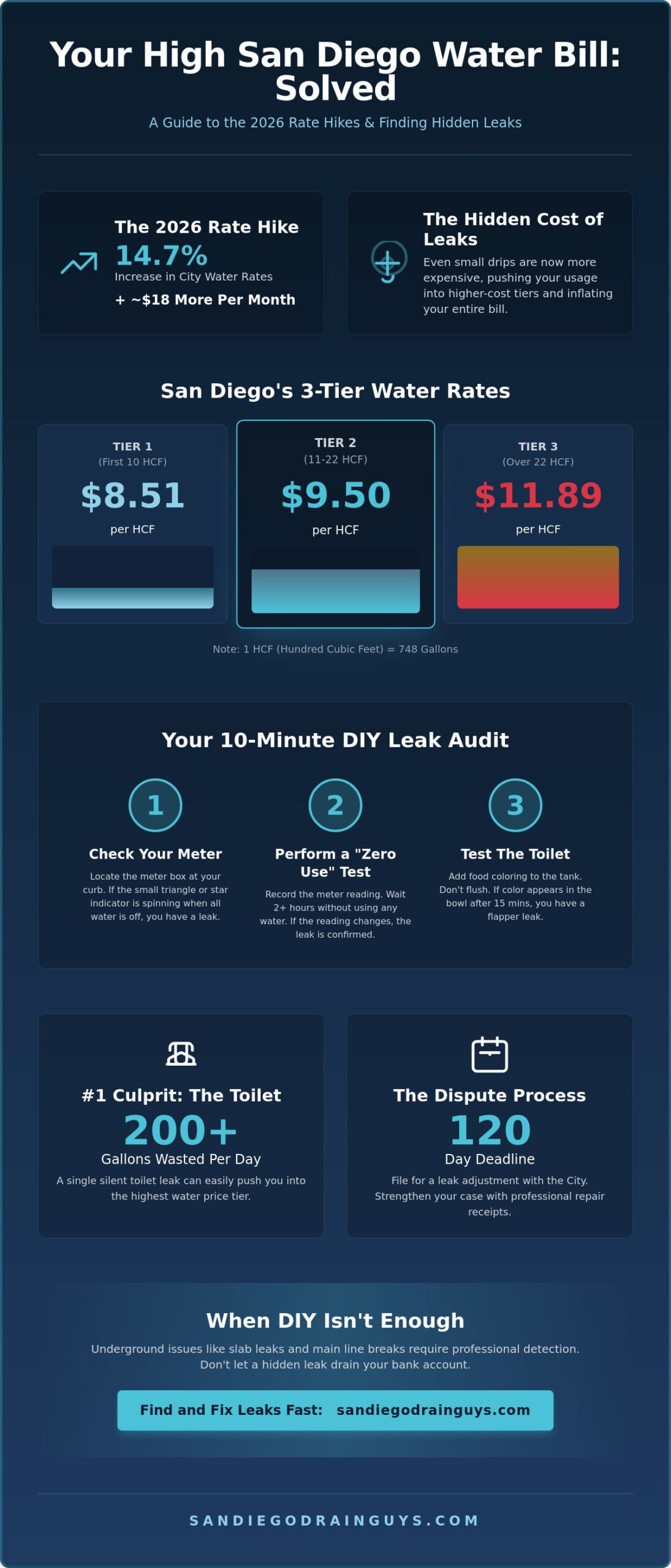
The City of San Diego implemented a significant 14.7 percent water rate increase on January 1, 2026. This change, combined with a 6 percent hike in wastewater rates, means the average single-family household is paying roughly $18 more per month just for baseline access. When you’re staring at a high water bill san diego what to do often starts with understanding that the price of every drop has simply gone up. We see many neighbors struggling to distinguish between these scheduled hikes and a genuine mechanical failure in their plumbing.
A small, silent leak is more expensive now than it was last year. Because of the tiered structure, a dripping faucet or a running toilet doesn’t just waste water; it can push your entire account into a higher price bracket. Practicing consistent water conservation is no longer just about being environmentally conscious. It is a financial necessity to keep your usage within the lower, more affordable tiers. A leak that adds just a few units of water can result in a disproportionately large bill.
Understanding Tiered Pricing for Single-Family Homes
San Diego uses a three-tier system for residential water. Tier 1 covers your first 10 HCF (Hundred Cubic Feet) at $8.51 per unit. Once you cross into Tier 2, which covers 11 to 22 HCF, the price jumps to $9.50. If a hidden leak or heavy summer irrigation pushes you into Tier 3, you’re paying a premium of $11.89 for every additional unit. We also want to highlight your “winter average.” The City calculates your sewer fees based on your water usage during the rainy months. If you have an undetected leak during this period, you’ll be overcharged for wastewater services for the entire following year.
Rate Hike vs. Usage Spike: Reading Your Meter
To determine if your bill is high due to rates or a leak, look at the “HCF” usage on your San Diego Public Utilities statement. One HCF equals about 748 gallons. Compare this number to your statement from the same month last year. If the HCF is identical but the total cost is higher, you’re likely feeling the impact of the 2026 rate increases. However, if your HCF has spiked without a change in your household habits, a leak is the probable culprit.
Always check if your bill is based on an “Actual” or “Estimated” read. If the meter reader couldn’t access your meter, the City might estimate your usage based on previous years. This can lead to significant billing errors. If you suspect an error or a leak, knowing high water bill san diego what to do involves verifying your meter’s current reading against what is printed on your bill. We recommend checking your meter box, usually located near the curb, to ensure the numbers align with the City’s report. If the dial is spinning while all your faucets are off, you have a leak.
The 10-Minute Home Leak Audit: DIY Steps
If you’re currently dealing with a high water bill san diego what to do is often found right at your curb. Most homeowners can confirm the presence of a leak in under ten minutes without any special tools. We believe that empowering you with this knowledge is the first step toward stopping the financial drain and protecting your property from water damage.
Your first task is to locate the water meter box. In most San Diego neighborhoods, this is a concrete or plastic box set into the ground near the sidewalk or curb. Lift the lid carefully. You might find a bit of dirt or a few spiders inside, so a pair of gloves is helpful. Once the dial is visible, look for the low-flow indicator. This is usually a small, brightly colored triangle or star. If that shape is spinning even slightly while no water is running in your home, you have an active leak.
Testing the Water Meter for Hidden Leaks
To perform a “Zero Usage” test, turn off every faucet, shower, and water-using appliance in your house. Ensure the irrigation system is off and the ice maker is not cycling. Record the exact numbers on the meter dial. Wait for at least two hours without using any water, then check the numbers again. If the meter has moved, the leak is likely in your main service line or deep within your home’s internal plumbing. This simple test provides the concrete evidence you need before calling for professional help.
Common Indoor Culprits: Toilets and Faucets
Toilets are the most frequent cause of unexpected spikes in usage. A “silent” toilet leak can waste up to 200 gallons of water a day, which is enough to push a household into Tier 3 pricing almost immediately. To check yours, remove the tank lid and drop a few drops of food coloring into the water. Don’t flush. Wait about 15 minutes. If color appears in the bowl, your flapper valve is leaking and needs replacement. Finding and fixing easy-to-fix water leaks like these is a high-impact way to lower your monthly costs.
We also recommend checking under-sink cabinets for dampness and inspecting the relief valve on your water heater for signs of constant dripping. If these DIY steps don’t reveal the source of the problem, professional leak detection can pinpoint the issue using acoustic technology, ensuring we find the leak without unnecessary digging or damage to your home.
Hidden Underground Leaks: Slab and Irrigation Issues
San Diego’s geology plays a major role in local plumbing failures. Our region is known for expansive clay soil. This soil acts like a sponge, swelling significantly when it rains and shrinking during our long, dry summers. This constant shifting creates immense pressure and friction against the copper pipes buried under your home’s foundation. Over time, that friction creates pinhole leaks. If you are investigating a high water bill san diego what to do next involves looking beneath your feet at the potential for a slab leak.
A hidden underground leak is particularly dangerous because it can go undetected for months. While a leaking toilet is obvious, a pipe burst under your front yard or foundation might only show up as a staggering balance on your San Diego Public Utilities statement. These leaks are often the primary reason households find themselves pushed into the Tier 3 price bracket of $11.89 per HCF, where every drop becomes a significant financial burden. We focus on identifying these issues early to prevent structural damage and stop the cycle of overpayment.
Identifying a Slab Leak in Your Home
You can often detect a slab leak by walking your home barefoot. If you feel a “hot spot” on the floor, it usually indicates a leak in a hot water line beneath the concrete. You might also hear the faint sound of rushing water behind a wall or under the floorboards when every faucet is closed. These hidden failures can erode the soil under your home, which eventually leads to foundation cracks. Utilizing professional leak detection is the most reliable way to confirm an underground issue without tearing up your flooring or guessing at the location.
Irrigation and Outdoor Water Waste
Outdoor water waste is a silent budget killer in Southern California. Many residents rely on older irrigation controllers that can suffer from “ghost” cycles, where the system runs at odd hours without your knowledge. A single broken sprinkler head can waste approximately 12 gallons of water per minute. During a standard 10 minute cycle, that is 120 gallons lost. We recommend walking your yard while the system is active to look for “weeping” valves or patches of grass that stay unusually soggy. Addressing these outdoor issues is essential to staying within the lower Tier 1 and Tier 2 rates and avoiding the steep 14.7 percent increase on your total water usage.
Navigating the City of San Diego Dispute Process
Dealing with the City of San Diego Public Utilities Department requires a blend of patience and precise documentation. If your DIY checks confirmed a spike, knowing high water bill san diego what to do next means initiating a formal “Request for Investigation.” This is not a simple phone call. You must submit a written request to have your account reviewed. The city typically looks for evidence that a billing error occurred or that a concealed leak was found and repaired. Keep in mind that you must submit this request within 120 days of the first high bill. If you miss this window, the city is unlikely to grant any financial relief.
The city operates on an “Adjusted Bill” policy, but it is limited. They generally only offer adjustments for concealed, non-irrigation pipe leaks. This means if your high bill came from a running toilet or a broken sprinkler head, you are likely responsible for the full amount. However, if the leak was hidden behind a wall or under a slab, you can recover a portion of the costs. To succeed, you need professional proof. A sewer camera inspection or a detailed repair receipt acts as your primary evidence. These documents prove to the city auditor that the issue was mechanical and has been resolved.
How to Prove a Billing Error
Start by taking a clear photo of your water meter today. Compare the reading to the “Current Reading” on your latest bill. If your meter shows a lower number than the bill, a “misread” occurred. While many people believe in the “broken meter” myth, meters almost always slow down as they age rather than speed up. A high bill is rarely the meter’s fault. Occasionally, utility lines are crossed in multi-unit properties. If you suspect you are paying for a neighbor’s usage, you should request a meter accuracy test. Be aware that the city may charge a fee if the meter is found to be working correctly.
Requesting a Leak Adjustment
San Diego offers a one-time leak adjustment for qualifying residential customers. The most important rule is that you must fix the leak before the city will even consider a refund. They want to see that the waste has stopped. Collect all repair invoices and photos of the damaged pipe. These documents must show the date of repair and the specific location of the leak. We provide detailed reporting for all our clients to ensure they have exactly what is needed for the city auditor. If you need professional documentation to support your claim, schedule a leak detection service today to get the evidence you need.
Professional Leak Detection: When DIY Isn’t Enough
If you have performed the meter tests and dye checks mentioned earlier but your usage remains high, the problem is likely hidden from view. For homeowners facing a persistent high water bill san diego what to do often comes down to utilizing specialized technology. We understand that the fear of a massive repair bill can be paralyzing. However, ignoring a hidden leak only leads to foundation erosion and even higher utility costs under the 2026 rate structure. We focus on non-invasive methods to find the exact source of your trouble without causing unnecessary damage to your home.
Professional diagnostics provide the clarity you need to move from anxiety to action. Our team uses a disciplined, methodical approach to ensure every potential failure point is inspected. By identifying the specific location of a leak, we eliminate the need for exploratory digging, which is both expensive and disruptive. We take pride in our transparent, flat-rate diagnostic fees, ensuring you know exactly what the investigation costs before we begin our work. This honesty is the foundation of the trust we build with our San Diego neighbors.
Acoustic and Thermal Leak Detection
We utilize acoustic sensors to “hear” the high-frequency vibrations created by water escaping a pressurized pipe. These sensors are sensitive enough to find a pinhole leak through several inches of concrete or soil. For hot water lines, we employ thermal imaging cameras. This technology allows us to see heat signatures behind drywall and under flooring, pinpointing slab leaks with incredible accuracy. Sometimes, mineral buildup or sludge in your pipes can interfere with a clear reading. In these cases, a professional hydro jetting service might be necessary to clear the lines before we can finalize our inspection.
Next Steps: Repair and Prevention
Once we locate the break, we prioritize repairs that respect your domestic environment. We often recommend trenchless sewer repair or pipe bursting to fix main line issues without excavating your entire yard. These modern methods are faster and preserve your landscaping. To prevent future bill spikes, we also suggest installing smart water shut-off valves. These devices monitor your flow in real-time and can automatically shut off your water if they detect a burst pipe, providing long-term peace of mind. If you are ready to stop the waste and secure your home, get a professional leak detection quote from San Diego Drain Guys today. We are here to handle your complex plumbing problems with the care and expertise you deserve.
Regain Control of Your Monthly Utility Costs
Managing a sudden spike in your expenses is stressful, especially with the 2026 rate increases now in effect. By understanding the city’s tiered pricing and performing a simple “Zero Usage” meter test, you’ve already taken the first steps toward a solution. If you’re still struggling with a high water bill san diego what to do next is to secure professional documentation before the city’s 120 day dispute deadline passes. We’re here to provide the expertise and clarity you need to resolve these issues for good.
We’ve served our neighbors as locally owned San Diego experts since 2018. Our team utilizes advanced acoustic leak detection technology to pinpoint hidden failures without invasive digging. We prioritize your peace of mind by offering flat-rate pricing with no hidden surprises or unexpected fees. You can trust us to handle your property with the utmost respect and privacy while we work to stop the waste.
Stop the waste—Book a Professional Leak Detection with San Diego Drain Guys Today. We look forward to helping you restore efficiency and predictability to your home’s water usage.
Frequently Asked Questions
How do I know if my San Diego water meter is broken?
Water meters rarely “speed up” or over-report usage as they age. Most mechanical meters actually slow down or stop completely when they fail. If your bill has spiked, it is almost certainly due to a hidden leak or the 2026 rate increases rather than a faulty meter. You can request an accuracy test from the Public Utilities Department, but they may charge a service fee if the meter is found to be functioning within standard limits.
Will the City of San Diego refund me for a leak?
The city only provides refunds for concealed, non-irrigation pipe leaks that were not visible to the homeowner. You won’t receive a refund for “avoidable” waste, such as a running toilet or a broken sprinkler head. To qualify for a partial credit, you must repair the issue and provide professional documentation, such as a repair invoice or a report from a leak detection specialist, within the 120-day filing window.
What is a “normal” water bill for a 3-bedroom house in San Diego?
A “normal” bill varies by household habits, but every single-family home starts with a $35.53 monthly base fee as of January 2026. For a typical family using 12 HCF, you can expect a monthly total between $130 and $160 including wastewater charges. If your bill consistently exceeds $250 without significant outdoor irrigation, you should investigate your property for a hidden mechanical failure.
How do I check for a slab leak myself?
You can check for a slab leak by walking your home barefoot to feel for hot spots on the floor or looking for dampness along your baseboards. Check your water heater to see if it’s constantly cycling, even when no one is using hot water. While these signs indicate a problem, pinpointing the exact location under a concrete foundation usually requires professional acoustic equipment to avoid damaging your flooring.
Can a running toilet really double my water bill?
A single running toilet can waste over 6,000 gallons of water in a single month. Because San Diego uses a tiered pricing structure, that extra usage often pushes your account into Tier 3, where you pay $11.89 per HCF. This “perfect storm” of high volume and high-tier pricing can easily add $100 or more to your monthly statement. Replacing a $15 flapper valve is the fastest way to stop this financial drain.
What should I do if I suspect a billing error by the city?
If you suspect a billing error, take a photo of your water meter’s current reading immediately. Compare the numbers on the meter to the “Current Reading” listed on your most recent bill. If the number on your meter is lower than the number on your bill, the city has made a “misread” error. Contact the Public Utilities Department with your photo evidence to request a corrected statement.
Is there a “leak adjustment” program in San Diego?
San Diego provides a one-time leak adjustment for residential customers who find and fix a concealed leak. This program is a vital part of knowing high water bill san diego what to do to recover lost funds. You must submit your request along with a plumber’s repair receipt to prove the waste has stopped. The city may then credit a portion of the Tier 2 or Tier 3 charges back to your account.
How much does it cost to have a plumber find a leak in San Diego?
The cost of leak detection depends on the size of the property and whether the leak is located under a concrete slab or deep underground. We believe in total transparency, which is why we provide flat-rate pricing for our diagnostic services. This approach ensures you know the exact cost of the investigation upfront, allowing you to make an informed decision about your repairs without any hidden surprises.