
What if the reason your toilet keeps clogging has nothing to do with what you’re actually flushing? It is incredibly frustrating to stand over a rising bowl with a plunger in hand, wondering why does my toilet keep clogging despite your best efforts to be careful. You likely feel a sense of anxiety every time a guest uses the bathroom, or worry that a messy overflow is just one flush away from ruining your flooring and your afternoon.
We believe you deserve a permanent fix rather than a temporary band-aid. Our goal is to help you discover the real reasons behind these recurring issues and learn how to fix them for good using expert diagnostic strategies. Whether the problem is a mechanical fixture failure or a systemic sewer restriction, we provide the clarity you need to move forward with confidence and peace of mind.
This article explores five hidden causes of persistent blockages and the latest 2026 professional solutions. We will walk you through how modern diagnostics like sewer camera inspections work and explain how the updated California plumbing codes might affect your home’s system, giving you a clear path to a worry-free bathroom.
Key Takeaways
- Learn why “flushable” wipes and early low-flow toilet designs are often the hidden culprits behind daily bathroom frustrations.
- Understand how external factors like blocked roof vents or hard water scale deposits can restrict your pipes’ drainage efficiency.
- Identify the exact reason why does my toilet keep clogging by utilizing advanced diagnostic tools like sewer camera inspections to see what plunging misses.
- Discover simple maintenance habits and the “one-flush rule” that prevent future backups without relying on damaging chemical cleaners.
- Explore modern, trenchless repair options and the relief of professional solutions backed by transparent, flat-rate pricing.
Common Surface-Level Culprits: Why Your Toilet Clogs Daily
You might feel like you’re in a losing battle with your plunger. Every time you think the problem is solved, the water rises again. If you’re constantly asking why does my toilet keep clogging, the answer often starts with the fixture itself or the immediate habits of your household. While some issues are hidden deep in the ground, many daily backups stem from how a standard toilet handles modern waste and paper products.
The Trapway Restriction
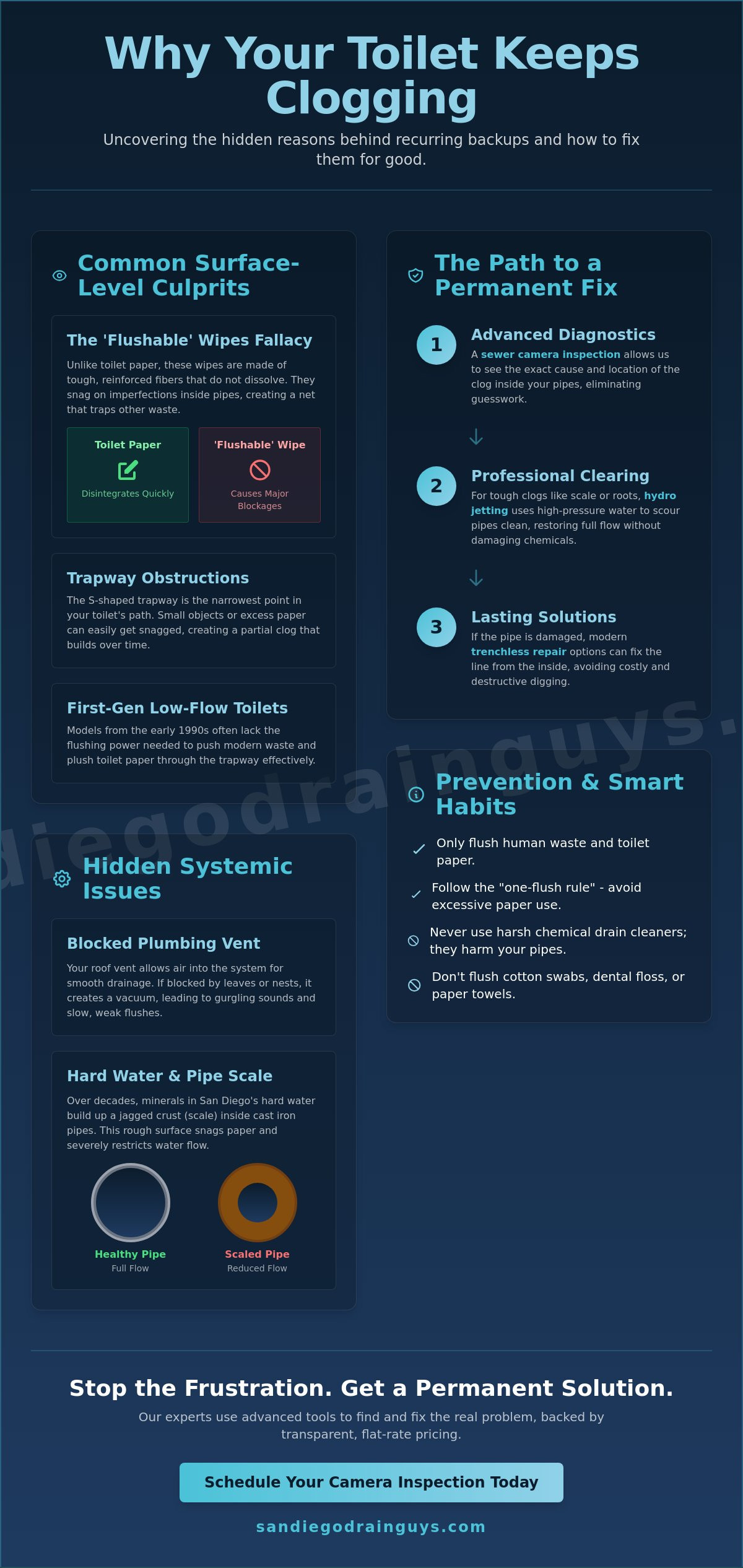
Every toilet features an S-shaped channel known as the trapway. This built-in curve is the narrowest point of the entire drainage path, usually measuring only two inches in diameter. Because of this tight design, it’s the most common spot for debris to snag. A partial clog, like a child’s small toy or a stray hygiene product, can sit in the trapway for weeks. It allows water to pass through but acts as a “catch-all” bridge for toilet paper, eventually leading to a full backup. The trapway serves as a critical barrier that maintains a water seal to prevent sewer gas from entering your living space. However, its restrictive shape means even a small amount of excessive paper can quickly overload the system’s capacity.
The ‘Flushable’ Wipes Danger
We see this issue constantly across San Diego neighborhoods. Despite what the packaging claims, “flushable” wipes are a primary cause of recurring clogs. Unlike standard toilet paper, which is designed to disintegrate almost instantly upon contact with water, these wipes are made of tough, reinforced fibers. They don’t dissolve. Instead, they travel into your pipes and snag on internal burrs, cast iron scale, or small tree root intrusions. Once one wipe catches, it creates a net that traps everything else behind it. For homeowners in older San Diego areas with original plumbing, these wipes are particularly dangerous because they accelerate the buildup of “fatbergs” that can eventually require professional hydro jetting to clear.
Another common culprit is the first-generation low-flow toilet. Many homes still have models from the early 1990s that were designed to save water but lacked the “head pressure” necessary to push waste through the trapway effectively. When you combine low flushing power with modern, ultra-plush toilet paper, the system simply can’t keep up. It’s also important to remember that your fixture is just one part of a larger drain-waste-vent system. If that system isn’t getting enough air, your toilet will struggle to flush even if the bowl itself is clear.
To keep your daily routine running smoothly, we recommend keeping a close eye on what enters the bowl. Common items that should never be flushed include:
- Cotton swabs and makeup pads
- Dental floss (which acts like a saw on PVC pipes)
- Paper towels or heavy napkins
- Excessive amounts of high-ply toilet paper
Understanding these surface-level triggers is the first step toward a clog-free home. If you’ve addressed these habits and the water still won’t go down, it’s time to look deeper into the systemic issues behind your walls.
Hidden Systemic Issues: When the Problem is Behind the Wall
If you’ve already banned “flushable” wipes and switched to thinner toilet paper but still find yourself reaching for the plunger, the problem is likely systemic. We often see homeowners get frustrated when they cannot figure out why does my toilet keep clogging despite having perfect habits. Usually, this indicates that the restriction isn’t in the bowl, but deep within the home’s drainage network or buried under your foundation.
The Role of the Vent Stack
Your plumbing needs air to move water effectively. Think of a straw in a glass of water; if you cover the top with your finger and lift, the liquid stays trapped inside. Your home’s vent stack, which usually exits through the roof, acts as the “finger” being removed. It provides the necessary atmospheric pressure for a smooth, “glug-free” flow. In San Diego, our coastal environment and local wildlife frequently lead to vents blocked by bird nests, salt spray corrosion, or fallen leaves. If you hear a gurgling sound in your bathroom sink when you flush the toilet, your pipes are likely struggling with a vacuum issue that no amount of plunging can fix.
Mineral Buildup and Pipe Scaling
San Diego is known for its hard water, and over several decades, the high calcium and magnesium content in our local supply creates a hard crust called scale. This is a significant issue for older homes with cast iron plumbing. This scale isn’t a smooth coating. It is a jagged, rough surface that acts like sandpaper on everything passing through. When homeowners ask us why does my toilet keep clogging, we often point toward the internal condition of these older lines. Even if you upgrade to modern WaterSense labeled models for better efficiency, they can’t overcome a pipe that has been narrowed by years of mineral buildup. We strongly advise against using chemical “liquid plumbers” to fix this. These harsh acids can corrode the bottom of scaled pipes, leading to expensive leaks behind your walls.
Beyond the vents and scale, the main sewer line itself could be the culprit. A “pipe belly” or sag occurs when a section of the line sinks due to soil shifting or poor installation. This creates a permanent puddle where solids collect and eventually harden into a blockage. Because this happens in the yard or under the concrete slab, it’s invisible to the naked eye. If the clog is actually in the yard, clearing the fixture is only a temporary fix. The blockage will return until the pipe’s physical slope is restored. If you suspect a deeper issue, a professional sewer camera inspection is the most reliable way to see what is happening behind your walls without any guesswork.
Professional Diagnostics: Seeing the Invisible Clog
When you reach for the plunger for the third time in a week, you aren’t just clearing a mess. You’re treating a symptom of a much larger problem. While a plunger creates enough pressure to move a localized blockage, it cannot fix a collapsed pipe or remove years of accumulated scale. If you’re stuck wondering why does my toilet keep clogging, it’s time to stop the physical labor and start the diagnostic phase. Continuing to force water through a restricted line can actually increase the risk of a messy overflow or structural damage to your home’s foundation. Professional diagnostics allow us to move beyond temporary fixes and look toward a permanent resolution.
Sewer Camera Inspections
The most effective way to end the cycle of backups is to see exactly what’s happening underground. We use high-definition sewer camera inspection technology to travel deep into your lines. These cameras provide a real-time video feed that pinpoints the exact footage of a blockage, whether it’s a massive root ball or a shifted pipe joint. This level of detail allows us to assess the overall condition of your plumbing before you commit to a repair strategy. A camera inspection removes the guesswork from plumbing by showing us the truth behind the wall. In San Diego, we frequently find that native landscaping, like eucalyptus or ficus trees, has sent thirsty roots directly into sewer pipe seams, creating a permanent trap for waste.
Advanced Clearing with Hydro Jetting
Once we identify the cause, the next step is choosing the right tool to clear it. Many people are familiar with snaking a drain, which involves a mechanical metal cable. While a snake is good for punching a small hole through a soft clog, it often leaves the majority of the debris behind. This is why does my toilet keep clogging even after a basic service; the snake simply didn’t finish the job. Instead, we recommend hydro jetting services in San Diego for a more thorough solution. Hydro jetting uses high-pressure water to literally scrub the internal pipe walls clean of grease, scale, and fine roots. It is significantly safer for older pipes than mechanical snakes because it doesn’t use abrasive metal teeth that can snag on fragile cast iron. A hydro-jetted pipe returns to nearly its original flow capacity, providing much longer-lasting results than traditional methods.
Prevention and Maintenance: How to Stop Future Clogs
Once we’ve cleared a major blockage, the focus shifts to keeping your pipes clear for the long term. It’s discouraging to wonder why does my toilet keep clogging even after a professional visit, but the secret often lies in your daily bathroom habits. Most modern toilets are engineered to be highly efficient, yet they have physical limits that are easily exceeded. By adopting a few simple routines, you can protect your plumbing and avoid the stress of a sudden overflow.
Safe Flushing Habits
Preventing a backup starts with educating everyone in the household. We recommend following the “P’s of flushing”: only pee, poop, and paper should ever enter the bowl. Anything else is a risk to your system’s health. We see a “Dirty Dozen” of items that frequently cause trouble in San Diego sewers, including dental floss, feminine hygiene products, paper towels, cotton swabs, and cooking grease. Even hair and facial tissues can bind with other debris to create a solid mass. If you have a larger amount of waste or paper, use the “One-Flush Rule.” Flush once for solids and a second time for paper. This prevents the trapway from becoming overwhelmed and ensures the water has enough force to push debris all the way to the main sewer line.
Homeowner Maintenance Tips
You can take proactive steps to maintain your system’s health without specialized tools. Once a month, pour a bucket of very hot, but not boiling, water down the toilet. This helps soften and move light grease or soap scum buildup that might be starting to form. You should also check your tank’s water level periodically. If the water line is too low, the flush won’t have enough “head pressure” to clear the trapway completely. If you’ve addressed these habits and the water still struggles to exit, it’s time to schedule a professional drain cleaning in San Diego to reset your system to factory-fresh conditions.
Stop using harsh chemical cleaners. These products generate heat and use acids that eat away at your pipes, especially older cast iron common in many San Diego neighborhoods. Instead, use enzymatic cleaners. They use natural bacteria to eat organic matter without damaging your plumbing. If your home has a flat sewer line or chronic issues, consider upgrading to a modern, pressure-assisted toilet. These models use compressed air to blast water through the system, making them nearly impossible to clog. For those in older homes, annual maintenance checks are vital to monitor the state of clay or cast iron lines before they fail. We are here to help you regain confidence in your home’s plumbing. Reach out to the team at San Diego Drain Guys to discuss a preventative maintenance plan tailored to your property.
Permanent Solutions with San Diego Drain Guys
Plumbing emergencies are stressful, but the solution shouldn’t be. We understand the frustration of repeatedly asking why does my toilet keep clogging after you’ve already tried every DIY trick in the book. Our team focuses on moving past temporary fixes to provide a permanent resolution. We lead with a “calm expert” persona because we know that when your home’s most essential fixture fails, you need a dependable partner, not a high-pressure sales pitch. Our commitment to transparent, flat-rate pricing ensures you know exactly what the job entails before we begin, removing the financial uncertainty often associated with major home repairs.
No-Dig Sewer Technology
If our diagnostic tools reveal that your issues are systemic, we offer advanced, non-invasive options to restore your system. We specialize in trenchless sewer repair in San Diego, which allows us to fix shifted, broken, or root-infested pipes without destroying your driveway or landscaping. One of our most effective methods is CIPP lining. This process involves inserting a resin-saturated felt tube into your existing pipe, which then hardens to create a seamless, “pipe-within-a-pipe” that is resistant to future root intrusion. For pipes that have completely collapsed, we utilize pipe bursting to pull a brand-new high-density polyethylene line through the old path. These methods are fast, clean, and designed to last for decades.
Expert Toilet Repair and Installation
Sometimes the root cause of why does my toilet keep clogging is simply an outdated or poorly designed fixture. If your current toilet requires multiple flushes or has a narrow, outdated trapway, it may be time to stop the cycle of repairs. We provide professional toilet repair and installation services to ensure your fixture is perfectly matched to your home’s existing plumbing and vent capacity. We help you navigate the 2026 standards for water efficiency while selecting models that provide the necessary flushing power for your specific household needs. Whether you need a simple valve replacement or a full high-performance upgrade, we handle every installation with a high degree of privacy and respect for your home environment.
We take pride in being a hardworking, no-nonsense neighbor in the San Diego community. Our goal is to provide you with the relief that comes from having a complex problem handled by capable hands. By combining technical expertise with personal empathy, we ensure that your bathroom returns to being a place of comfort rather than a source of anxiety. Schedule your professional inspection with us today to end the clogging cycle for good and regain your peace of mind.
Take Control of Your Home’s Plumbing Today
A recurring toilet clog is rarely just a nuisance; it’s a signal that your plumbing system needs expert attention. We’ve explored how everything from “flushable” wipes to deep-seated root intrusions can be the source of your frustration. Plunging is only a temporary fix. By utilizing advanced diagnostics like sewer camera inspections, you can stop the cycle of backups and address the root cause once and for all. Don’t let the persistent question of why does my toilet keep clogging cause unnecessary anxiety or risk a messy overflow in your home.
San Diego Drain Guys has been locally owned and operated since 2018. We provide our neighbors with peace of mind through flat-rate, transparent pricing and advanced solutions like hydro jetting and trenchless technology. We believe in getting the job done correctly while respecting your home’s privacy. You deserve a plumbing system that works perfectly every time.
End the frustration and schedule your expert drain inspection with San Diego Drain Guys today! We’re ready to help you restore comfort and confidence to your San Diego home.
Frequently Asked Questions
Is it normal for a toilet to clog once a week?
No, it is not normal for a toilet to clog on a weekly basis. Frequent clogs suggest a deeper issue like a partial blockage in the trapway or a systemic restriction in the pipes. If you are constantly asking why does my toilet keep clogging, you likely have a physical obstruction or a venting problem that needs a professional assessment. Relying on a plunger every few days indicates that the initial blockage was never fully removed.
Can a clogged vent pipe really cause my toilet to overflow?
Yes, a blocked vent pipe can lead to a messy overflow. Without proper airflow from the roof vent, your plumbing system creates a vacuum that slows down water movement significantly. This “slug” of water cannot clear the trapway quickly enough, causing the bowl to fill up and spill over during a flush. Vents are often blocked by bird nests or leaves, which requires a professional to clear the line safely.
Will a better toilet stop my bathroom from clogging constantly?
A high-performance toilet can help, but only if the problem is limited to the fixture itself. Modern pressure-assisted models are designed to blast waste through the trapway more effectively than older low-flow units. However, if your sewer line has roots or a physical sag, even the best toilet will eventually backup. Understanding why does my toilet keep clogging requires looking at both the fixture and the pipes it connects to for a permanent fix.
How do I know if my toilet clog is actually a main sewer line problem?
Look for signs of multiple fixtures being affected at the same time. If water backs up into the shower when you flush, or if you hear gurgling in the sinks, the issue is likely in the main sewer line. A single toilet clogging while other drains work perfectly usually points to a problem with that specific fixture. Main line issues often require professional diagnostics like a camera inspection to locate the exact source of the trouble.
Are chemical drain cleaners safe for older San Diego plumbing?
No, you should avoid using chemical drain cleaners in older San Diego homes. These products often contain harsh acids that generate heat and eat away at cast iron or clay pipes. Over time, this causes the pipe floor to thin and eventually leak, leading to much more expensive repairs than a standard cleaning. We always recommend mechanical or enzymatic cleaning methods to protect the long-term integrity of your plumbing system.
What is the most common thing that clogs toilets in Southern California?
Non-flushable items like “flushable” wipes and hygiene products are the most frequent culprits we see. In Southern California, we also encounter a high volume of clogs caused by tree root intrusion. Thirsty roots from local landscaping find small cracks in sewer lines and grow into massive blockages that trap paper and waste. This combination of modern waste and natural growth creates significant challenges for older drainage systems.
How much does a professional sewer camera inspection cost in San Diego?
Costs for a professional sewer camera inspection can vary based on the complexity of your plumbing system and the accessibility of the cleanout. While industry averages provide a general range for this type of service, we recommend requesting a transparent, flat-rate quote to avoid any financial surprises. This diagnostic tool is the most reliable way to identify the exact cause of your recurring backups without digging up your yard.
Can tree roots in my yard cause my toilet to backup?
Yes, tree roots are a primary cause of main sewer line backups in residential properties. Roots are naturally attracted to the moisture and nutrients found inside your pipes. Once they enter through a tiny seam or crack, they expand and create a thick “web” that catches toilet paper and solids, eventually stopping the flow entirely. This type of blockage usually requires professional hydro jetting to clear the pipe walls completely and restore flow.