
What if that low, rhythmic vibration coming from your sink isn’t a sign of total failure, but actually your appliance trying to protect itself? We understand the immediate stress of a kitchen sink backup. Between the rising odors of trapped food and the fear of an electrical shock, a garbage disposal humming but not working can disrupt your entire evening. You don’t always need to brace for the cost of a new appliance. We’re here to help you safely diagnose the cause and determine if a simple DIY fix can restore your kitchen to order.
Our guide walks you through the methodical steps to clear a jam and reset your motor. We also look at how California’s SB 1383 organic waste regulations make a functioning disposal more vital than ever in 2026. You’ll learn exactly how to handle the situation with confidence, including the specific signs that indicate you need a professional repair. We believe in transparency and respect for your home environment. We’ll provide the clear information you need to get your sink flowing again without any hidden surprises or unnecessary complications.
Key Takeaways
- Understand why a garbage disposal humming but not working is actually a safety mechanism indicating a jammed flywheel rather than a total motor failure.
- Learn the essential safety protocols to disconnect power before attempting to manually clear obstructions from the grinding chamber.
- Identify the location of the manual jam-clearing hex socket and the thermal reset button to restore functionality quickly.
- Evaluate your unit using the 10-year lifespan rule to decide if a professional repair is cost-effective or if a replacement is necessary.
- Determine the clear “go/no-go” signs that indicate a stubborn kitchen blockage requires expert intervention to protect your plumbing.
Why Your Garbage Disposal Is Humming But Not Spinning
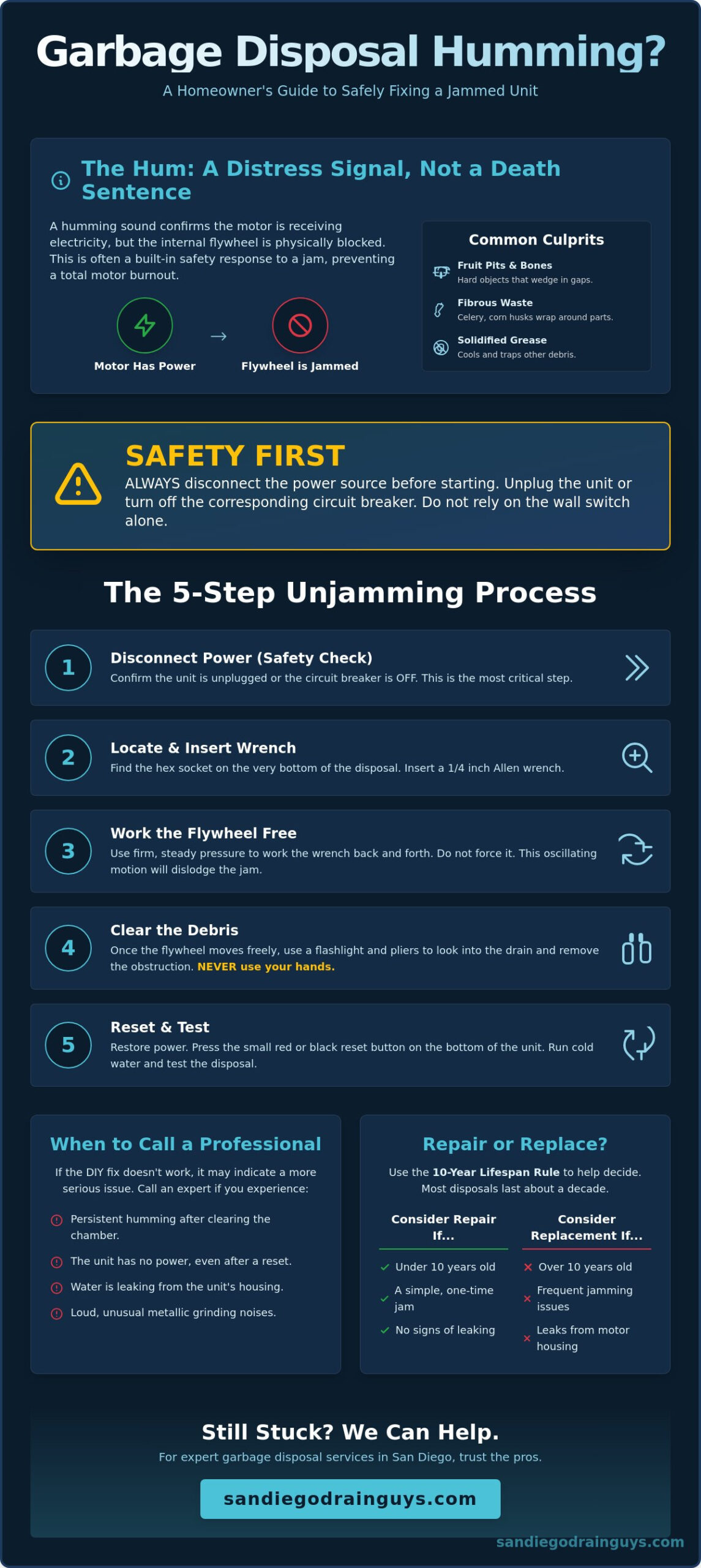
When you flip the switch and hear a low, vibrating drone instead of the usual roar of grinding blades, your appliance is sending you a specific distress signal. This sound confirms the motor is receiving electrical power, but the internal flywheel is physically unable to rotate. Think of it like a car engine that’s trying to turn over while the wheels are locked in place. If your garbage disposal humming but not working is a new development, it’s usually because something has wedged itself between the spinning impellers and the stationary shredder ring.
Leaving the unit switched on while it’s in this stalled state is a serious fire hazard. The electrical energy that should be converted into motion is instead converted into heat. As the motor’s copper windings grow hotter, they can eventually melt or ignite nearby materials. Fortunately, a modern Garbage disposal unit includes a built-in safety feature called a thermal overload protector. This internal circuit breaker “trips” to cut power automatically before the heat reaches dangerous levels. If the humming suddenly stops on its own, it’s a sign that this safety mechanism has successfully engaged to prevent a total motor burnout.
The Anatomy of a Stalled Disposal Motor
The core of the issue lies in the relationship between the motor shaft and the flywheel. The motor uses a magnetic field to spin a rotor, which then turns the flywheel and its mounted impellers. When a mechanical jam occurs, the rotor stops moving, but the magnetic field continues to pulsate at 60 cycles per second. This vibration is the source of the “hum” you hear. While a jam is the most common culprit, a seized bearing can produce a similar sound. A bearing failure is usually a result of long-term wear or water leaking into the motor housing, which often means the unit has reached the end of its functional life.
External Factors: Hard Water and Debris
Local environmental factors play a significant role in how these appliances perform. San Diego is known for having exceptionally hard water, which is rich in calcium and magnesium. Over time, these minerals create a stubborn scale that can “glue” the impellers to the flywheel overnight, especially if the unit isn’t used daily. Beyond mineral buildup, several common household items frequently lead to a garbage disposal humming but not working scenario:
- Fruit Pits and Bones: These hard objects are often the perfect size to wedge into the gap between the flywheel and the shredder ring.
- Fibrous Waste: Celery stalks, corn husks, and onion skins can wrap around the motor shaft, creating enough friction to stall the motor.
- Solidified Grease: Fats and oils may go down as liquids, but they cool into a waxy solid that traps other debris, eventually seizing the moving parts.
By understanding these mechanical and environmental triggers, you can better diagnose whether your disposal needs a simple manual reset or if the internal components have suffered permanent damage from the local water conditions.
The 5-Step Process to Unjam a Humming Garbage Disposal
Safety is our absolute priority whenever we’re dealing with a garbage disposal humming but not working. Before you reach for any tools or look down the drain, you must ensure the unit cannot accidentally turn on. Start by unplugging the power cord from the outlet under your sink. If your disposal is hardwired directly into the wall, find your home’s electrical panel and flip the specific circuit breaker to the “off” position. Do not rely on the wall switch alone; physical disconnection is the only way to guarantee your safety during the repair.
Once the power is cut, follow these steps to clear the obstruction:
- Locate the Hex Socket: Look at the very bottom of the disposal unit under the sink. You’ll find a small, circular opening in the center of the motor housing. This is the manual override socket.
- Insert the Wrench: Use a standard 1/4 inch Allen wrench. Insert it into the socket and feel for it to seat firmly.
- The Back-and-Forth Technique: Don’t try to force the wrench in one direction. Instead, use firm, steady pressure to wiggle it back and forth. This oscillating motion helps break the friction of the jam without snapping the internal components.
- Clear the Chamber: Once the wrench moves freely in a full circle, use a high-lumen flashlight to look down the drain. Use long-handled needle-nose pliers to extract the debris. Never put your hands inside the unit.
- The Final Test: Remove the wrench from the bottom, restore the power, and run a heavy stream of cold water. Flip the switch briefly to verify the motor spins smoothly.
When you are troubleshooting a humming garbage disposal, it’s important to remember that the goal is to restore rotation, not to force the motor. If the wrench doesn’t budge after several attempts, the obstruction might be deeply embedded or the motor itself may have seized due to San Diego’s hard water conditions.
Tools You Will Need for the Fix
We recommend having these specific items ready before you begin. Most manufacturers include a 1/4 inch Allen wrench with the unit, often tucked into a small pouch or taped to the side. You’ll also need a powerful flashlight to see into the dark grinding chamber. Finally, a pair of long-handled pliers is essential for safely removing items like fruit pits or metal scraps that could cause a garbage disposal humming but not working situation.
What to Do if the Flywheel is Still Stuck
If the hex wrench won’t turn, you can try the “top-down” method. Insert a wooden broom handle into the drain and rest the tip against one of the impellers. Use the handle as a lever to try and nudge the flywheel. If you hear a heavy grinding sound instead of a smooth spin, the bearings have likely failed. When DIY steps don’t resolve the issue, it’s time to consult the experts at San Diego Drain Guys to protect your kitchen plumbing from further damage.
Troubleshooting the Reset Button and Overheating Issues
Once you’ve attempted to clear a jam, you might find that the appliance remains completely silent when you flip the switch. This lack of sound often follows a period of your garbage disposal humming but not working. When the motor stalls, it generates intense internal heat very quickly. To prevent the motor windings from melting or starting a fire, the unit utilizes a thermal overload protector. This is a dedicated internal circuit breaker that trips and cuts power to the motor before permanent damage occurs.
You can usually find the reset button on the very bottom of the disposal or near the base on the side. It’s a small, red plastic button that pops out about a quarter of an inch when the unit overheats. If you see this button protruding, don’t try to press it back in immediately. We recommend following the “Cool Down” rule: wait at least 5 to 10 minutes for the motor to dissipate heat. If you attempt a reset while the internal components are still hot, the button will simply pop back out, and you risk damaging the sensitive thermal sensor.
The Logic of the Thermal Overload Switch
The overload switch is your first line of defense against motor burnout. When the motor is forced to work against a physical jam, the electrical resistance spikes, causing the temperature to rise. A popping reset button is a symptom of an underlying mechanical jam or motor strain, not the primary problem itself. If you find yourself resetting the unit frequently, it’s a sign that the impellers are dragging or the motor is reaching the end of its functional life. If the button feels loose, spongy, or won’t stay depressed after a cooling period, the switch itself has likely failed and the unit may require a professional garbage disposal repair.
Electrical Failures: Beyond the Hum
If the motor is cool and the reset button is pushed in, but the unit still won’t hum or spin, the power interruption is likely further up the line. Most modern kitchens in San Diego are equipped with GFCI (Ground Fault Circuit Interrupter) outlets. These outlets can trip due to the same power surge that caused the disposal to stall. Look for a “Reset” button on the outlet itself and ensure it is clicked in. You should also check your home’s main electrical panel for a tripped breaker.
Identifying these “silent” failures is crucial because it helps distinguish between a dead appliance and a simple lack of power. If the outlet has power and the reset button is engaged, but there’s still no response from the motor, the internal wiring may have failed. We advise you to stop DIY electrical troubleshooting at this point. Handling exposed wires under a wet sink is dangerous. If these steps don’t restore function, it’s time to contact a San Diego plumbing expert to safely diagnose the electrical integrity of your system.
Repair vs. Replacement: When Is Your Disposal Beyond Saving?
If you’ve followed the troubleshooting steps and still find your garbage disposal humming but not working, the issue might be structural rather than a simple jam. We recommend evaluating the unit’s age as your first step. Most disposals have an average lifespan of 8 to 12 years. If your unit is approaching the decade mark, the internal components have likely suffered significant wear from daily use and San Diego’s specific environmental factors. At this stage, the metal components often become brittle, and the motor’s efficiency drops significantly.
A simple repair is often cost-effective for a unit under five years old. However, we suggest a full replacement if the cost of a professional repair exceeds 50% of the price of a new installation. This is a practical baseline for long-term savings. Our local hard water accelerates the corrosion of internal grinding elements, so an older unit that starts to fail will likely develop more issues shortly after a minor fix. Investing in a new, more efficient model often provides better peace of mind than patching up an appliance that has reached the end of its functional life.
Terminal Symptoms of a Dead Disposal
Some signs indicate a disposal is physically beyond saving. If you see water dripping directly from the bottom of the motor housing, the internal seals have failed. This allows water to enter the electrical motor compartment, which is a non-repairable safety hazard that can lead to short circuits. Similarly, a persistent smell of burnt ozone or visible smoke during operation means the motor windings have melted. If the motor only “clicks” when you flip the switch but never hums or spins despite having a clear flywheel, the start capacitor or the motor itself has likely failed. These are clear signals that the hardware is compromised.
Choosing the Right Replacement for San Diego Homes
When selecting a new unit, we suggest prioritizing stainless steel grinding components. San Diego’s water is rich in minerals that cause galvanized steel to rust and pit, leading to premature jams and the familiar scenario of a garbage disposal humming but not working. Upgrading from a standard 1/2 HP motor to a 3/4 or 1 HP model can also prevent future stalls. These higher-torque motors handle fibrous waste more effectively and support the local wastewater systems by liquefying food waste into finer particles.
Modern disposals also offer advanced sound insulation. High-end models can operate as quietly as 40 decibels, which is a significant improvement over older, noisier units. While DIY installation is possible with newer “Lift and Latch” systems, professional installation ensures that the mounting ring is perfectly sealed and the discharge tube is correctly aligned. If you need help deciding on the best model for your kitchen, you can book a professional garbage disposal repair or installation with our team to ensure your new appliance is set up for years of reliable service.
Professional Garbage Disposal Services in San Diego
When DIY methods fail to resolve a garbage disposal humming but not working, the problem often lies deeper within your home’s infrastructure. We understand that a non-functional sink is more than just an inconvenience; it’s a disruption to your family’s daily rhythm. Our team at San Diego Drain Guys specializes in diagnosing these high-stress situations with technical precision and a calm, expert approach. We prioritize your peace of mind by using a transparent flat-rate pricing model. This ensures you know the exact investment required for your repair or installation before we even begin the work, eliminating the anxiety of hidden fees or hourly surprises.
Our commitment to reliability extends beyond just fixing the appliance. We treat your kitchen with the highest level of respect and privacy, ensuring our work area remains clean and your domestic environment is undisturbed. By choosing a professional service, you benefit from our standardized operational steps that guarantee a long-term resolution rather than a temporary fix. We take pride in our deep roots within the San Diego community, providing neighborly service that faceless corporate entities simply cannot match.
Beyond the Disposal: Checking Your Kitchen Drainage
A humming disposal is frequently a symptom of a larger issue within your pipes. If you’re searching for a clogged sink drain near me, it’s possible that food waste has backed up into the branch line. We often integrate disposal repairs with professional drain cleaning in San Diego to ensure your entire system is clear. Using advanced sewer camera inspections, we can verify that your lines are free of scale and debris. We also inspect your dishwasher-to-disposal connections to prevent foul-smelling backflow, ensuring your kitchen remains a sanitary space for your family.
Schedule Your San Diego Disposal Expert Today
Attempting to force a stubborn unit can lead to electrical shorts or significant leaks. Professional installation and repair carry better warranties than DIY attempts, protecting your investment for years to come. Our local experts are ready to restore your kitchen’s efficiency with disciplined, methodical service. We cover the entire San Diego area with a focus on punctuality and transparent communication. Contact San Diego Drain Guys for reliable garbage disposal repair and experience the relief of having your plumbing problems handled by capable, honest hands.
Restoring Your Kitchen’s Efficiency
Dealing with a garbage disposal humming but not working doesn’t have to be a source of anxiety. You now know that the hum is often just a sign of a mechanical jam that can be cleared with a hex wrench and a bit of patience. By following the safety protocols and understanding the logic of the reset button, you can handle many common kitchen disruptions on your own. Proper maintenance is especially vital now that California’s organic waste regulations require more from our home appliances in 2026.
When mineral buildup from hard water or age-related motor failure makes DIY repairs impossible, we’re here to help. We’ve served as expert San Diego plumbers since 2018 and take pride in being 5-star rated local drain and fixture specialists. We provide a transparent flat-rate pricing structure so you never have to worry about hidden costs during a high-stress repair. Our team is committed to providing a clean and respectful service experience for every neighbor in our community.
Get Fast, Flat-Rate Garbage Disposal Repair in San Diego Today and let our team handle the heavy lifting with the respect and expertise your home deserves. We’re ready to get your kitchen back in working order.
Frequently Asked Questions
Is it safe to use a humming garbage disposal?
No, you should never leave a humming disposal switched on. The hum indicates that electricity is flowing to a stalled motor, which creates intense heat and can lead to a fire hazard. If you hear this sound, turn the unit off immediately at the wall switch to allow the internal components to cool and prevent permanent motor burnout.
How do I manually rotate my garbage disposal flywheel?
You can manually rotate the flywheel by inserting a 1/4 inch Allen wrench into the hex socket located at the center of the unit’s bottom. Move the wrench in a back and forth motion to break the friction of the jam. This method provides direct leverage to the motor shaft, allowing you to bypass the mechanical obstruction without using electrical power.
Why does my garbage disposal hum but the reset button isn’t popped?
A garbage disposal humming but not working without a popped reset button means the motor hasn’t reached its thermal trip point yet. The jam is preventing rotation, but the heat hasn’t built up enough to trigger the safety switch. You must turn the power off manually before the unit overheats and trips the protector on its own.
Can I use Drano or chemical cleaners in a humming disposal?
We strongly advise against using chemical cleaners in any disposal unit. These caustic liquids can corrode the internal metal components and damage the delicate rubber seals over time. Additionally, if the disposal remains jammed, you’ll be left with a sink full of toxic chemicals that makes professional repair much more hazardous for a plumber to handle.
What tools do I need to fix a jammed garbage disposal?
Most jams only require a 1/4 inch Allen wrench, a high-lumen flashlight, and a pair of long-handled needle-nose pliers. The wrench clears the jam from the bottom, while the pliers safely remove the debris from the top. We recommend keeping these tools together under the sink so you can react quickly when a blockage occurs.
How much does it cost to have a plumber fix a humming disposal in San Diego?
Service costs in San Diego typically reflect the local labor rates, which are approximately 15% to 25% above the national average due to the high cost of living. While simple jams are straightforward fixes, more complex repairs involving motor seals or internal electrical failures vary. We utilize a transparent flat-rate pricing model to ensure you know the exact investment before we begin.
Why does my garbage disposal hum after I haven’t used it for a while?
Lack of use allows San Diego’s hard water minerals to crystallize on the internal components. This mineral scale effectively “glues” the impellers to the shredder ring, preventing the motor from spinning. Running your disposal for a few seconds every day with plenty of cold water helps prevent this buildup and keeps the moving parts free to spin.
Should I hear a click when I press the reset button?
You should feel and hear a distinct click when resetting a tripped motor. This sound confirms the thermal overload protector has re-engaged the circuit. If the button feels spongy or doesn’t stay pushed in, the internal switch may be damaged, or the motor might still be too hot to safely resume operation. Wait another ten minutes before trying again.