
Imagine you’re finishing the dinner dishes when you notice the kitchen sink won’t drain; moments later, you hear the guest bathroom toilet gurgling for no reason. Realizing you have multiple drains clogged at once is enough to make any homeowner’s heart sink. It isn’t just an annoying coincidence. It’s a serious red flag that your home’s main sewer line is failing. We understand the immediate stress this causes, especially when you’re worried about raw sewage backing up into your living space or facing unexpected repair bills.
You’re likely feeling overwhelmed by the confusion of whether this is a simple fix or a major crisis. In San Diego, homeowners are responsible for the maintenance of their entire sewer lateral connecting to the city main, so taking the right steps quickly is vital. This article will show you exactly how to stop an active backup and why specialized diagnostics are necessary to protect your property. We’ll preview the latest non-invasive solutions like CIPP lining and pipe bursting that can resolve the issue permanently while keeping your landscaping intact.
Key Takeaways
- Understand why having multiple drains clogged at once is a statistical impossibility for simple clogs and actually indicates a “Main Line Red Alert.”
- Learn how San Diego’s unique environment, from invasive tree roots to aging clay pipes in historic neighborhoods, contributes to sudden sewer failures.
- Discover the immediate “Water Ceasefire” protocol you must follow to prevent a catastrophic sewage backup into your living space.
- Compare the effectiveness of temporary snaking against high-pressure hydro jetting for clearing stubborn and recurring main line blockages.
- Explore how modern sewer camera inspections and trenchless repair technologies provide permanent solutions without the need to dig up your driveway.
Why Multiple Clogs Are Never a Coincidence
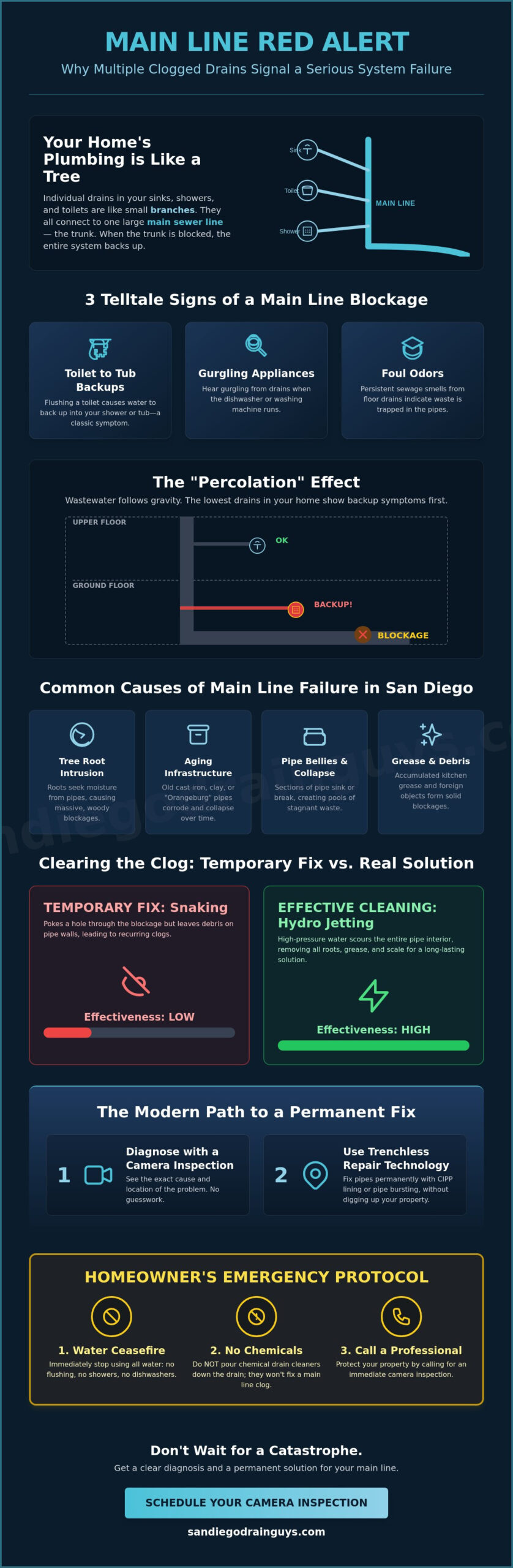
When you discover multiple drains clogged at once, your first instinct might be to reach for a bottle of chemical cleaner or a hand snake. However, we want to dispel the “coincidence myth” immediately. It’s statistically improbable for two or more independent plumbing fixtures to develop isolated clogs at the exact same moment. Instead, this scenario acts as a “Main Line Red Alert.” Think of your home’s plumbing like a tree; while individual branch lines serve your sinks and showers, they all eventually feed into one single trunk: the main sewer line. When this primary exit is blocked, everything you send down any drain has nowhere to go but back up into your home.
This interconnected network is known as your Drain-Waste-Vent (DWV) system, and its job is to safely transport wastewater and sewer gases away from your living space. Because every drop of water used in your house relies on this single artery to reach the municipal sewer or septic tank, a blockage here affects every room. A main line clog is a total system failure where the exit point for all household waste is completely obstructed.
The Symptoms of a Main Sewer Line Blockage
Identifying a main line issue early can save you from a messy cleanup and expensive property damage. We recommend watching for these specific warning signs that indicate the problem is deeper than a simple sink clog:
- Toilet to Tub Backups: Water backing up into the shower or bathtub whenever you flush a nearby toilet is a classic sign of a main line obstruction.
- Gurgling Appliances: Listen for strange gurgling sounds coming from your drains when the dishwasher or washing machine is running; this happens as air is trapped in the system.
- Foul Odors: Persistent sewage smells emanating from floor drains or basement fixtures suggest that waste is sitting in the pipes rather than flowing out.
The “Percolation” Effect: Why the Lowest Drain Fails First
You might wonder why your upstairs sink seems fine while your downstairs shower is filling with water. This happens because of the “percolation” effect. Wastewater always follows the path of least resistance and is governed by gravity. Since your lowest drains are physically closer to the main sewer line, they’re the first to show symptoms when a blockage occurs. If you ignore a slow-draining shower in the basement or a gurgling floor drain, it’s only a matter of time before the backup reaches the upper floors. Addressing the issue at the first sign of a lower-level failure is the best way to prevent a catastrophic whole-home backup.
Common Causes of Multi-Drain Failures in San Diego
San Diego homeowners face unique challenges that often lead to a “Main Line Red Alert.” When you experience multiple drains clogged at once, it’s usually the result of local environmental factors or the specific age of your neighborhood’s infrastructure. According to the EPA, the most frequent causes of sewer line blockages include grease, debris, and root intrusion. In our coastal climate, these issues are amplified by soil conditions and thirsty vegetation.
Beyond natural causes, we often see structural failures in the main lateral. This can include “bellies,” where a section of the pipe sinks and creates a stagnant pool, or total pipe collapses. When the main line fails structurally, wastewater can’t exit the property, leading to the simultaneous backup of sinks, toilets, and showers throughout the home.
Tree Root Intrusion: The Silent Clog
Our semi-arid climate makes sewer lines a primary target for local trees. Roots are experts at seeking out moisture, and they can sense the condensation on the outside of your pipes. They enter through microscopic cracks in pipe joints and grow rapidly once they reach the nutrient-rich water inside. What starts as tiny hair-like fibers can eventually turn into a massive, woody obstruction. Chemical root killers rarely work for established clogs because they can’t reach the heart of the root mass. If you suspect roots are invading your lines, a professional sewer camera inspection is the only way to see the true extent of the damage.
Aging Infrastructure and “Orangeburg” Pipes
In historic San Diego neighborhoods like North Park and Hillcrest, aging pipes are a common culprit. Homes built between 1950 and 1970 often utilized cast iron, clay, or even “Orangeburg” pipes, which are essentially wood fibers bound with sealed tar. Over time, cast iron develops internal corrosion and scale that narrows the pipe’s diameter. Clay pipes are brittle and easily crack when the ground shifts. Orangeburg is particularly problematic as it tends to flatten or “egg” under the weight of the soil. These materials are prone to sudden, multi-drain failure once they reach the end of their functional lifespan.
The “Fatberg” Phenomenon
We also frequently encounter “fatbergs” in local sewer laterals. These occur when cooking grease is poured down the sink and combines with so-called “flushable” wipes. Despite the marketing, these wipes do not break down like toilet paper. They snag on pipe imperfections and bind with congealed grease to create a concrete-like mass. This accumulation eventually chokes off the main line, causing a plumbing emergency that requires professional intervention to clear safely.
Snaking vs. Hydro Jetting: Which Fix Actually Works?
When you’re dealing with multiple drains clogged at once, the tool you choose determines whether you’re fixing the problem or just delaying the inevitable. Many homeowners instinctively reach for a mechanical snake, thinking it’s the standard solution for any blockage. While a snake has its place in plumbing, it’s often the wrong choice for a main line emergency. Using the wrong equipment can lead to recurring backups and, in some cases, permanent damage to your home’s infrastructure.
We’ve seen how traditional methods often fall short when the entire system is compromised. For a main line to function correctly, it needs a clear, unobstructed path to the municipal sewer. If the pipe is narrowed by years of buildup, a simple cable won’t provide the long-term relief you need. Hydro jetting restores the pipe to its original internal diameter by scouring the walls clean, rather than just poking a hole through the center of a clog.
The Limitations of the Plumbing Snake
A plumbing snake, or drain auger, is essentially a flexible metal cable that spins through the pipe to break up a localized obstruction. It’s an excellent tool for a single clogged toilet or a hair clog in a sink trap. However, when the issue is a main line failure, a snake usually only provides a “temporary hole.” It might restore some flow, but it leaves behind the grease, scale, and root mass that caused the problem in the first place. Within weeks, debris begins to snag on the remaining residue, leading to another backup.
There’s also a significant risk involved with older San Diego properties. If your home has fragile clay or cast iron pipes, the aggressive thrashing of a heavy mechanical snake can actually crack or shatter the pipe walls. This turns a clearing job into a much more expensive repair. We generally view snaking as a waste of money when the symptoms point toward a total system failure.
Why Hydro Jetting is the Modern Standard
To provide a permanent solution, we utilize the 4,000 PSI cleaning power of San Diego Drain Guys professional equipment. Hydro jetting uses high-pressure water delivered through specialized nozzles to pulverize tree roots and emulsify grease. Unlike a snake, which only makes a small path, the water jet cleans the entire circumference of the pipe. It effectively “pressure washes” the interior of your sewer lateral, removing even the most stubborn calcified scale.
This method is also a critical step in preparing a pipe for trenchless repair. By cleaning the line thoroughly, we ensure that modern lining materials can bond correctly to the host pipe. Hydro jetting is also environmentally friendly because it relies solely on water pressure rather than harsh, corrosive chemicals that can damage your plumbing and the local ecosystem. It’s the most effective way to stop the immediate threat of a backup while protecting the long-term health of your sewer system.
The San Diego Homeowner’s Emergency Protocol
Discovering multiple drains clogged at once is a high-stress event that requires a calm, methodical response. Your immediate actions can mean the difference between a simple professional clearing and a restoration project involving thousands of dollars in water damage. We want to ensure you have a clear roadmap to follow before the technician arrives. By taking these specific steps, you protect your property and help us resolve the issue more efficiently.
One of the most important things you can do is avoid the “Chemical Trap.” Many homeowners reach for caustic liquid drain cleaners when they see a backup. This is a mistake. These chemicals rarely reach a main line blockage effectively; instead, they sit in the pipes, creating a hazardous, boiling pool of acid. This makes the job significantly more dangerous for your plumber and can lead to skin or eye injuries during the repair process. Stick to the protocol below to keep everyone safe.
Step 1: The Water Ceasefire
The moment you suspect a main line issue, you must establish a total water ceasefire. This means no flushing toilets, no running sinks, and absolutely no using the dishwasher or washing machine. In a system where multiple drains clogged at once, the wastewater has nowhere to go. Even a single flush of a toilet can displace enough water to cause an immediate overflow in your bathtub or shower. If you’re worried about family members accidentally using a fixture, we recommend turning off the main water shut-off valve to the house until the problem is diagnosed.
Step 2: Locate the Cleanout
Your sewer cleanout is the primary access point for clearing a main line blockage. It’s usually a four-inch diameter pipe with a white or black threaded cap, typically located in your yard or near the foundation of your home. Clearing away brush, dirt, or landscaping debris from this area saves valuable time during a service call. If you live in an older San Diego home and can’t find a cleanout, don’t panic. Some historic properties were built without them, and we have specialized tools to access the line through other points, though locating it early is always the preferred first step.
Before the technician arrives, take a moment to document the symptoms. Note which drains are backing up first, whether you hear gurgling in the walls, or if you smell raw sewage in specific rooms. This information allows us to pinpoint the failure point much faster. If you’re currently facing a backup and need professional help, contact San Diego Drain Guys to get an expert on the way to your property immediately.
Permanent Solutions: Camera Inspections and Trenchless Repair
When we arrive to address multiple drains clogged at once, our primary goal isn’t just to get the water flowing again. We want to identify the root cause so the backup never returns. While hydro jetting is an elite cleaning tool, it can’t fix a structural crack or a collapsed joint. This is where modern diagnostic and repair technology becomes essential. We provide homeowners with a clear, visual understanding of their sewer health before recommending any major work, ensuring you aren’t paying for guesswork.
Our team focuses on providing flat-rate, transparent relief for these high-stress situations. We believe you should never be surprised by a bill in the middle of a plumbing emergency. By using advanced technology, we can offer permanent solutions that respect both your budget and your property’s integrity. We’ve moved beyond the era of “dig first, ask questions later” to a more precise, methodical approach.
The Diagnostic Power of the Sewer Camera
A professional sewer camera inspection is the only way to see the truth inside your pipes. We use high-definition, waterproof cameras on flexible cables to navigate the entire length of your sewer lateral. This footage identifies the exact location of clogs and the current condition of the pipe material. It’s the most effective way to determine if you need a simple cleaning or a structural repair.
We always encourage you to watch the video footage with us. Seeing the state of your pipes firsthand provides peace of mind and justifies the next steps in the repair process. If the camera reveals a structural break rather than just a grease clog, we can pinpoint the failure point without guessing. This precision prevents unnecessary labor costs and ensures the fix is tailored to the specific damage found in your system.
No-Dig Sewer Repair (Trenchless)
In the past, a main line failure meant excavating your yard and destroying your driveway. Today, we offer trenchless sewer repair as a cleaner, faster alternative. This technology allows us to fix your pipes from the inside out using existing access points. It’s a game-changer for San Diego homeowners who want to preserve their expensive landscaping and hardscaping.
One of the most effective methods we use is CIPP sewer lining. This “pipe within a pipe” solution involves inserting an epoxy-saturated liner into the damaged host pipe. Once it cures, it creates a seamless, jointless, and root-proof new line. This method is ideal for our local environment because it’s resistant to the thirsty tree roots that cause multiple drains clogged at once. Modern lining materials boast a 50-year lifespan, providing a permanent solution that protects your home for decades to come.
Restore Your Peace of Mind and Your Plumbing
Facing multiple drains clogged at once is a critical signal that your home’s main sewer line needs expert attention. By choosing modern diagnostics over temporary fixes, you protect your property from the stress of recurring backups and the high costs of traditional excavation. Professional service providers like CH Enviro advocate for this methodical approach, starting with a clear camera inspection to turn a plumbing emergency into a manageable, permanent solution. Taking the right steps now ensures that a single blockage doesn’t become a long term nightmare for your household.
Our team is dedicated to providing 24/7 emergency response for main line clogs using specialized trenchless and hydro jetting equipment. We believe in building trust through transparent, flat-rate pricing so you never have to worry about hidden surprises during a crisis. Get Flat-Rate Relief from San Diego Drain Guys Today and let our experts handle the heavy lifting with the precision your home deserves.
Frequently Asked Questions
Is it possible for two drains to be clogged at the same time by accident?
It is statistically improbable for two independent drains to develop isolated clogs at the exact same moment by coincidence. When you see multiple drains clogged at once, it’s a definitive sign of a blockage in the main sewer line. Individual sink clogs are isolated events, but a systemic backup indicates that the primary exit for all household wastewater is obstructed.
Can I use a plunger if multiple drains are clogged?
Using a plunger is generally ineffective when the problem is in the main sewer line. Plungers are designed to clear localized blockages in a single fixture’s trap by creating pressure. If the main line is blocked, that pressure has nowhere to go and won’t reach the deep obstruction. You risk pushing wastewater into other low-lying fixtures like your shower or floor drains.
How do I know if the clog is in my house or the city’s sewer main?
You can determine the location by checking your external sewer cleanout. If you open the cleanout cap and see standing water, the blockage is likely further down the line toward the city main. If the cleanout is empty but your indoor fixtures are backing up, the clog is located within your home’s private sewer lateral rather than the municipal system.
Will a main line clog clear itself if I wait?
A main line clog will not clear itself over time. These blockages are typically composed of solid materials like tree roots, calcified scale, or congealed grease that only get worse as more debris accumulates. Ignoring the problem only leads to a complete sewage backup into your home; this causes far more expensive property damage and requires extensive professional remediation.
How much does it cost to clear a main sewer line in San Diego?
The cost to clear a main line in San Diego depends on the severity of the blockage and the technology required to remove it. Traditional snaking is often an affordable initial attempt, while professional hydro jetting requires specialized equipment but provides a more thorough cleaning. We recommend a camera inspection first to ensure you aren’t paying for a service that won’t solve the root cause.
Can tree roots grow back after hydro jetting?
Tree roots will eventually grow back after hydro jetting because the process clears the obstruction but leaves the entry points open. Roots are naturally drawn to the moisture inside your pipes. To prevent their return, we often suggest follow-up solutions like CIPP lining to seal the pipe joints. This creates a permanent, root-proof barrier that protects the pipe for decades.
Is a sewer backup covered by my San Diego homeowner’s insurance?
Standard homeowner’s insurance policies in San Diego often do not cover sewer backups unless you have specifically added a sewer backup endorsement to your coverage. We suggest reviewing your policy or contacting your agent to confirm if you’re protected against water damage resulting from a main line failure. Some policies also distinguish between a simple backup and a full pipe collapse.
What is the fastest way to fix multiple clogged drains?
The fastest and most reliable way to resolve multiple drains clogged at once is a professional sewer camera inspection followed by hydro jetting. This combination allows a technician to see exactly what is causing the blockage and clear it immediately with high-pressure water. It eliminates the guesswork and prevents the need for multiple service calls for the same recurring issue.