
In San Diego, a sump pump without a battery backup is only half a solution. While we typically enjoy the sunshine, our heaviest flash floods are almost always accompanied by high winds that strain the local power grid. You likely already know the sinking feeling of watching the rain pour down while the lights flicker, wondering if your primary pump will keep up. We understand the anxiety that comes with potential flooding in your crawl space or basement. Installing a professional battery backup sump pump san diego residents can rely on is the most effective way to protect your home when the electricity fails.
We want to help you replace that worry with lasting peace of mind. This article explains why a backup system is the ultimate insurance policy for your property during a storm. We’ll break down the differences between AC and DC backup technologies so you can make an informed choice for your specific needs. You’ll also learn about local discharge regulations and the latest 2026 smart models capable of moving thousands of gallons of water per hour. By the end, you’ll have a clear path to a flood-proof home and the confidence that comes with a job done correctly.
Key Takeaways
- Understand why a standard pump isn’t enough during San Diego’s storm-driven power outages and how a secondary system acts as vital insurance.
- Learn how a battery backup sump pump san diego homeowners trust provides a second line of defense by automatically activating the moment your primary power fails.
- Compare different battery technologies, including AGM and Lithium-Ion, to determine which backup system offers the best longevity for your property.
- Discover the common pitfalls of DIY installation, such as float switch interference, and why professional calibration is essential for a flood-proof home.
- Find out how to secure your home with transparent, flat-rate pricing and expert diagnostics that ensure your system is perfectly sized for the job.
Why San Diego Homes Need a Battery Backup Sump Pump
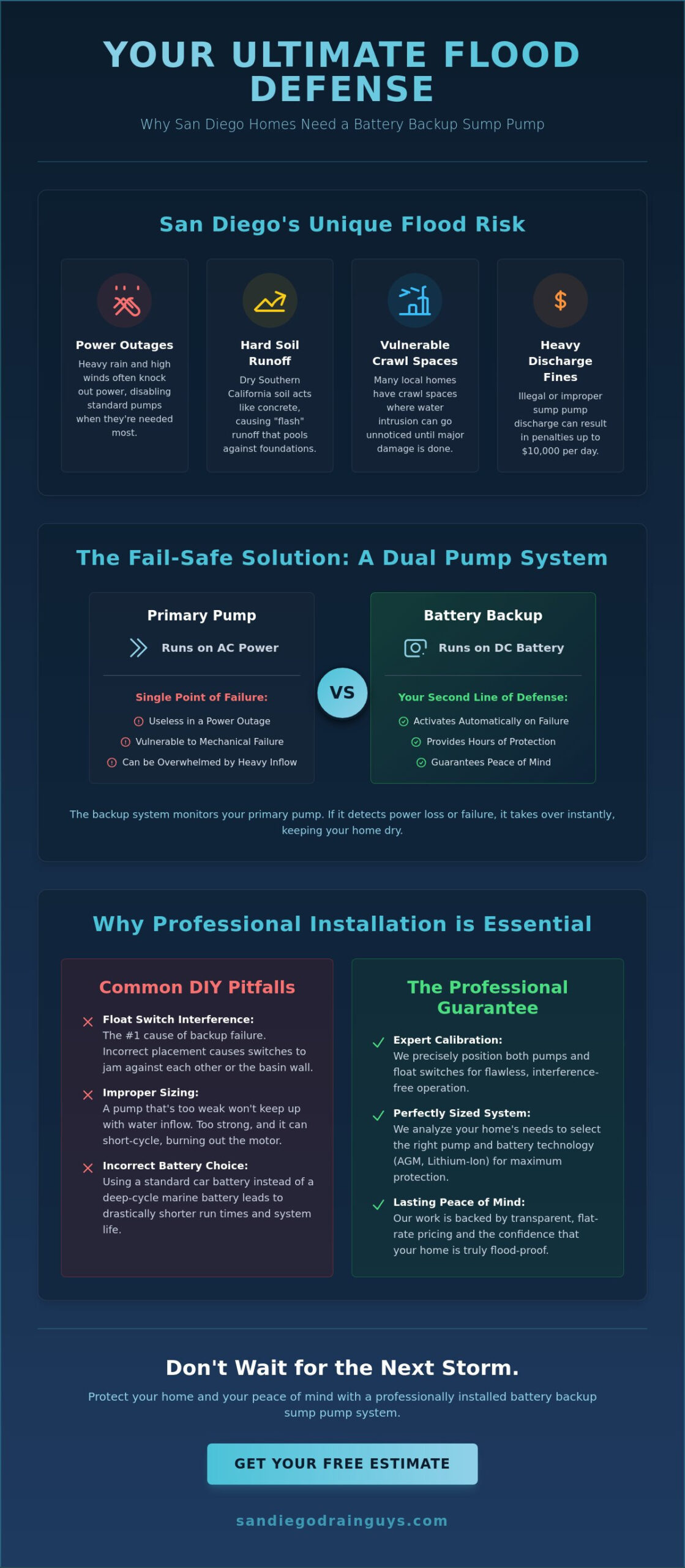
A Sump pump is often the only thing standing between a dry home and a costly disaster. However, a standard system relies entirely on your home’s electrical grid. A battery backup sump pump is a secondary, independent unit that operates on its own power source. In San Diego, where heavy rain is frequently paired with high winds and power outages, this isn’t a luxury; it’s a necessity. When atmospheric rivers hit our coast, they strain the local drainage systems and the power grid at the same time. The financial risk of a flooded basement or crawl space is significant. Professional cleanup and structural repairs are expensive. Investing in a battery backup sump pump san diego homeowners can trust is a proactive step that costs far less than a single flood event.
The Vulnerability of San Diego Architecture
Our local geography creates unique challenges for homeowners. Areas like Mission Valley and coastal lowlands are particularly susceptible to rising water tables during storms. Many San Diego homes feature crawl spaces rather than full basements, making water intrusion harder to spot until damage is already done. Our dry, hardened Southern California soil often acts like concrete during a “flash” rain event. Instead of soaking into the ground, water sheets off the surface and collects directly against your foundation. Without a working pump, that water quickly finds its way inside. Beyond property damage, San Diego regulations are strict. Illegal sump pump discharge into the storm sewer system can result in penalties of up to $10,000 per day per incident, making it vital to have a system that works correctly and legally.
Primary Pumps vs. Battery Backups
Your primary pump is a hardworking machine, but it has a single point of failure: electricity. If a storm trips your circuit breaker or a transformer fails down the street, that pump becomes useless. Additionally, aging systems often suffer from mechanical float switch failures where the pump simply won’t turn on. A battery backup sump pump san diego system solves this by monitoring the primary pump’s performance. It senses when power is lost or when the primary pump can’t keep up with the inflow. It then takes over automatically, ensuring your home stays dry even in the middle of a total blackout. This redundant protection is the only way to guarantee safety when the weather is at its worst.
How Battery Backup Sump Pumps Work as a Second Line of Defense
Installing a high-quality battery backup sump pump san diego homeowners can depend on involves more than just a battery. It creates a redundant system with two distinct pumps living in the same basin. Your primary pump runs on standard AC power from your wall outlet. The secondary pump is a DC-powered unit that draws energy from a dedicated deep-cycle battery. This dual-pump architecture ensures that even if the primary motor burns out or the power grid fails, your home remains protected. It is a fail-safe strategy that keeps your foundation dry when the primary system reaches its limit.
The system relies on an automatic transfer switch or a secondary float sensor. When the water level rises above the primary pump’s activation point, the backup system recognizes the failure and engages immediately. Modern units also include sophisticated alarm systems. These will sound an audible alert or send a notification to your smartphone if the backup pump is running. This early warning allows you to address the primary pump’s issue before the battery runs out. If you’re concerned about your current setup’s reliability, our team can provide expert diagnostics and sump pump services to ensure your backup is ready for the next storm.
The Role of the Inverter and Charger
The heart of the backup system is the charging controller. It performs two critical tasks: converting battery power into a form the motor can use and maintaining the battery’s health. In San Diego, we often go months without significant rain. Without a smart “trickle” charger, a battery would slowly lose its charge or become damaged from overcharging, a process often called “cooking.” A high-quality charger monitors the battery’s voltage. It provides exactly what is needed to keep it at peak capacity without degrading the internal plates, ensuring it is ready for a sudden atmospheric river.
Pumping Capacity and Head Pressure
When selecting a battery backup sump pump san diego homes require, we look closely at Gallons Per Hour (GPH) and head pressure. Head pressure refers to the vertical distance the pump must push water to reach the discharge line. For instance, high-performance models like the Wayne WSS30VN can move up to 5,100 gallons per hour. While backup pumps are sometimes slightly less powerful than primary units, they must still handle the vertical lift requirements of your specific property. If your discharge line has to climb ten feet out of a deep crawl space, a weak pump will simply churn water without clearing the pit. We calculate these requirements precisely so your secondary line of defense is strong enough to handle a true flash flood.
Choosing the Right Backup System for Your San Diego Property
Selecting the right battery backup sump pump san diego system requires a balance between power and endurance. We typically see two main configurations: pure DC systems and AC/DC hybrid systems. A pure DC backup is a dedicated secondary pump that only activates when the primary pump fails or the power goes out. Hybrid systems are more integrated, using a single pump that can switch between wall power and battery power. We usually recommend the dedicated DC backup for our clients because it offers true mechanical redundancy. If the primary pump’s motor burns out, you still have a completely separate machine ready to work.
Run-time expectations are a major factor in your decision. Most professional-grade backup systems provide between 7 and 10 hours of continuous pumping on a full charge. For example, high-end models like the Zoeller Aquanot 508 are designed to handle heavy cycles for approximately 7.5 hours during a total blackout. Modern systems also offer smart technology, such as Wi-Fi connectivity. These units send real-time alerts to your smartphone if the power fails or if the battery needs attention. This remote monitoring is invaluable if a storm hits while you are away from home, giving you time to react before a flood occurs.
AGM vs. Lead-Acid Batteries
The type of battery you choose determines how much maintenance you’ll need to perform. Traditional lead-acid batteries are affordable but require you to manually add distilled water to the cells every few months. In the dry San Diego heat, these batteries can lose fluid quickly. We consider maintenance-free AGM (Absorbed Glass Mat) batteries the industry standard for reliability. They are sealed, spill-proof, and better suited for long periods of dormancy. While a typical battery needs replacement every 3 to 5 years, premium Lithium-Ion options are now entering the market, offering even longer lifespans for those who want the highest level of protection.
Sizing the System for San Diego Rainfall
We don’t believe in a one-size-fits-all approach. Sizing your system correctly involves matching the backup pump’s capacity to your specific lot. We often use findings from a sewer camera inspection to understand how water moves through your property’s existing lines. We also consider the slope of your yard and the total length of the discharge pipe. A pump that is too powerful for a small crawl space might cycle too quickly, leading to premature motor wear. Conversely, a weak pump won’t have the “head pressure” needed to push water up and out if your lot has a steep incline. We ensure your backup system is perfectly calibrated to handle the unique drainage challenges of your San Diego home.
Professional Installation and Maintenance in San Diego
Installing a battery backup sump pump san diego system is a technical task that demands precision. While some homeowners attempt a DIY approach, we often find that small errors lead to total system failure during a storm. One of the most frequent issues is float switch interference. If the backup float gets tangled with the primary pump’s power cord or the side of the basin, it won’t rise with the water level. This prevents the backup from ever turning on. We ensure that both pumps are positioned with enough clearance to operate independently and reliably.
Beyond the pumps themselves, the surrounding infrastructure must be perfect. We verify that your discharge line is clear and sized correctly for your pump’s Gallons Per Hour (GPH) rating. A line that is too small creates excessive back pressure, which can shorten the lifespan of your equipment. We also recommend a dedicated electrical circuit for your primary pump. Sharing a circuit with a heavy appliance like a freezer or washing machine is a recipe for a tripped breaker during a heavy downpour. Our team integrates these installations into our broader plumbing services in San Diego to ensure your entire drainage system works in harmony.
The Installation Checklist
We follow a methodical process for every installation. First, we test the check valve. This one-way valve is critical because it prevents water already in the discharge pipe from flowing back into the pit once the pump stops. Without it, your pump will cycle repeatedly, wasting battery life and wearing out the motor. We also set the backup float activation point approximately two inches higher than the primary pump’s start point. This ensures the backup only runs when the primary system is overwhelmed or fails. Finally, we secure the battery case in a dry, elevated location to protect the electronics from any potential moisture in the crawl space.
Annual Maintenance for Peace of Mind
Regular maintenance is the only way to guarantee your backup is ready for a San Diego flash flood. We recommend a “Bucket Test” at least once a year. By slowly pouring water into the sump pit, you can simulate a flood and watch the system activate. It’s also vital to clean the pump intake screen. Over time, silt and debris can clog the intake, reducing the pump’s efficiency. During the dry summer months, check the battery terminals for any white, crusty corrosion. Cleaning these terminals ensures a solid connection when the winter rains finally arrive. If you want to ensure your home is fully protected, contact San Diego Drain Guys for expert sump pump services today.
Reliable Flood Prevention with San Diego Drain Guys
We believe that protecting your home shouldn’t be a source of financial stress or technical confusion. That’s why we operate with a transparent, flat-rate pricing model for every project we undertake. You won’t face hidden fees or surprise costs once the work is finished. Our team takes a methodical approach to expert diagnostics, ensuring your battery backup sump pump san diego is perfectly sized for your property’s specific water volume requirements. We handle the complex technical details, from electrical integration to plumbing calibration, so you can focus on your family’s safety instead of worrying about your basement.
Our expertise extends beyond just pump installation. We provide comprehensive drainage support that addresses the root cause of water accumulation. This often begins with professional drain cleaning in San Diego to ensure that storm runoff has a clear, unobstructed path away from your foundation. By looking at the entire system, we prevent the temporary fixes that often fail during the first heavy rain of the season. We act as your dependable partner, providing a premium service experience that prioritizes your home’s structural integrity and your personal privacy.
Why Our Local Knowledge Matters
Having deep roots in the community means we understand San Diego’s unique soil and water table challenges. Our dry, expansive clay soil behaves differently than the soil found in other regions, placing specific pressures on foundation walls and drainage basins during flash floods. We use this local knowledge to recommend the best placement and discharge strategies for your specific lot. If we discover structural pipe issues during our initial evaluation, we can seamlessly integrate your project with trenchless sewer repair. This ensures your home’s infrastructure is modern, efficient, and capable of handling the most intense atmospheric rivers without a single surprise.
Get Your San Diego Home Storm-Ready
Don’t wait for the next flash flood warning to wonder if your crawl space is safe. A storm-driven power outage is the worst possible time to realize your primary pump is working alone. We’re here to provide a professional sump pump evaluation and a clear, honest assessment of your home’s readiness. Our disciplined and methodical technicians treat your domestic environment with the highest level of respect and empathy, ensuring the job is done correctly the first time. Protect your home with a professional battery backup installation today and experience the lasting peace of mind that comes from being truly prepared for whatever the weather brings.
Secure Your Home Against the Next Atmospheric River
Protecting your property from flash floods requires more than just a standard pump; it requires a redundant system that works even when the power fails. We’ve explored how a professional battery backup sump pump san diego homeowners trust acts as a vital second line of defense. By choosing the right battery technology and ensuring a precise installation, you eliminate the single points of failure that lead to foundation flooding. Our team at San Diego Drain Guys is locally owned and has been serving our neighbors since 2018. We specialize in advanced sewer and drainage solutions designed specifically for our unique Southern California landscape.
We believe in honesty and transparency, which is why we always provide specific, flat-rate pricing before any work begins. You don’t have to navigate the technical complexities of float switches and charging cycles alone. We handle every detail with the discipline and respect your home deserves. Secure your home today with San Diego’s drainage experts and rest easy knowing your foundation is protected. Let’s make sure your property is ready for whatever the next storm brings.
Frequently Asked Questions
How long does a battery backup sump pump last during a power outage?
A high-performance battery backup system typically provides 7 to 10 hours of continuous pumping capacity on a full charge. Some premium models are specifically designed to operate for approximately 7.5 hours during a total power outage. This duration is usually sufficient for most San Diego storm events. If you’re concerned about extended blackouts, we can discuss installing additional batteries to increase your home’s runtime.
Do I need a separate discharge pipe for my backup sump pump?
You don’t strictly need a separate discharge pipe, but we often recommend it for maximum redundancy. Many combination systems use a single discharge line with a check valve to prevent backflow. However, a completely independent line ensures that if the primary pipe becomes clogged or damaged, the backup pump can still move water safely to your landscaping. This setup follows San Diego municipal codes regarding permeable surface discharge.
What is the difference between a water-powered and a battery backup pump?
The main difference is the power source; battery backups use stored electrical energy while water-powered pumps use your home’s city water pressure to create suction. Water-powered pumps don’t need batteries, but they require a consistent, high-pressure water supply and can consume significant amounts of city water. In many neighborhoods, a battery backup sump pump san diego residents prefer is more reliable because it doesn’t depend on external water pressure.
How often should I replace the battery in my backup system?
You should replace the battery in your backup system every 3 to 5 years to ensure it holds a reliable charge. Even if the pump hasn’t run, the internal plates in the battery degrade over time. The cost for a replacement battery typically ranges from $50 to $150. We recommend checking the terminals for corrosion annually to prevent unexpected failures during a heavy rain event.
Will a battery backup pump notify me if the primary pump fails?
Yes, most modern backup systems include an audible alarm or smart technology to notify you of a primary pump failure. Some advanced models feature Wi-Fi connectivity that sends real-time alerts directly to your smartphone if the power goes out or if the backup pump activates. This feature provides peace of mind by allowing you to address the issue before your crawl space or basement floods.
Can I install a battery backup on my existing sump pump system?
We can certainly install a standalone battery backup on your existing sump pump system. We simply add the secondary pump and battery to your current basin, provided there is enough physical space for the additional hardware. Our technicians will evaluate your existing pit during a consultation to ensure the backup float switch has enough clearance to operate without getting tangled in your primary pump’s cords.
What happens if the battery dies during a long storm?
If the battery dies during a prolonged storm, the backup pump will stop functioning until power is restored and the charger can replenish the cells. To prevent this, we can install high-capacity systems that move up to 3,500 gallons per hour. For homes in high-risk areas, we also offer dual-battery configurations that effectively double your pumping time during extended San Diego power outages.
Is a battery backup sump pump worth the investment in San Diego?
A battery backup sump pump san diego is absolutely worth the investment because our heaviest rains are frequently accompanied by power grid failures. A primary pump is useless without electricity, leaving your foundation vulnerable during the exact moment it needs protection most. When you consider the high cost of flood remediation and structural repairs, the one-time cost of a backup installation provides essential financial and emotional security.