
Your sewer line is failing, and the contractor standing in your driveway just handed you a quote that includes tearing up your Spanish tile patio, your mature landscaping, and a good portion of your sanity. Here’s what he didn’t tell you: there’s a strong chance none of that destruction is actually necessary. CIPP pipe lining, short for cured-in-place pipe lining, can rehabilitate a damaged sewer line from the inside out, with no excavation, no demolished hardscaping, and no weeks of upheaval to your daily routine.
If you’re a San Diego homeowner, you already know the anxiety that comes with sewer problems. The soil shifts, the roots push in, and suddenly you’re facing a repair that feels like it could cost you everything you’ve worked to build. That fear is completely valid, and it’s exactly why so many people end up agreeing to invasive, expensive work before they understand all their options.
This guide cuts through the confusion. We’ll explain exactly how CIPP lining works, why it’s particularly well-suited to San Diego’s challenging soil conditions, what the process looks like from start to finish, and how to get a transparent, flat-rate price so there are no surprises along the way.
Key Takeaways
- CIPP pipe lining rehabilitates damaged sewer lines entirely from the inside, meaning your patio, landscaping, and hardscaping stay completely intact throughout the repair.
- Most CIPP projects are completed within 24 hours, compared to the 5–7 days of disruption that traditional excavation typically requires.
- Not every damaged pipe needs to be replaced — cracks, leaks, and minor root intrusion in cast iron, clay, PVC, and orangeburg pipes are all strong candidates for lining.
- A proper CIPP repair always begins with a sewer camera inspection and hydro jetting, two critical steps that determine whether lining will hold long-term.
- Flat-rate pricing and a transparent process mean you’ll know exactly what you’re paying for before any work begins — no surprise charges after the job is done.
What is CIPP Pipe Lining? The ‘No-Dig’ Solution for San Diego
CIPP pipe lining is a trenchless rehabilitation method that repairs a damaged sewer line entirely from the inside, without removing or replacing the original pipe. A flexible, resin-saturated liner is inserted into the damaged pipe, inflated against the pipe walls, and then cured in place using heat or UV light. What you’re left with is a structurally sound, seamless pipe within a pipe, one that’s built to last and requires zero excavation to install.
The simplest way to understand it is to think about a cardiac stent. When a cardiologist treats a blocked artery, they don’t open the chest and replace the vessel. They insert a reinforcing structure from the inside that restores function while leaving everything surrounding it completely undisturbed. CIPP works on exactly the same principle. Your damaged clay, cast iron, or orangeburg pipe becomes the host, and the cured epoxy liner becomes the new structural wall inside it. Modern epoxy liners are rated for a service life of up to 50 years, which means a properly executed repair isn’t a short-term patch; it’s a long-term infrastructure upgrade.
San Diego homeowners are shifting away from traditional dig-and-replace methods for a straightforward reason: the math stopped making sense. Excavating a sewer line through a finished backyard means breaking concrete, killing mature trees, and paying for landscape restoration on top of the pipe work itself. When a trenchless alternative exists that meets the same structural standards, the choice becomes obvious.
How CIPP Protects San Diego Property Infrastructure
The properties most at risk during a traditional sewer repair are often the ones homeowners have invested the most in. Stamped concrete driveways, Spanish tile patios, pool decks, and established drought-tolerant landscaping all sit directly above the sewer lines they took years to build. CIPP lining accesses the damaged section through existing cleanout points, meaning none of that work gets touched. For homes where the sewer line runs beneath the foundation slab, it also eliminates the scenario that keeps homeowners up at night: a full slab excavation to reach a failing pipe buried under the house.
The Science of Cured-In-Place Technology
CIPP has been used in municipal infrastructure since the 1970s, but its refinement into a reliable residential solution is a more recent development driven by advances in resin chemistry and flexible liner materials. The benchmark that governs structural quality is ASTM F1216, the standard specification that defines how a cured-in-place liner must perform under pressure, bending, and long-term load. Reputable contractors work to this standard as a baseline, not an option.
The curing phase is where the repair either succeeds or fails. Once the saturated liner is positioned and inflated, controlled heat or UV light triggers the resin to harden into its final form. If curing is rushed or temperature isn’t properly managed, the liner won’t achieve full structural integrity. It’s the step that demands the most technical precision, and it’s why the experience of the crew performing the work matters as much as the quality of the materials they’re using.
The Step-by-Step CIPP Lining Process
Understanding what actually happens during a CIPP pipe lining repair removes the anxiety from the unknown. This isn’t a black-box process where a crew shows up, does mysterious things underground, and hands you a bill. Every phase has a clear purpose, a defined outcome, and a direct connection to whether the repair holds for decades or fails within years.
Phase 1: Sewer Camera Inspection
Nothing gets lined until we know exactly what we’re dealing with. A sewer camera inspection maps the full length of the damaged pipe, identifying the precise location of cracks, root intrusions, joint separations, and any sections that have collapsed beyond the threshold where lining is viable. This diagnostic step also confirms pipe diameter and material, both of which determine liner sizing. Skipping it isn’t a shortcut; it’s a setup for a liner that doesn’t fit, doesn’t seal, or gets installed in a pipe that needed full replacement instead.
Phase 2: Hydro Jetting
A liner installed against a dirty pipe wall is a liner that won’t bond properly. Professional hydro jetting uses high-pressure water to clear 100% of debris, including scale, grease buildup, and root intrusions, from the pipe interior before any liner is introduced.
Think of it like surface prep before painting. A fresh coat applied over rust and grime peels away. The same logic applies here. The pipe walls need to be surgically clean so the epoxy resin makes direct, uninterrupted contact with the host pipe. Any residual material left behind creates a weak point where the liner can separate under load.
Phase 3: Liner Saturation
A felt tube, cut to the exact length of the damaged section, is saturated with high-grade epoxy resin under controlled conditions. Saturation has to be even and complete; dry spots in the felt translate directly to voids in the cured liner. This preparation step happens before the liner ever enters the pipe.
Phase 4: Insertion and Curing
This is where the two primary installation methods diverge, and the choice between them matters for residential San Diego layouts.
Inversion vs. Pull-in-Place Methods
The inversion method feeds the liner into the pipe by turning it inside-out as it travels, using water or air pressure to push it forward. It’s well-suited for longer, straighter runs because the inversion process keeps the liner under consistent tension along the full length. The pull-in-place method pulls a pre-shaped liner through the pipe using a cable, then inflates it against the pipe wall. It gives technicians more precise control over placement, making it the preferred approach when damage is isolated to a specific section or when the pipe layout includes bends that an inversion couldn’t navigate cleanly.
Most San Diego residential sewer lines, which tend to run 50 to 100 feet from the house to the city connection, are well within the operational range of both methods. The camera inspection findings from Phase 1 determine which approach fits the specific layout.
Once positioned, the liner is cured using heat or UV light, hardening the resin into a seamless, jointless pipe within a pipe. Curing time varies by method and liner thickness, but the result is the same: a structurally independent liner that doesn’t rely on the original host pipe for strength.
Phase 5: Final Camera Inspection and Service Restoration
After curing is complete, a second camera pass confirms the liner has seated correctly, with no wrinkles, voids, or uncured sections. Any lateral connections are reopened using a robotic cutter. Once the inspection clears, service is restored, typically within the same day the work began.
If you’re trying to determine whether your pipe is a strong candidate for this process, talking through the diagnostic findings with an experienced trenchless specialist is the most reliable first step.
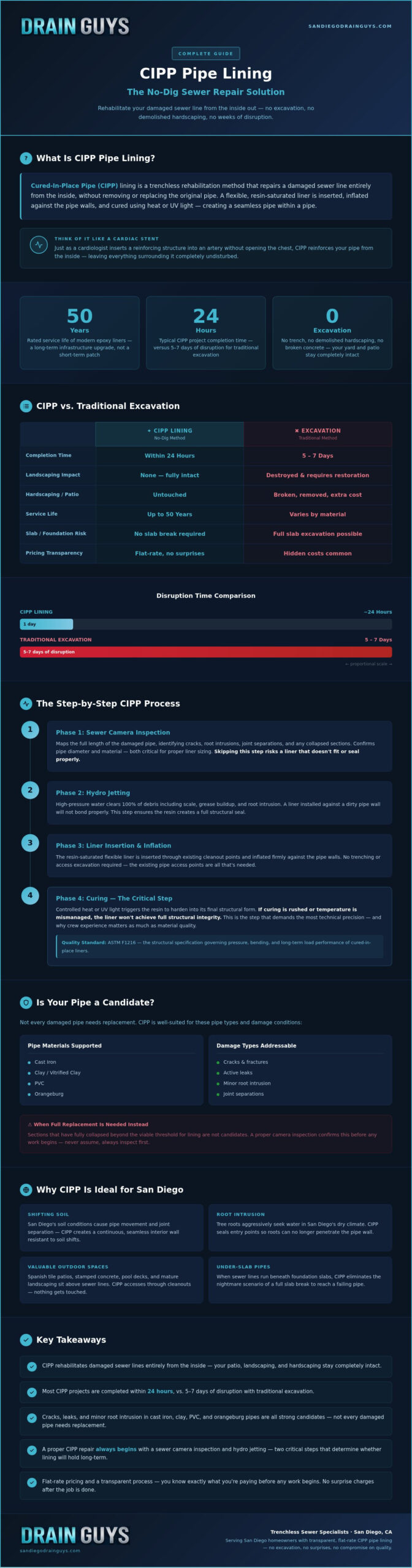
CIPP vs. Traditional Excavation: A Comparison
Most homeowners compare these two repair methods by looking at the quote on the page. That’s the wrong number to focus on. The real comparison happens when you add up what traditional excavation actually costs once the pipe is fixed and the crew drives away.
A conventional dig-and-replace job requires heavy equipment to break through concrete, remove soil, expose the pipe, install new sections, backfill, and compact the ground. The pipe work itself might be finished in a day or two. But the concrete that got jackhammered, the irrigation lines that got severed, and the mature plants that got removed? Those get handed to you as separate line items, or worse, as problems you’re expected to solve on your own. CIPP pipe lining sidesteps every one of those secondary costs because there’s nothing to restore. The surface never gets touched.
The time difference is equally significant. Traditional excavation typically disrupts a property for five to seven days. CIPP lining is almost always a single-day repair. For homeowners with families, rental properties, or home-based businesses, that gap in downtime isn’t a minor inconvenience; it’s a meaningful difference in how your life functions during the repair window.
There’s also an environmental argument that rarely gets discussed. Excavation generates significant soil displacement, concrete waste, and the carbon footprint of operating heavy machinery on-site. Trenchless repair requires no excavation equipment, produces no demolition debris, and leaves the surrounding soil structure completely undisturbed. For San Diego homeowners who’ve invested in drought-tolerant landscaping or native plant gardens, that matters.
One technical advantage of CIPP that new PVC pipe can’t replicate is the seamless, jointless finish. Traditional pipe replacement creates mechanical joints wherever pipe sections connect. Those joints are the points where root intrusion restarts and where ground movement causes future separation. A cured epoxy liner has no joints. It’s a single continuous structure from access point to access point, which removes the most common failure modes from the equation entirely.
Saving Your San Diego Hardscaping
Stamped concrete installation in San Diego runs into the thousands of dollars depending on square footage, and that’s before factoring in the cost of matching an existing pattern or color after a partial replacement. Pool decks present an even harder problem; in many cases, digging beneath them without causing structural damage to the deck itself is simply not feasible. Coastal lots with narrow side yards create another constraint, since there’s often no physical space to maneuver a backhoe. CIPP accesses the damaged section through existing cleanout points, so none of these obstacles become your problem.
Is CIPP Always Cheaper?
Honest answer: not always. When a pipe has fully collapsed over a long section, or when the host pipe is too structurally compromised to hold a liner against the wall, full replacement becomes the correct call. A thorough camera inspection is what separates those cases from the majority of residential repairs where lining is both viable and cost-effective. Factoring in the 50-year service life of a properly cured epoxy liner, the long-term return on a CIPP repair typically outperforms a jointed PVC replacement even when the upfront costs are similar. For a full breakdown of how these methods compare in San Diego’s specific infrastructure environment, our trenchless sewer repair San Diego guide walks through the decision framework in detail.
Is Your Property a Candidate for Pipe Lining?
The honest answer to this question depends on two things: what your pipe is made of, and how far the damage has progressed. CIPP pipe lining works across a wide range of pipe materials and damage types, but it isn’t a universal fix. Knowing where the boundaries are saves you from both unnecessary excavation and from a lining job that won’t hold.
The four pipe materials most commonly rehabilitated with CIPP are cast iron, clay, PVC, and orangeburg. Each has its own failure pattern. Cast iron corrodes and develops pinhole leaks over decades. Clay cracks under ground movement and allows root intrusion at every joint. PVC can shift and separate at connections when the soil beneath it settles. Orangeburg, the tar-paper composite pipe installed in mid-century homes, deteriorates from the inside out and eventually collapses under its own weight. All four are strong candidates for lining when the structural walls are still intact enough to hold a liner against them.
San Diego’s expansive clay soil adds a layer of complexity that most national guides don’t address. When clay soil absorbs moisture during the rainy season and then dries out through the summer, it contracts and expands in cycles. That repeated movement stresses buried pipes from the outside, accelerating joint separation and cracking. A jointed pipe replacement drops new mechanical connections directly into that same unstable soil. A cured epoxy liner, being seamless and jointless, distributes stress across its entire length rather than concentrating it at vulnerable connection points. In San Diego’s soil conditions specifically, that structural characteristic isn’t a minor advantage; it’s a meaningful reason why lining outperforms replacement over the long term.
The Root Intrusion Problem in San Diego
San Diego’s drought-resistant landscape plantings, including ficus, eucalyptus, and mature palms, have root systems that actively seek moisture. A leaking sewer joint is a reliable water source, and roots will find it. Once inside, they expand with the pipe’s flow and accelerate cracking. Chemical root foaming treatments slow re-growth, but they don’t seal the entry point. A cured liner eliminates the joint entirely, leaving no gap for roots to exploit. It’s the only repair method that removes the access point rather than just managing what grows through it.
When CIPP Isn’t the Right Choice
A pipe that has fully bellied, meaning a section has dropped below grade and created a low point where waste pools, can’t be corrected by lining. The liner conforms to the existing pipe shape, so a belly stays a belly. Similarly, a fully collapsed section has no interior wall to press the liner against. In both scenarios, pipe bursting is the appropriate trenchless alternative; it fractures the old pipe outward while simultaneously pulling a new pipe into position, with no excavation required.
This is exactly why the camera inspection isn’t optional. It’s the diagnostic step that tells you which solution actually fits your pipe, before any money changes hands on the repair itself. Schedule a sewer camera diagnostic with our team to get a clear picture of what you’re working with.
Why Choose San Diego Drain Guys for Your CIPP Project?
Locally owned and operating in San Diego since 2018, we built this company around a simple premise: homeowners dealing with sewer problems deserve straight answers, fair pricing, and a crew that treats their property with genuine respect. That’s not a marketing line. It’s the operational standard we hold every project to, from the first camera inspection through the final service restoration.
San Diego’s plumbing environment has its own set of rules. The city’s infrastructure codes, the permit requirements that vary by neighborhood, and the specific challenges that expansive clay soil creates for buried pipe systems are details a national franchise learns from a manual. We’ve been working in these conditions for years. That local knowledge shapes every recommendation we make, including when we tell a homeowner that lining is the right call and when we tell them it isn’t.
Our Transparent Pricing and Process
Flat-rate pricing isn’t a promotional offer. It’s how we operate on every job. Before any CIPP pipe lining work begins, you receive a complete, itemized quote that reflects the full scope of the repair. There are no hourly rates that balloon when the job runs long, no surprise charges for materials, and no separate invoices for permit handling. What you approve is what you pay.
Here's what a typical service call looks like from start to finish:
- Diagnostic inspection: A sewer camera assessment maps the damage and confirms whether lining is viable for your specific pipe layout.
- Written quote: You receive a flat-rate price covering hydro jetting, liner installation, curing, and the final camera verification pass.
- Permit coordination: We handle the paperwork. You don’t need to navigate the city’s permit office.
- One-day repair: In most residential cases, the full lining process is completed within a single day.
- Post-cure inspection: A second camera pass confirms the liner has seated correctly before we consider the job done.
On workmanship and materials, we stand behind what we install. For specific warranty terms applicable to your repair, we’ll walk you through exactly what’s covered during your consultation, because warranty language deserves a direct conversation, not fine print.
Get Started with a San Diego Sewer Expert
The right first step is a camera inspection. It’s the only way to know whether your pipe is a strong candidate for lining or whether a different trenchless approach fits better. Booking one doesn’t commit you to any repair work; it gives you the diagnostic clarity to make an informed decision.
If another contractor has already given you a quote for excavation, we’re glad to provide a second opinion. Bring the quote. We’ll review the camera findings, explain what we’re seeing in plain language, and tell you honestly whether lining is viable for your situation. No pressure. No upsell. Just a clear picture of your options from a team that knows San Diego’s soil, codes, and infrastructure from the ground up.
Contact San Diego Drain Guys to schedule your sewer camera diagnostic and get a flat-rate CIPP pipe lining quote from a locally owned team that’s been solving San Diego’s toughest sewer problems since 2018.
Your San Diego Sewer Line Doesn’t Have to Mean a Demolished Backyard
A failing pipe is stressful enough without adding weeks of excavation, destroyed hardscaping, and an unpredictable final bill on top of it. CIPP pipe lining changes that equation entirely. It’s a single-day repair, it leaves your property exactly as you found it, and the epoxy liner it installs is built to perform for decades without the joint failures that come back to haunt traditional replacements.
Three things set the right repair apart from the wrong one: an honest diagnostic before any work begins, a flat-rate price you can hold someone to, and a crew that actually knows San Diego’s soil and infrastructure. That’s what we bring to every job.
The first step costs you nothing but a conversation. Schedule your sewer camera inspection with San Diego Drain Guys and find out exactly what your pipe needs, with a clear, flat-rate quote and no pressure attached. Your property deserves a repair done right the first time.
Frequently Asked Questions About CIPP Pipe Lining
How long does CIPP pipe lining actually last?
A properly installed CIPP liner is rated for a service life of up to 50 years, provided the pipe was correctly prepped and the resin achieved full cure during installation. That longevity depends heavily on the quality of the hydro jetting prep, the resin formulation used, and whether the crew followed proper curing protocols. A liner installed against a dirty wall or under-cured won’t reach that benchmark regardless of what the spec sheet says.
Is CIPP lining safe for drinking water pipes?
CIPP pipe lining is used primarily on sewer and drain lines, not potable water supply pipes, and that’s the context this guide addresses. For sanitary sewer applications, cured epoxy liners are inert once fully hardened and don’t leach into the surrounding soil. If you have questions about a specific pipe application beyond sewer rehabilitation, that’s a conversation worth having directly with a licensed specialist before any work is authorized.
Will CIPP lining reduce the diameter of my sewer pipe?
Yes, but minimally. A standard residential liner adds roughly 6 to 12 millimeters to the interior wall, which slightly reduces the pipe’s internal diameter. In practice, this rarely affects flow capacity because the cured liner’s smooth interior surface actually improves flow efficiency compared to a corroded or root-roughened original pipe. A camera inspection will confirm whether your pipe’s existing diameter can accommodate a liner without creating a functional restriction.
Can CIPP lining be used to fix roots in my sewer line?
Yes, and it’s one of the strongest use cases for CIPP pipe lining specifically. Hydro jetting clears the root mass before the liner goes in, and the cured epoxy seals every joint and crack that roots previously exploited. Unlike chemical treatments that slow regrowth without closing the entry point, a seamless liner eliminates the gap entirely. There’s simply no joint left for roots to find, which is why lining outperforms other root management approaches over the long term.
How much does CIPP pipe lining cost in San Diego?
We don’t publish price ranges here because the variables involved, including pipe length, diameter, material, access point location, and the extent of damage, mean that a number pulled from a general guide rarely reflects what your specific repair actually costs. What we can tell you is that our pricing is flat-rate and fully itemized before any work begins. The most reliable way to get an accurate number is to schedule a camera inspection so the quote reflects your actual pipe, not an industry average.
What happens if my sewer pipe is already collapsed?
A fully collapsed pipe isn’t a candidate for CIPP lining because there’s no intact interior wall to press the liner against. In that scenario, pipe bursting is the appropriate trenchless alternative. It fractures the damaged pipe outward while simultaneously pulling a new pipe into position, all without excavation. A sewer camera inspection identifies collapsed sections before any repair method is recommended, which is exactly why that diagnostic step comes first on every job we take on.
How long will my water be turned off during the lining process?
Sewer service, not water supply, is temporarily suspended during a CIPP repair. In most residential projects, that window runs between four and eight hours depending on liner length and curing method. The majority of jobs we complete restore full sewer service the same day work begins. You’ll know the expected timeline before the crew starts, not after, because that’s information you need to plan your day around.
Do I need a permit for CIPP lining in San Diego County?
Permit requirements vary depending on the scope of work and the specific municipality within San Diego County. Some trenchless sewer repairs do require a permit, and skipping that step can create complications when you sell the property. We handle permit coordination as part of the job, so you don’t need to navigate the city’s permitting office on your own. It’s one less thing to manage during an already stressful repair process.