
It is 6:00 PM on a Tuesday when you notice the water in your shower isn’t just standing; it’s rising with a dark, foul-smelling liquid you didn’t put there. We understand the immediate panic that hits when you’re facing an emergency sewer backup in San Diego. It’s a high-stakes race against property damage, and the confusion over municipal codes only adds to the stress. You’re likely worried about whether you’re responsible for the repair or if the city will step in, especially with the 6% wastewater rate increase that took effect in January 2026.
We’re here to help you regain control. In this guide, you’ll learn exactly how to stop an active backup and navigate the specific lateral rules that dictate who pays for what in our city. We’ll also explore why 40% of local overflows are caused by root intrusions and how modern, no-dig repairs can fix the problem without destroying your landscaping. This walkthrough covers everything from the six-month claim deadline to the latest trenchless technology, ensuring you have a clear, step-by-step plan to resolve this crisis and protect your home.
Key Takeaways
- Stop all water usage immediately and clear the area around your main cleanout to mitigate interior flooding during a plumbing crisis.
- Identify the exact source of an emergency sewer backup san diego with a high-definition camera inspection before committing to any invasive repairs.
- Recognize how San Diego’s legacy clay pipes and aggressive local root systems create unique infrastructure vulnerabilities for homeowners.
- Opt for trenchless CIPP lining to resolve an emergency sewer backup san diego without the high cost of destroying your yard or driveway.
- Understand your specific financial responsibility under Municipal Code 64.0403 to effectively manage an emergency sewer backup san diego and navigate city claims.
Immediate Steps: What to Do During a Sewer Backup in San Diego
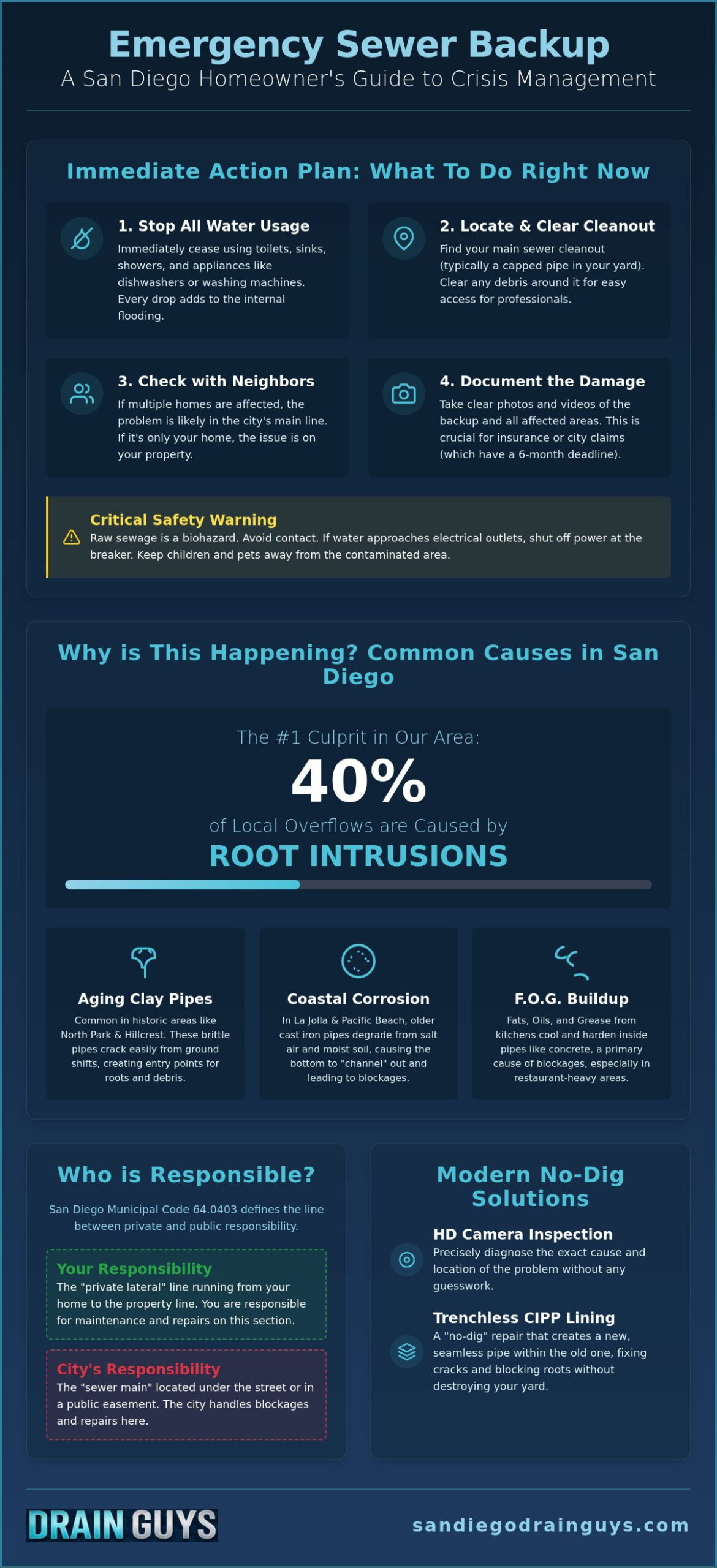
Facing an emergency sewer backup in San Diego is a high-stress event that requires a disciplined response. The moment you notice floor drains gurgling or sewage surfacing in your tubs, your primary goal is to limit the volume of the spill. Stop all water usage immediately. This means no flushing toilets, running the dishwasher, or using the washing machine. Any water you send down the drain right now will only contribute to the flooding inside your home. This situation is essentially a Sanitary sewer overflow (SSO) occurring within your private property, and every gallon saved prevents further structural damage.
Once the water is off, locate your main sewer cleanout. In most San Diego neighborhoods, this is a white PVC or black ABS pipe with a threaded cap located in your front yard or near the foundation. Clearing away brush or debris from this access point saves valuable time when help arrives. While you’re outside, check with your neighbors. If multiple homes on your block are experiencing similar backups, the problem is likely a blockage in the City of San Diego’s main line rather than your private lateral. If it’s just your home, the issue is localized to your property’s plumbing.
Documentation is your best friend during the recovery process. Use your phone to take high-quality photos and videos of the backup, the affected flooring, and any damaged personal property. San Diego municipal rules are strict; if you intend to file a claim for damages against the city, you must submit it through the Public Liability Claims Portal within six months of the incident. Having a clear visual record of the “emergency sewer backup san diego” event will be the cornerstone of your insurance or city reimbursement claim.
Critical Safety Precautions
Raw sewage is a biohazard that contains harmful bacteria and pathogens. Avoid direct contact with the wastewater and keep children and pets away from the area. If the water level is rising near electrical outlets or appliances, head to your breaker box and shut off power to the affected rooms. If you must enter the zone to retrieve essential items, wear heavy-duty rubber boots and gloves to protect your skin from contamination.
Who to Call First
If you suspect the blockage is in the city main, contact the City of San Diego Public Utilities Department immediately. They’ll dispatch a crew to check the public side of the system. However, if the backup is confined to your property, you’ll need a specialized drain expert to perform a sewer camera inspection. This diagnostic step is the only way to see if the crisis is caused by a simple clog or a structural failure like a pipe collapse. Finally, call your homeowners insurance provider to open a claim file while the details are still fresh.
In addition to plumbing repairs, you must also prioritize professional water mitigation; experts like DK Production provide the specialized restoration services necessary to handle hazardous wastewater and protect your property’s structural integrity.
Common Causes of Sewer Emergencies in San Diego Neighborhoods
Understanding why an emergency sewer backup san diego occurs is the first step toward preventing the next one. Our city’s unique geography and history create specific plumbing challenges that you won’t find in newer developments. From the historic bungalows of North Park to the coastal cliffs of La Jolla, the cause of your backup is often tied directly to your zip code. Approximately 40% of sewer overflows in our area are caused by root intrusions, but that’s only part of the story.
In neighborhoods like North Park and Hillcrest, many homes still rely on original vitrified clay pipes. These legacy lines were standard 60 to 100 years ago. While durable in some respects, clay is incredibly brittle. It doesn’t handle ground movement well. As the soil shifts, these pipes crack or offset, creating a perfect entry point for debris and moisture-seeking roots. Once a crack forms, an emergency sewer backup san diego is often just a matter of time.
If you live in La Jolla or Pacific Beach, your primary enemy is often coastal corrosion. Older cast iron lines in these areas face constant exposure to salt air and moist, salty soil. Over decades, this causes channeling where the bottom of the pipe literally rots away. This leads to frequent clogs and eventual structural failure. Meanwhile, in our vibrant restaurant districts, Fats, Oils, and Grease (FOG) remain the leading cause of commercial backups. When grease cools, it hardens like concrete inside the line, catching every other piece of waste that follows.
Aging Infrastructure in Historic Districts
San Diego’s canyon-heavy topography adds another layer of risk. Many older tracts used Orangeburg pipe, a material made of wood pulp and tar that eventually flattens under the weight of the earth. When soil settles along canyon rims, it creates bellies or low spots in the line. Standing water collects in these dips, eventually leading to an emergency sewer backup san diego in local homes. You can often spot these issues early by watching for slow drains or listening for gurgling sounds in your lower-level fixtures.
Vegetation Hazards Specific to Southern California
Southern California’s climate is beautiful, but it’s tough on plumbing. The Ficus Factor is a real phenomenon here. Ficus and Palm trees have aggressive, moisture-seeking root systems. During San Diego’s frequent drought cycles, these roots hunt for any source of water, and your sewer lateral is a prime target. They enter through tiny cracks and grow into massive root balls that completely obstruct flow. We often recommend hydro jetting services in San Diego to clear these stubborn intrusions without damaging the pipe structure itself. If you’re noticing recurring clogs, it’s a good idea to schedule a professional inspection to see what’s happening underground before a crisis hits.
Professional Diagnostics: The Power of a Sewer Camera Inspection
When the gurgling starts and floors begin to flood, the first instinct is speed. However, rushing into a fix without visual confirmation is a gamble you don’t need to take. A sewer camera inspection utilizes a high-definition, waterproof lens on a flexible rod to navigate your lateral line. This step is essential during an emergency sewer backup san diego because it allows us to see the internal condition of your pipes in real-time, providing a surgical map of the obstruction rather than relying on guesswork.
A “sewer scope” is non-negotiable for any modern plumbing professional. It eliminates the expensive trial-and-error often associated with older San Diego homes. For instance, a backup could be a simple mass of paper, or it could be a structural collapse caused by shifting canyon soil. Treating a major pipe failure with a standard drain snake can actually cause further damage. By seeing the issue on a monitor, we can determine the fastest resolution for an emergency sewer backup san diego without resorting to traditional, destructive excavation.
Beyond the immediate fix, this footage serves as a vital legal and financial tool. As we’ve discussed, documenting the cause of the failure is necessary for insurance or city reimbursement claims. If the camera proves the blockage is located on the city’s side of the property line, this recorded evidence is your primary leverage. We provide a copy of the recording, ensuring you have a permanent record of your pipe’s health. This level of transparency is critical when managing the fallout of an emergency sewer backup san diego.
What a Sewer Scope Reveals
The camera reveals specific failures like offsets, where pipe sections have separated, and bellies, which are low spots where debris pools. We also pinpoint the exact depth and location of faults from above ground using signal transmitters. Learn more about our sewer scope near me in San Diego.
The Diagnostic Process
The process is clean and efficient. We typically insert the camera through an exterior cleanout or a temporarily pulled toilet if no other access is available. Watching the monitor with us ensures you understand the logic behind our advice. This step is the foundation of our “No-Dig” philosophy, allowing us to fix the pipe without ever touching your lawn or driveway.
Emergency Solutions: Hydro Jetting vs. Trenchless Repair
Once our camera inspection identifies the culprit, we move into the resolution phase. Most homeowners facing an emergency sewer backup in San Diego assume they have to choose between a temporary snake service or a massive trench through their front yard. Modern technology has changed that. We focus on solutions that prioritize the structural integrity of your pipes while protecting your property’s aesthetic value. Whether we’re scrubbing the line clean or installing a brand-new pipe from the inside, our goal is a fast, reliable recovery.
Hydro jetting is our first line of defense for severe blockages that haven’t yet destroyed the pipe. This process uses specialized nozzles to blast water at 4,000 PSI through the line. It doesn’t just poke a hole in a clog; it scours the pipe walls clean. For more significant damage, such as a collapsed section or heavy root intrusion in old clay, we look toward trenchless repairs. Methods like pipe bursting allow us to pull a new, high-density polyethylene (HDPE) pipe through the old one. This replaces the line completely with only two small access points, saving your driveway from the jackhammer.
When Hydro Jetting is the Best Fix
We recommend hydro jetting when the pipe structure is still sound but the flow is restricted by years of grease or heavy root masses. It’s particularly effective for San Diego’s commercial kitchens and older residential lines where traditional cabling falls short. Hydro jetting is the gold standard for non-invasive cleaning.
Trenchless Sewer Repair: The Long-Term Emergency Cure
If the camera reveals cracks or offsets, a simple cleaning won’t prevent the next emergency sewer backup in San Diego. This is where trenchless sewer repair in San Diego becomes the smartest investment. The most common method we use is CIPP, or Cured-In-Place Pipe lining. We insert an epoxy-saturated liner into the damaged pipe, which then hardens into a seamless, jointless “pipe within a pipe.”
The benefits of this “No-Dig” philosophy are financial as well as practical. While traditional excavation requires you to pay for the repair plus the cost of restoring your landscaping and hardscaping, trenchless avoids those secondary expenses. In San Diego, restoring a damaged yard or driveway can easily cost between $3,000 and $8,000. By lining the pipe instead of digging it up, you keep your yard intact and ensure roots can never penetrate the line again. It’s a permanent fix that provides immediate peace of mind. If you’re ready to fix your line without the mess, contact our team for a trenchless consultation today.
Navigating San Diego’s Sewer Lateral Responsibility & Costs
One of the most stressful aspects of an emergency sewer backup in San Diego is the sudden financial uncertainty. You might assume the city is responsible for any pipe located under the street or sidewalk, but local regulations are more specific than that. According to the City of San Diego Municipal Code 64.0403, the property owner is responsible for the maintenance and repair of the entire sewer lateral. This responsibility extends from your home all the way to the point where your pipe connects with the City’s sewer main, even if that connection point is located in the public right-of-way.
Understanding the “Property Line” rule is vital for your budget. While you own the pipe, the city will only intervene in very specific circumstances. For instance, if you have lost all sewer service and the issue is found to be in the public right-of-way, the city might perform the repair, provided the failure isn’t due to a lack of routine maintenance. This is why we emphasize the importance of a professional camera inspection. It provides the definitive proof required to show exactly where the blockage or break is located, which is the only way to potentially shift the financial burden to the city.
We believe in transparency, especially during a crisis. Many companies charge fluctuating hourly “emergency” rates that can lead to sticker shock when the final bill arrives. We utilize a flat-rate pricing model instead. This approach ensures you know the cost upfront before any work begins. It removes the anxiety of a ticking clock and allows us to focus entirely on solving your emergency sewer backup in San Diego with the highest level of care and precision.
Homeowner vs. City Responsibility
The default position in San Diego is that the homeowner pays for the lateral. However, exceptions do exist. If the city main itself is blocked, affecting multiple homes on your street, the city handles the clearing and cleanup. There are also rare cases involving damage from city-owned trees. Proving these exceptions requires clear, high-definition video evidence. Our team acts as your advocate, providing the documentation you need to file a claim with the Risk Management Department if the fault lies with the municipal system.
Estimating the Cost of Relief
The total investment for a repair depends on several technical factors. The depth of the pipe, the total length of the run, and the specific repair method chosen all influence the final number. For example, a shallow line in a sandy coastal yard is often simpler to access than a deep line buried under a concrete driveway in a canyon-side neighborhood. We prioritize trenchless solutions because they eliminate the massive secondary costs of rebuilding your property’s hardscaping.
Investing in professional drain cleaning in San Diego is a proactive way to avoid these high-stakes emergencies entirely. Regular maintenance keeps your pipes clear and allows for early detection of structural issues. If you’re currently in the middle of a crisis, we’re ready to provide the clarity you need. Contact San Diego Drain Guys for a transparent, flat-rate emergency quote today.
Restoring Your Home and Your Peace of Mind
Facing an emergency sewer backup in San Diego is undeniably stressful, but you now have the tools to handle it with confidence. By taking immediate action to stop water usage and utilizing high-definition camera diagnostics, you can identify the exact cause of the failure without any guesswork. Whether the issue stems from aging clay pipes or aggressive root systems, modern trenchless technology allows for a permanent fix that preserves both your landscaping and your budget.
We’ve been serving our neighbors as local experts since 2018, and we’re committed to providing the transparency you deserve during a plumbing crisis. Our flat-rate pricing model means you’ll never have to worry about hidden surcharges or unexpected hourly fees. We specialize in no-dig solutions to ensure your home is protected for the long haul while respecting your privacy and your property; for readers looking to further safeguard their premises, you can check out Security Guard Pros for expert security services in the area.
Don’t let a drainage disaster disrupt your life any longer. Get 24/7 Emergency Sewer Relief in San Diego – Call the Drain Guys Now. We’re ready to help you move from crisis to a state of informed confidence with reliable, expert care.
Frequently Asked Questions
Does the City of San Diego pay for sewer lateral repairs?
The City of San Diego typically does not pay for repairs to your private sewer lateral. Property owners are responsible for the entire line from the home to the connection at the public main, even if that connection is under the street. You can only seek reimbursement if the city main is confirmed to be the source of the problem. In those cases, you must file a claim through the Public Liability Claims Portal within six months.
What is the most common cause of sewer backups in San Diego?
Root intrusion is the primary culprit, causing approximately 40% of all sewer overflows in our region. Local vegetation, particularly Ficus and Palm trees, aggressively hunts for moisture in aging clay and cast iron pipes. This often leads to a sudden emergency sewer backup in San Diego homes during drought cycles. Soil movement in our canyon-heavy geography also causes brittle pipes to crack, creating easy entry points for these roots.
How much does an emergency sewer camera inspection cost in San Diego?
The cost for a professional diagnostic varies based on the complexity of the access and the urgency of the situation. We recommend choosing a provider that offers transparent, flat-rate pricing rather than hourly fees. This ensures you don’t face hidden surcharges or financial uncertainty while dealing with an emergency sewer backup in San Diego. A flat fee allows the technician to focus on finding the exact problem without rushing the process.
Can I use chemical drain cleaners to fix a main sewer backup?
Chemical cleaners are ineffective for main line issues and should be avoided entirely. These products use caustic reactions that generate intense heat, which can warp modern PVC or further corrode fragile, older cast iron lines. They are also dangerous for plumbers who may need to work on the line later. These liquids won’t dissolve a massive root ball or fix a structural offset in your pipe.
How long does a trenchless sewer repair take to complete?
A trenchless repair typically takes about one day to finish from start to finish. Because we don’t have to dig long, destructive trenches through your yard, the actual lining or pipe-bursting process is very efficient. Most of the time is spent on the preparation and the curing process for the new liner. You’ll avoid the weeks of landscape reconstruction and driveway repairs that follow traditional excavation methods.
What neighborhoods in San Diego are most at risk for sewer failure?
Neighborhoods with homes built before 1970 face the greatest risk of pipe failure. North Park, Hillcrest, and Kensington are known for aging clay pipes, while coastal areas like La Jolla and Pacific Beach often deal with corroded cast iron. These historic districts have infrastructure that is reaching the end of its functional lifespan. Canyon-side properties also face unique risks due to soil movement and settling that causes pipe bellies.
Does homeowners insurance cover sewage backup cleanup and repair?
Most basic homeowners insurance policies don’t cover sewer backups automatically. You usually need a specific “water back-up” rider or endorsement for coverage to apply to cleanup and repairs. It’s best to review your policy details or contact your agent now to confirm your status. If you believe the city is at fault, remember that you only have six months from the date of the incident to file a formal claim.
What is the difference between a sewer cleanout and a sewer main?
A cleanout is a capped pipe on your property that gives us access to your lateral for cleaning or inspections. The sewer main is the large, city-owned pipe under the street that collects waste from the entire neighborhood. Think of the cleanout as your private doorway to the public system. Your legal responsibility ends exactly where your lateral meets that public main, regardless of where your property line sits on the map.