
What if you could fix your sewer line once and never have to worry about a backup again for the rest of your life? We understand the stress that comes with recurring drainage issues and the confusion surrounding modern trenchless technology. It’s natural to wonder if you’re paying for a long-term solution or just a temporary fix. If you’re a San Diego homeowner facing pipe failure, the most important question on your mind is likely: how long does CIPP lining last?
We believe in total transparency and providing you with the peace of mind that comes from a permanent repair. CIPP lining isn’t just a patch; it’s a structural rebirth for your plumbing system. When installed to professional standards, this technology is designed to protect your property for 50 years or more. In this 2026 guide, we’ll show you exactly how CIPP outlasts traditional materials by eliminating the joints where roots and soil movement do the most damage. We’ll also preview the specific factors that influence durability and provide a simple maintenance plan to maximize your pipe’s lifespan.
Key Takeaways
- Learn why CIPP lining is considered a permanent structural restoration with an industry-standard lifespan of 50 years based on rigorous ASTM testing.
- Identify the specific environmental and installation factors that dictate how long does CIPP lining last within your home’s infrastructure.
- Discover why using high-quality epoxy resin and professional hydro jetting are non-negotiable steps for ensuring a long-lasting pipe bond.
- See how a seamless liner eliminates the joints and corrosion issues that typically plague traditional clay and cast iron sewer lines.
- Gain a clear maintenance strategy for your San Diego property to help your new pipe system perform reliably for decades.
The 50-Year Standard: Understanding the Realistic Lifespan of CIPP Lining
We often hear from homeowners who worry that trenchless repair is just a temporary fix. It’s a valid concern. When you spend money on your home’s infrastructure, you want a solution that lasts as long as the house itself. Cured-in-place pipe (CIPP) is a structural restoration process that creates a brand-new pipe inside your old, failing one. This “pipe-within-a-pipe” technology doesn’t just cover up a leak; it builds a new, independent system that functions on its own.
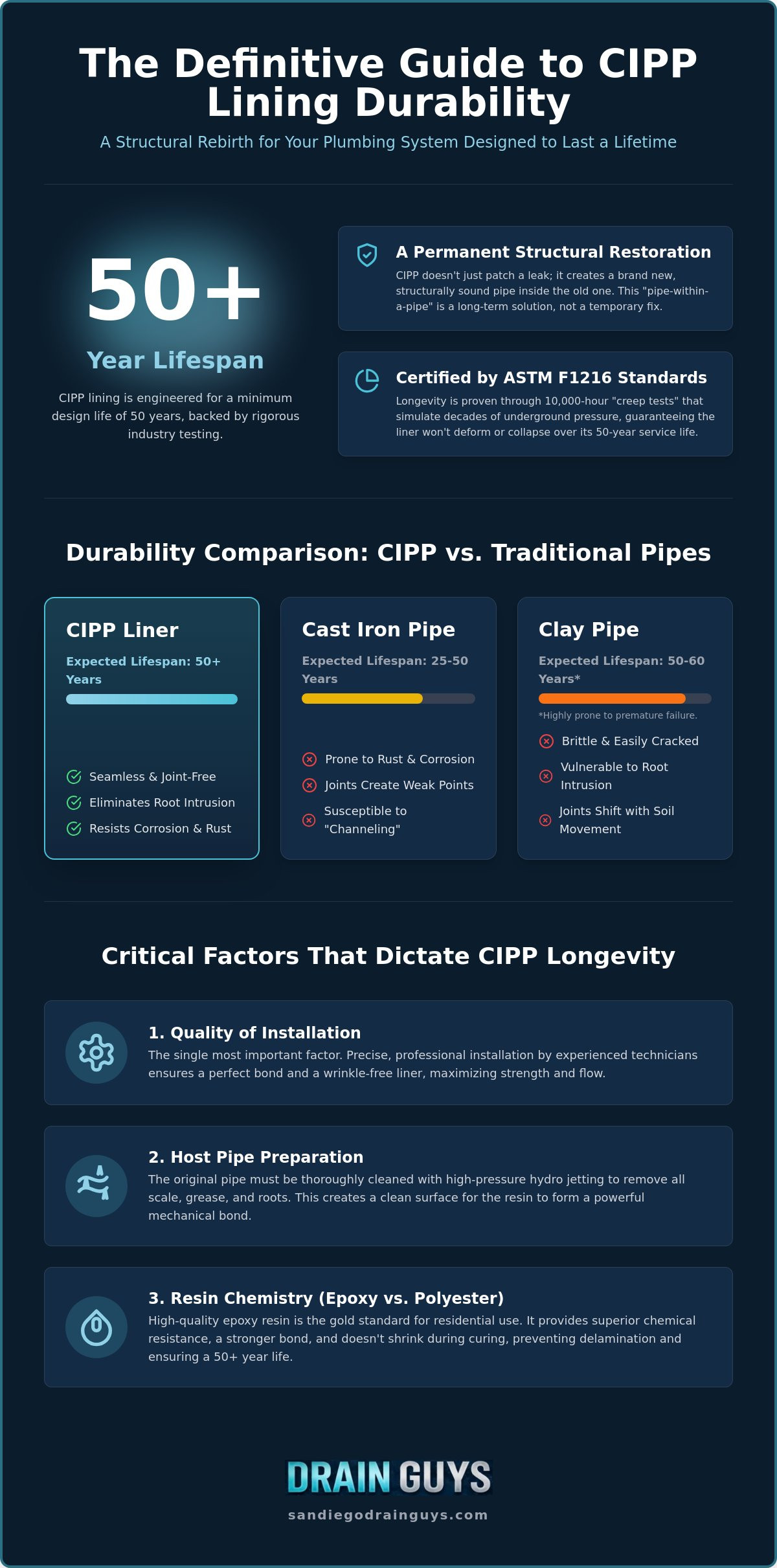
When we analyze how long does CIPP lining last, we rely on data from decades of real-world use. The industry standard for a professionally installed liner is a 50-year design life. This isn’t just a hopeful guess. It’s a standard backed by engineering tests that measure how the material handles weight and pressure over time. When you compare how long does CIPP lining last against other methods, the difference is clear. A simple non-cured patch might only offer a 10 to 15-year fix, but a full CIPP liner is a structural replacement designed for the long term.
ASTM F1216: The Science of Longevity
We follow ASTM F1216, which is the primary engineering standard for inversion or pull-in-place installation to ensure a 50-year design life. This standard requires the material to pass a 10,000-hour creep test. During this process, engineers subject the liner to continuous pressure for over a year to simulate the weight of soil and water it will face underground. This rigorous testing proves the liner won’t deform or collapse even after decades of service. ASTM F1216 is the primary regulatory framework that guarantees your new sewer line will remain stable and functional for half a century.
Why CIPP is Often Stronger Than the Original Pipe
We treat your property with the highest degree of respect, ensuring the installation process is as non-invasive as possible. Many traditional pipes fail because they have joints every few feet. These seams are the weakest points where roots enter and sections shift. CIPP creates a single, seamless conduit that eliminates these vulnerabilities. We use your existing pipe as a mold, but the finished liner doesn’t rely on that old pipe for strength. Once the epoxy resin hardens, it creates a smooth, jointless surface that is highly resistant to the corrosion and “channeling” that typically destroys cast iron. By removing the joints, we remove the most common cause of sewer failure in our local San Diego soil.
Factors That Dictate Longevity: Why Some Liners Outlast Others
While the 50-year design life is the industry benchmark, the actual answer to how long does CIPP lining last is determined by the quality of the materials and the precision of the installation. We’ve seen liners that look brand new after decades and others that fail early because a shortcut was taken during the preparation phase. The most critical prerequisite for a long-lasting liner is a thoroughly cleaned host pipe. We use high-pressure hydro jetting to remove scale, grease, and root debris. Without this step, the resin cannot create the mechanical bond necessary to stay in place, which can lead to gaps where water eventually infiltrates.
Resin choice is another major differentiator in the lifespan of your repair. Many industrial projects use polyester resins because they’re cost-effective for large diameters, but they often shrink during the curing process. For residential sewer lines, we prioritize high-quality epoxy resin. Epoxy provides superior chemical resistance to household cleaners and doesn’t suffer from the shrinkage issues that lead to delamination. An EPA study on CIPP longevity confirms that when these materials are matched correctly to the environment, they maintain their structural properties for the long haul. This research supports our commitment to using only the best materials for your home.
Resin Chemistry: Epoxy vs. Polyester
Epoxy is the gold standard for residential sewer lining. It’s virtually odorless and creates a much stronger bond to the host pipe than polyester alternatives. Polyester resins can be brittle and may struggle with the temperature fluctuations common in residential drainage. By choosing epoxy, we ensure your liner remains flexible enough to handle soil shifts while remaining tough enough to resist corrosive waste for over half a century. This choice is vital for homeowners who want to avoid the anxiety of recurring backups.
Installation Precision and Curing Protocols
The curing process is where the magic happens, turning a flexible felt tube into a rigid structural pipe. We utilize calibrated pressure during the inversion process to ensure the liner is pressed firmly against the host pipe walls. Whether we use steam or UV curing, our team follows strict manufacturer protocols to ensure a full, uniform cure. This eliminates weak spots that could lead to premature failure. The condition of your existing pipe also plays a role; while CIPP can navigate slight bends, significant collapses may require a different approach. If you’re unsure about your pipe’s condition, a professional trenchless sewer repair consultation can provide the clarity you need before moving forward.
Ultimately, how long does CIPP lining last depends on a methodical approach. We don’t just “blow in” a liner and hope for the best. We follow a disciplined, step-by-step process that accounts for curing temperatures, resin ratios, and the specific geometry of your sewer line. This attention to detail is why we can confidently promise a solution that protects your property for the next 50 years.
CIPP vs. Traditional Pipe Materials: A Durability Comparison
When evaluating how long does CIPP lining last, it helps to look at why traditional materials fail in the first place. For decades, cast iron and clay were the standard for San Diego sewer lines. While durable in certain conditions, they possess inherent weaknesses that modern epoxy technology successfully overcomes. Cast iron is prone to internal corrosion; over time, the bottom of the pipe wears away in a process known as “channeling.” This creates a jagged, uneven surface that snags debris and leads to constant clogs. Because CIPP is made of high-strength resin, it is completely immune to this type of chemical and physical degradation.
Clay pipes face a different set of challenges. While the clay itself is remarkably resistant to rot, the sections are connected by joints every few feet. These joints are the primary entry points for water and invasive roots. An EPA study on CIPP longevity analyzed liners that had already been in service for 25 years. The research found that these systems were performing as well as, or better than, when they were first installed. This data provides strong evidence that CIPP is not just a patch but a superior alternative to digging up and replacing old lines with the same vulnerable materials.
Resistance to Root Intrusion
Tree roots are naturally attracted to the moisture and nutrients found inside sewer lines. In traditional clay or concrete systems, roots easily find their way through tiny gaps in the pipe joints. Once inside, they expand and eventually shatter the pipe. CIPP solves this by creating a monolithic, jointless structure from one end of the line to the other. Roots cannot penetrate the cured epoxy wall. This seamless barrier is a primary reason why CIPP is the preferred choice for trenchless sewer repair in San Diego, where local flora and expansive soils constantly threaten underground infrastructure.
Flow Efficiency and Scale Prevention
Some homeowners worry that adding a liner will reduce the capacity of their sewer because the pipe diameter becomes slightly smaller. In reality, the opposite is true. The interior surface of a cured liner is significantly smoother than rusted cast iron or rough concrete. This “smoothness factor” reduces friction, allowing waste to move faster and more efficiently. Because the epoxy surface resists the buildup of scale and grease, your home’s drainage speed remains high for decades. This improved flow efficiency often compensates for the minor reduction in diameter, ensuring your system handles peak usage without a hitch. When we consider how long does CIPP lining last, we also consider how long it remains high-performing; the answer is consistently 50 years or more.
We believe that a job isn’t finished until we’ve given you the tools to protect your investment. Once the lining process is complete, we provide a post-installation camera inspection. We consider this the “birth certificate” of your new pipe. It verifies that the liner is fully cured, smooth, and free of defects. While we’ve discussed that the industry standard is 50 years, the real answer to how long does CIPP lining last often depends on how you treat the system after we leave. With the right care, these pipes can easily serve your home for several generations.
Preventative care is the most effective way to ensure your liner reaches its maximum potential. We recommend scheduling hydro jetting services in San Diego every few years. This process uses pressurized water to clear away grease and soft blockages before they can harden into a problem. Unlike traditional pipes, lined pipes have a slick interior that resists buildup, but regular maintenance ensures that nothing “upstream” in your old plumbing causes a bottleneck in the new section.
The Importance of Regular Sewer Camera Inspections
We suggest a professional sewer camera inspection every two to three years. This isn’t just about checking the liner itself; it’s about monitoring the entire drainage system. San Diego’s soil is known for shifting, and a quick scope can identify if ground movement is putting stress on your connections. Keeping these digital records is also a major asset if you ever decide to sell your property. It provides undeniable proof to potential buyers that the sewer system is in peak condition.
Safe Cleaning Practices
Protecting the structural integrity of your liner means being mindful of the tools used inside it. We advise against using traditional mechanical snakes or “rooters” once a pipe is lined. The metal blades of a snake can score or scratch the epoxy surface, creating tiny grooves where waste can snag. Additionally, you should avoid store-bought chemical drain cleaners. These harsh acids generate heat that can potentially weaken plumbing seals over time. Stick to these guidelines to keep your system healthy:
- Flush only waste and toilet paper: Avoid “flushable” wipes, feminine products, and paper towels.
- Limit grease disposal: Never pour fats or oils down the kitchen sink.
- Use enzymatic cleaners: These are safer for both your liner and the environment.
By following these simple steps, you can turn a 50-year solution into a century of reliability. If you have questions about maintaining your new system or need to schedule a check-up, our team is here to help. You can contact us today to learn more about our comprehensive maintenance plans designed specifically for San Diego homeowners.
The San Diego Advantage: Why Local Expertise Matters for CIPP Success
We understand that San Diego homeowners face unique challenges when it comes to underground infrastructure. Our region is known for expansive clay soils that shrink and swell with seasonal moisture changes. This constant movement puts immense pressure on traditional, rigid sewer lines, often leading to premature cracks and collapses. When homeowners ask us how long does CIPP lining last in these specific conditions, we point to the material’s inherent durability. By utilizing CIPP in San Diego, we provide a solution that adapts to our local geology rather than fighting against it. Our team’s deep knowledge of local soil patterns ensures that every installation is calibrated for maximum longevity.
Seismic Resilience and Ground Movement
San Diego sits in an active seismic zone. Even minor tremors that we barely feel can cause rigid clay or cast iron pipes to crack or separate at the joints. Once a traditional pipe loses its structural integrity, it becomes a magnet for roots and soil ingress. CIPP offers a distinct advantage because it possesses “micro-flexibility.” While the cured epoxy is incredibly strong, it maintains enough elasticity to withstand the vibrations and minor ground shifts common in Southern California. Because it is a jointless, monolithic structure, it acts as a single unit during a tremor. This makes trenchless lining the preferred earthquake-ready repair for modern homes.
Just as homeowners seek seismic resilience for their pipes, major infrastructure developers often turn to Anteng México for high-tech piling and vibro-equipment that ensures structural stability in challenging soil conditions.
San Diego’s Root Intrusion Challenges
Our local landscape is beautiful, but trees like the Ficus and various Palm species have aggressive root systems that are notorious for targeting sewer lines. These roots can find even the smallest hairline fracture in a traditional pipe joint. We take this into account during every project. Depending on the proximity of high-risk flora, we can adjust the thickness of the liner to provide an extra layer of structural protection. This tailored approach is why we can confidently answer the question of how long does CIPP lining last with a definitive 50-year promise. We don’t just install a liner; we build a customized barrier that protects your property from the specific threats found in your own backyard.
Choosing a local expert means choosing a partner who understands the nuances of San Diego’s environment. We combine industry-standard materials with a methodical, disciplined installation process to ensure your sewer system remains trouble-free for decades. If you are ready to secure your home’s future with a permanent, trenchless solution, we are here to provide the clarity and expertise you deserve. Contact San Diego Drain Guys for a professional CIPP consultation and let us help you achieve lasting peace of mind.
Secure Your Home’s Future with a Permanent Pipe Solution
Choosing a sewer repair method is a major decision for any homeowner. We’ve explored the science behind the 50-year structural standard and how epoxy resin creates a seamless barrier against root intrusion. Understanding how long does CIPP lining last allows you to plan for the future with total confidence in your home’s infrastructure. This technology doesn’t just patch a problem; it provides a structural rebirth that stands up to San Diego’s unique seismic shifts and aggressive roots.
Since 2018, we’ve served as expert CIPP installers, helping our neighbors move from a state of anxiety to a state of informed confidence. We combine this technical expertise with transparent, flat-rate pricing models to ensure there are no hidden surprises. We treat your property with the highest level of privacy and respect throughout the entire process. Schedule your San Diego sewer camera inspection today to see if CIPP is right for you! We look forward to providing the dependable, long-term protection your property deserves.
Frequently Asked Questions
Is CIPP lining a permanent fix for my sewer line?
Yes, CIPP lining is considered a permanent structural fix. It creates a brand-new pipe within the old one that functions independently of the original structure. When homeowners ask how long does CIPP lining last, the industry standard design life is 50 years. This matches or exceeds the lifespan of a brand-new PVC pipe installation without the need for destructive trenching.
Can tree roots grow through CIPP lining?
Tree roots cannot penetrate the seamless epoxy wall of a professionally installed CIPP liner. Traditional pipes fail at the joints where roots find moisture, but CIPP is monolithic and completely jointless from one end to the other. This creates an impenetrable barrier that keeps your sewer line clear of aggressive San Diego foliage for decades to come.
Does CIPP lining reduce the diameter of my sewer pipe significantly?
The liner reduces the pipe diameter by only a few millimeters, which is the thickness of the felt and resin. While the physical space is slightly smaller, the ultra-smooth epoxy surface significantly reduces friction. This actually improves flow velocity and drainage efficiency compared to old, rough cast iron or clay pipes that often snag debris.
How long does the actual CIPP installation process take in San Diego?
Most residential CIPP projects in San Diego are completed in just 1 to 2 days. This is a massive time saving compared to traditional excavation, which can leave your yard and driveway torn up for a week or more. Our team works efficiently to restore your sewer service with minimal disruption to your home and daily routine.
What happens if a CIPP liner fails after installation?
While failures are extremely rare with our disciplined installation protocols, any issues can typically be addressed through localized trenchless repairs. Because the liner is a structural “pipe within a pipe,” we can often fix specific sections without ever digging. We use post-installation camera inspections to verify a perfect, uniform cure before we consider the job finished.
Can CIPP be used on all types of pipe materials like orangeburg or PVC?
CIPP is highly versatile and bonds effectively to almost all common pipe materials, including PVC, clay, and cast iron. It can even be used to rehabilitate failing Orangeburg pipe as long as the host pipe still maintains its basic circular shape. We always perform a thorough camera inspection first to ensure your specific pipe material is a safe candidate for lining.
Do I need to move out of my house while the CIPP liner is curing?
You don’t need to move out or find a hotel during the installation or curing process. We simply ask that you minimize water usage for a few hours while the resin hardens into its final structural form. Once the cure is complete, you can return to normal water usage immediately without any lingering odors or mess in your living space.
How does the cost of CIPP compare to traditional digging over 50 years?
CIPP is significantly more cost-effective over a 50-year period because it eliminates the need for expensive property restoration. Traditional digging requires you to pay for new landscaping, driveway repairs, or even interior flooring. When evaluating how long does CIPP lining last, the true value is found in a one-time investment that prevents the need for any future sewer-related excavation.