
That low price you saw online for a new unit likely doesn’t account for the technical reality of living in Southern California. Between strict seismic strapping requirements and the high mineral content in our local supply, finding out exactly how much to replace a water heater in san diego involves more than just looking at a sticker on a tank. It’s stressful to deal with a sudden loss of hot water; it’s even worse to worry that you’re overpaying for labor or missing a critical safety permit during an emergency repair.
We understand that you need a reliable, long term solution that keeps your home up to code without any financial surprises. This guide provides a clear look at the local regulations, hardware options, and hidden factors that determine the real cost of a replacement in 2026. We will walk you through the impact of the latest Title 24 energy standards, the necessity of the $114.66 city permit fee, and why San Diego’s “very hard” water means your choice of hardware matters more than ever for your peace of mind.
Key Takeaways
- Identify how your household size and fuel source choices, such as gas or high-efficiency heat pumps, directly influence your total investment.
- Evaluate the long-term value of tankless systems versus traditional units, especially regarding space-saving benefits for San Diego condos and ADUs.
- Ensure your home meets 2026 California Title 24 standards and mandatory seismic safety requirements to avoid compliance issues.
- Learn how San Diego’s specific water chemistry causes mineral buildup and what steps you can take to protect your unit’s efficiency.
- Understand exactly how much to replace a water heater in san diego by utilizing transparent, flat-rate pricing models that prioritize honesty and expert code compliance.
The Primary Variables in San Diego Water Heater Replacement Costs
Understanding how much to replace a water heater in san diego depends on several technical factors that go beyond the base price of the unit itself. We find that homeowners often overlook how labor intensity and material quality shift the final total. For example, replacing a unit in a spacious garage is a much different task than maneuvering a new tank into a tight hallway closet or an attic. Professional-grade models often feature brass drain valves and thicker insulation compared to the plastic components found in retail-grade units. These higher-quality materials affect the long-term durability of your investment and your overall peace of mind.
Labor intensity also changes based on whether you are performing a standard “like-for-like” replacement or moving the unit to a new location. Relocating a water heater requires extending gas lines, water pipes, and venting systems. This adds complexity to the project. We focus on these details early to ensure there are no surprises once the work begins. Our goal is to provide a reliable solution that fits your specific home layout and usage patterns.
Standard Tank Size and Capacity Selection
San Diego homes typically rely on 40-gallon or 50-gallon tanks as the residential standard. Selecting the right one depends on your peak hour demand. This is the amount of hot water your family uses during the busiest hour of the day. A multi-generational household with three bathrooms running simultaneously requires more recovery power than a single-occupancy condo. We also have to consider the physical dimensions of the unit. Newer, high-efficiency tanks are often wider due to increased insulation requirements. This can make installation in older, narrow utility closets a complex logistical challenge that requires expert handling.
Fuel Type and Infrastructure Readiness
Your home’s existing infrastructure plays a massive role in the final installation. Modern water heating technologies offer various fuel paths, but switching from gas to a hybrid heat pump isn’t always a simple swap. If you choose a gas-powered high-efficiency model, we must ensure your gas line can handle the BTU requirements. We also check that your venting system is compatible with modern safety standards. Conversely, moving to an electric or heat pump model might require an upgrade to your electrical panel. These infrastructure checks are vital to ensure your system operates safely and meets all local San Diego codes. We prioritize these technical evaluations so you have a complete picture of how much to replace a water heater in san diego before we start the physical labor.
Tank vs. Tankless: Comparing Initial Investment and Long-Term Value
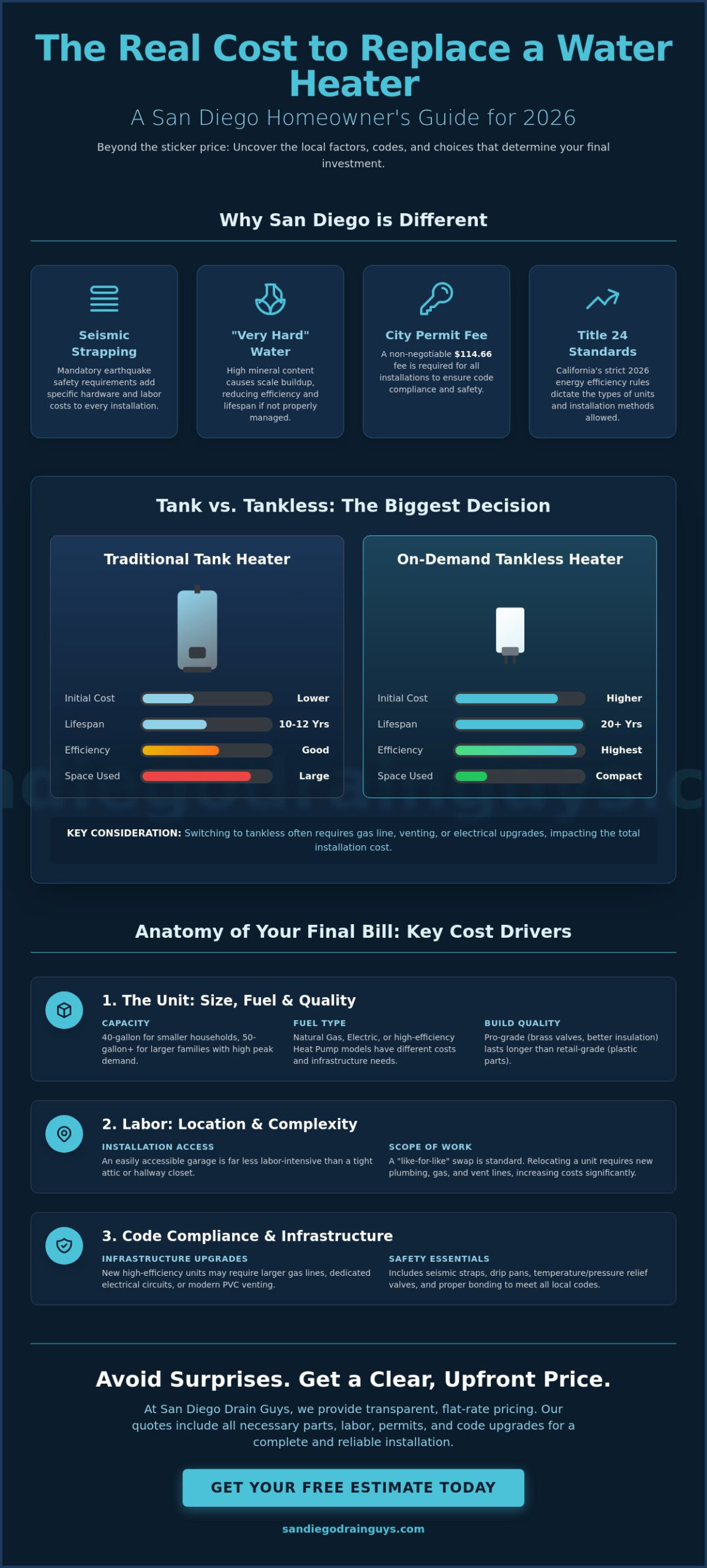
Deciding between a traditional tank and a modern tankless system is the most significant choice you’ll make when calculating how much to replace a water heater in san diego. While a standard tank offers a lower initial price point, tankless models provide a compelling long-term value proposition through extended lifespans. A typical tank system lasts about 10 to 12 years, whereas a well-maintained tankless unit can serve your home for 20 years or more. This durability makes tankless technology a popular choice for homeowners who plan to stay in their property for the long haul.
Energy efficiency is another primary driver for this decision. Under California’s Building Energy Efficiency Standards, there is a strong push toward high-efficiency appliances to reduce carbon footprints. Tankless units only heat water on demand, which eliminates the standby heat loss associated with keeping 50 gallons of water hot all day. For San Diego residents living in condos or Accessory Dwelling Units (ADUs), the compact, wall-mounted design of a tankless system also frees up valuable square footage that a bulky tank would otherwise occupy.
The Tankless Transition in San Diego Homes
Switching to tankless involves more than just swapping the hardware. These units require a much higher BTU input to heat water instantly, which often necessitates an upgrade to your gas meter or the installation of larger gas lines. Venting is also a critical factor; high-efficiency condensing models typically use specialized PVC venting, while non-condensing units require stainless steel. We also look closely at your home’s flow rate, measured in Gallons Per Minute (GPM). Larger homes with multiple bathrooms need a unit capable of high GPM to ensure you don’t lose pressure when the shower and dishwasher run at the same time.
Traditional Tank Systems: Reliability and Simplicity
Traditional tank systems remain the most budget-friendly immediate solution for many households. They are straightforward to install and don’t require the extensive infrastructure upgrades often associated with tankless models. Modern tanks feature improved insulation standards that significantly reduce heat loss compared to models from a decade ago. However, they do require consistent maintenance. Because most use glass-lined steel tanks, the sacrificial anode rod must be checked regularly to prevent internal corrosion. If you’re looking for a dependable, cost-effective fix, a professional water heater installation involving a high-quality tank is often the most practical path forward for your San Diego home.
San Diego Building Codes and Permit Requirements for 2026
Compliance with local building codes is a non-negotiable part of your installation project. While some might view these regulations as a hurdle, they exist to protect your family from fire, flooding, and gas leaks. A major factor in how much to replace a water heater in san diego is the 2026 California Title 24 energy standards. These standards require specific efficiency ratings for new units, especially in new construction or major renovations. Beyond the unit itself, we must ensure your plumbing system includes a thermal expansion tank. This is necessary for closed-loop systems to prevent pressure spikes that could damage your pipes or the new heater.
Safety components like the Temperature and Pressure (T&P) relief valve require precise installation. This valve must have a dedicated discharge pipe that leads to a safe location, usually the exterior of the home. Because San Diego’s water hardness causes rapid mineral buildup, these safety valves can sometimes become clogged with scale. Inspectors look closely at this piping to ensure that if the tank overpressurizes, the hot water has a clear, safe path to exit without causing injury or property damage.
The San Diego City Permit Process
The City of San Diego requires a “Simple No-Plan” permit for standard tank replacements, which costs $114.66 as of April 2026. Professional plumbers handle this filing to ensure the work is legally documented. After the installation, a city inspector will visit your home to verify that all safety standards are met. Skipping this step is a mistake. Unpermitted work can lead to denied insurance claims if a leak occurs. It also creates significant headaches when you try to sell your home, as savvy buyers and home inspectors will check for proof of permit finalization.
Seismic and Safety Compliance
Living in a high-seismic zone means we must follow strict earthquake strapping rules. California law requires all water heaters to be double-strapped, with one strap in the top third and another in the bottom third of the tank. This prevents the unit from tipping or moving during a tremor, which could rupture gas or water lines. We also install a drip pan under the unit if it is located in an area where a leak could cause interior damage, such as a second-floor closet. For gas units, proper venting is the highest priority. We verify that your exhaust system is clear and correctly sized to prevent dangerous carbon monoxide buildup inside your living space.
Local Factors: How San Diego Water Hardness Impacts Your Unit
San Diego’s water supply is officially classified as “very hard,” with a mineral content averaging between 16 and 18 grains per gallon. While these minerals are safe to drink, they are incredibly destructive to your plumbing appliances. When you are calculating how much to replace a water heater in san diego, you must account for the local chemistry that will immediately begin attacking your new unit. Calcium and magnesium sediment settle at the bottom of the tank, creating a thick layer of scale between the burner and the water. This layer acts as an insulator, forcing your heater to run longer and hotter to reach the desired temperature, which drives up your monthly utility bills.
To combat this, every tank system relies on a sacrificial anode rod. This rod is designed to corrode so your tank doesn’t have to. However, in San Diego’s aggressive water, these rods often dissolve much faster than the manufacturer’s estimate. We recommend a regular flush schedule, at least once a year, to remove the accumulated sediment before it hardens into a rock like substance that is impossible to clear. This simple maintenance step is the most effective way to preserve the efficiency of your system and keep your energy costs predictable.
Sediment Buildup and Unit Failure
You can often hear the signs of mineral buildup before the unit actually fails. If your heater starts making popping or rumbling noises, it’s often the sound of steam bubbles escaping from beneath a layer of sediment. This buildup also leads to slow recovery times, meaning you’ll wait longer for hot water between showers. Tankless units aren’t immune to this; they require annual descaling with a specialized solution to keep the heat exchanger clear. Many homeowners find that installing a water softening system alongside their new unit is the most effective way to protect their investment from our local water conditions.
Maximizing Your Hot Water Investment
When selecting a new model, we suggest looking for units equipped with self-cleaning features or heavy duty powered anode rods. These professional grade components are better suited for San Diego’s harsh environment than standard retail models. Regular professional inspections allow us to catch minor corrosion before it leads to a catastrophic tank failure. Without consistent maintenance, San Diego’s extreme water hardness can reduce a heater’s expected lifespan by 25%. If you are ready for a reliable upgrade, contact us for a professional water heater installation that accounts for our local water challenges and ensures long term performance.
Reliable Water Heater Installation with San Diego Drain Guys
Choosing a partner for your home’s plumbing needs shouldn’t be a source of stress. We recognize that when you are researching how much to replace a water heater in san diego, you are looking for more than just a number; you are looking for a team that respects your home and your time. Our approach is built on a foundation of reliability and absolute transparency. We utilize a flat-rate pricing model that eliminates the anxiety of hidden fees or sudden “surprises” once the work is underway. This commitment to honesty is our core signature, ensuring you understand the value of your investment before we ever pick up a wrench.
Our deep expertise in local San Diego plumbing codes means we handle the technical details that others might overlook. We take the burden of permit filing and code compliance off your shoulders, ensuring your new system is legally documented and safely installed. If you are facing a sudden loss of hot water, we provide emergency water heater installation to restore comfort to your household as quickly as possible. We treat every domestic environment with the highest degree of privacy and empathy, working methodically to minimize disruption to your daily life.
Our Methodical Installation Process
We follow a disciplined operational sequence to ensure every installation meets our premium service standards. Our process includes:
- Comprehensive Site Assessment: We identify necessary code upgrades, such as seismic strapping or expansion tanks, before starting.
- Eco-Friendly Removal: We carefully remove your old unit and ensure it is disposed of according to local environmental regulations.
- Rigorous Testing: After the new unit is in place, we perform detailed checks for gas line integrity and proper water pressure.
Peace of Mind for San Diego Homeowners
Working with a neighborly team means you get local accountability that big-box retailers simply cannot match. We prioritize high-quality, professional-grade components that are built to withstand the rigors of local water conditions. Our goal is to move you from a state of concern to a state of informed confidence, knowing your home is protected by capable hands. For more information on maintaining your home’s infrastructure, explore our guide on Professional Plumbing Services in San Diego. We are here to provide a dependable, long-term solution that keeps your hot water flowing and your family safe.
Securing Your Home’s Hot Water Future
Replacing a water heater is more than a simple appliance swap; it is an investment in your home’s safety and long-term efficiency. By understanding the impact of San Diego’s water hardness and the rigorous 2026 Title 24 energy standards, you can make a choice that avoids future repair headaches. We focus on these technical details so you don’t have to. Our team has been locally owned and operated since 2018, providing the expertise needed to navigate complex building codes while maintaining a transparent, flat-rate pricing model.
Knowing exactly how much to replace a water heater in san diego allows you to plan with confidence and eliminate financial uncertainty. We take pride in our methodical process and deep respect for your personal environment. If you’re ready to restore your hot water with a reliable, professional-grade system, we are here to help. Get a Transparent Water Heater Quote from San Diego Drain Guys and enjoy the peace of mind that comes with expert service. You deserve a hot water solution that lasts.
Frequently Asked Questions
Do I need a permit to replace a water heater in San Diego?
Yes, you must obtain a permit for all water heater replacements within the City of San Diego. For a standard tank replacement, you need a “Simple No-Plan” permit, which costs $114.66 as of April 2026. This permit is a critical factor when calculating how much to replace a water heater in san diego because it ensures the installation meets mandatory safety codes for seismic strapping and venting. We handle the filing process for you to ensure your home remains fully compliant.
How long does a typical water heater installation take?
A standard “like-for-like” tank replacement typically takes between two and four hours to complete. If you are switching from a tank to a tankless system or relocating the unit to a different area of your home, the process is more complex and can take a full day. We perform a thorough site assessment before starting to identify any necessary infrastructure upgrades. This methodical approach allows us to work efficiently and restore your hot water as quickly as possible.
Is a tankless water heater worth the extra cost in San Diego?
Tankless units are often worth the investment for homeowners who prioritize long-term energy savings and a lifespan that can exceed 20 years. They are especially beneficial in San Diego condos or ADUs where square footage is at a premium. While the initial setup requires a higher investment for venting and gas line upgrades, the on-demand heating eliminates standby energy loss. We can help you evaluate if the long-term utility savings and space benefits outweigh the upfront installation costs.
What are the signs that my water heater is about to fail?
Look for rusty water, puddles around the base of the unit, or inconsistent water temperatures as primary warning signs. If your tank is over 10 years old, it’s likely nearing the end of its reliable service life. We recommend a proactive replacement before a catastrophic leak occurs and causes expensive damage to your flooring or walls. Catching these issues early is the best way to maintain peace of mind and avoid emergency repair stress.
Does San Diego have hard water, and does it affect my heater?
San Diego has “very hard” water, with city reports showing an average of 16 to 18 grains per gallon. This high mineral content leads to rapid scale buildup inside your tank or heat exchanger. This sediment reduces heating efficiency and can shorten your unit’s life by up to 25% if it isn’t maintained. We suggest annual professional flushing to protect your new investment from these aggressive local water conditions and keep your bills low.
What is California Title 24, and how does it affect my plumbing?
California Title 24 refers to the state’s Building Energy Efficiency Standards that were updated on January 1, 2026. These regulations mandate higher efficiency ratings for water heaters and require specific insulation for the first five feet of connected piping. Compliance with these standards affects how much to replace a water heater in san diego by influencing which models are legal for installation. We stay current on these evolving laws to ensure your home meets all state and local requirements.
Can I install a water heater myself to save on labor costs?
We don’t recommend DIY installation because of the complex gas, electrical, and seismic safety requirements involved in Southern California. San Diego codes are strict; unpermitted or improper work can lead to insurance claim denials or major hurdles when you try to sell your property. Professional installation ensures that your unit is safely strapped, vented, and permitted. It’s the most reliable way to protect your home’s value and your family’s safety.
Why is my water heater making a popping or knocking sound?
These sounds are caused by heavy sediment buildup at the bottom of your tank. As the burner heats the water, steam bubbles get trapped under a layer of mineral scale and pop as they escape. This is a clear signal that your heater is struggling to work through thick calcium deposits. Regular flushing can sometimes help, but loud knocking often indicates that the sediment has hardened, which means a replacement is likely necessary to restore efficiency.