
Did you know that the historic “thousand-year storm” in early 2024 damaged nearly 5,000 structures across our county? For many local residents, learning how to prevent basement flooding san diego has become a top priority to avoid the high costs of mold remediation and structural repairs. We understand the anxiety that comes with heavy winter rains, especially when you’re unsure if your home’s current defenses are enough to keep the water at bay.
It’s frustrating to stand in a damp basement and wonder if you need a waterproofer or a plumber. We believe that peace of mind comes from having a clear, actionable plan. In this 2026 guide, you’ll discover how to protect your property by mastering local drainage risks and professional prevention strategies. We’ll cover everything from the latest California building standards to ensuring your sump pump and sewer lines are ready for whatever the next atmospheric river brings. You deserve a dry, usable basement and the confidence that your home is secure. By the end of this guide, you’ll have a professional’s perspective on maintaining a healthy, flood-proof home.
Key Takeaways
- Learn how intense atmospheric rivers and expansive clay soils create unique hydrostatic pressure against San Diego foundations.
- Understand why maintaining your sewer line health is the most critical step to prevent basement flooding san diego during the drought-to-flood cycle.
- Discover the essential roles of sump pumps and backwater valves in creating a reliable last line of defense against rising groundwater and city sewer backups.
- Follow a practical pre-storm checklist to audit your gutter systems and landscape grading, ensuring water flows safely away from your home.
- See how professional sewer camera inspections and transparent pricing provide the clarity you need to protect your property before the next major storm hits.
Understanding San Diego’s Unique Basement Flood Risks
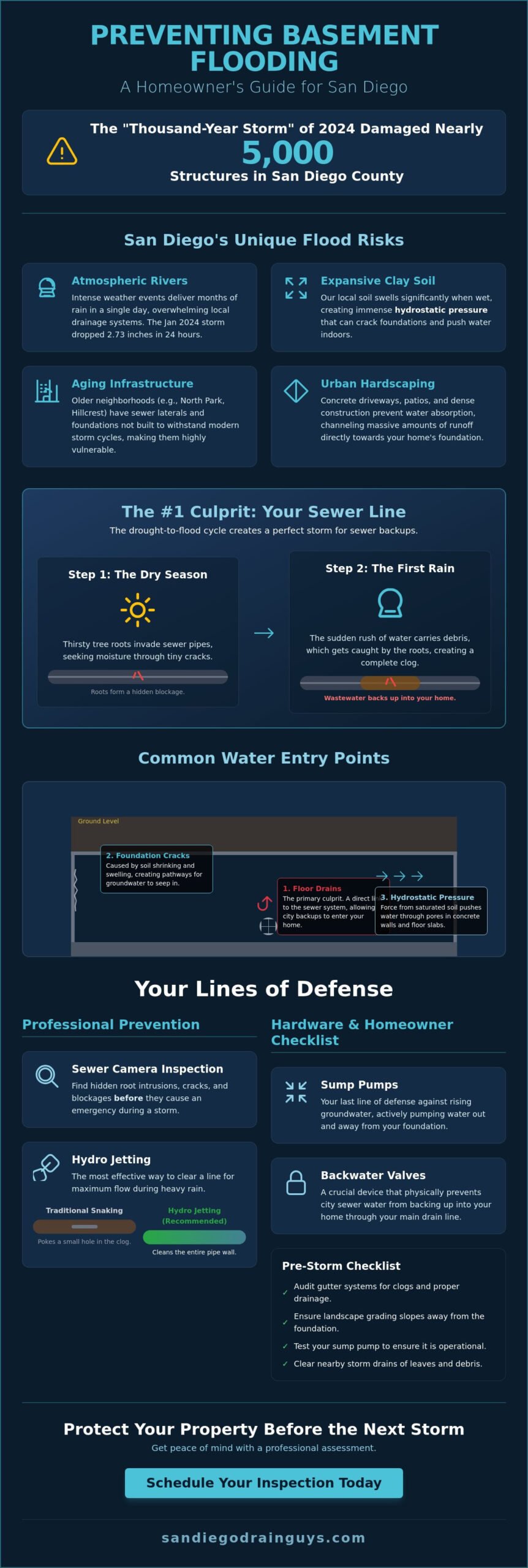
San Diego homeowners often assume we’re safe from floods until the sky opens up and stays open. The January 2024 storm proved that our “thousand-year” events are happening much more frequently, with 2.73 inches of rain falling in just 24 hours. To prevent basement flooding san diego residents must first understand that our weather patterns are shifting. Atmospheric rivers now deliver months of rain in a single day, overwhelming local drainage systems that weren’t designed for this volume. This historic event displaced over 1,225 households, showing that even inland basements are at risk when the infrastructure can’t keep up.
If you live in older areas like North Park or Hillcrest, your risks are significantly higher. These neighborhoods feature aging infrastructure and foundations that have weathered decades of soil movement. Unlike newer builds, these homes often lack modern Basement waterproofing techniques, leaving them vulnerable when the water table rises. We frequently see that these older sewer laterals are the first to fail when the ground becomes saturated; they simply weren’t built to handle the hydrostatic pressure common in 2026 storm cycles.
There’s also a vital distinction to make between surface seepage and catastrophic sewer backups. Seepage occurs when water slow-cooks its way through your foundation walls or floor over several days. A sewer backup, however, is a sudden and often contaminated event where the city’s main line or your own clogged lateral forces water back into your home. Both require different prevention strategies, but both start with understanding the ground beneath your feet.
The Role of San Diego’s Soil and Topography
Our local ground is largely composed of expansive clay. When this soil gets wet, it swells significantly and creates immense pressure against your basement walls. For those living on canyon-side properties, the risk is doubled because gravity sends runoff from higher elevations straight toward your foundation. Additionally, the heavy “hardscaping” in urban areas, like concrete driveways and patios, prevents the ground from absorbing water. Instead, it funnels that runoff directly toward your home’s lowest points.
Common Entry Points for Water
Water is patient; it finds the path of least resistance every time. Floor drains are the primary culprit for flooding because they connect directly to the main sewer line. If the city’s system is overwhelmed, sewage can back up into your living space through these drains. Foundation cracks also play a major role as our local dry-to-wet cycle causes the ground to shrink and expand, pulling at your concrete. Hydrostatic pressure is the force exerted by stagnant water against your basement slab or walls, often pushing moisture through even the smallest pores in the concrete.
The Critical Link Between Sewer Health and Flood Prevention
While many homeowners focus on sealing foundation cracks, a clogged main sewer line is often the fastest route to a flooded basement. When heavy rains hit San Diego, the city’s infrastructure and your home’s private lateral line are put under immense stress. If there’s a blockage in your line, the wastewater has nowhere to go but back up through your lowest drains. To effectively prevent basement flooding san diego residents must look beyond the walls and ensure their underground pipes are clear and functional. We’ve seen that a single neglected blockage can cause more damage in an hour than a slow foundation leak does in a month.
San Diego’s drought-to-flood cycle creates a specific challenge for our sewer systems. During long dry spells, thirsty tree roots seek out the moisture inside your pipes, entering through tiny fissures and growing into thick, pipe-blocking masses. When the first heavy storm of the season arrives, these roots act as a net, catching debris and sediment that has settled during the summer. This “first rain” rule is why many backups occur during the initial hours of a storm. Scheduling sewer camera inspections before the rainy season allows us to identify these root intrusions and structural defects before they lead to an emergency.
Hydro Jetting: Clearing the Path for Stormwater
For a basement to stay dry, your drainage system must be able to handle a high volume of water instantly. We recommend professional hydro jetting as the most effective way to prepare your home for 2026 weather patterns. While traditional snaking only pokes a hole through a clog, hydro jetting uses high-pressure water to scrub the interior walls of your pipes. This process removes grease, scale, and heavy root blockages, restoring the pipe to its full capacity. Investing in a preventative cleaning is a straightforward way to prevent basement flooding san diego and is significantly more affordable than the cost of emergency flood restoration and mold removal.
Early Warning Signs of Sewer Failure
Your plumbing often provides clues before a total failure occurs. Paying attention to these signs can save your basement from a catastrophic backup. We suggest watching for the following symptoms:
- Gurgling sounds: If your basement floor drains or toilets make a bubbling noise when you run water elsewhere, there’s a venting or blockage issue.
- Slow-moving toilets: A basement toilet that consistently struggles to flush is a major red flag for a lateral line problem.
- Multiple drain backups: If more than one fixture is backed up at the same time, the problem is likely in the main line.
If your home is more than 40 years old, these inspections are even more critical. Older clay or cast iron pipes are prone to cracking and shifting over time. A quick professional sewer line health check can give you the clarity you need to enjoy a worry-free winter season.
Essential Hardware: Sump Pumps and Backwater Valves
While clearing your sewer lines ensures water has a path out, mechanical hardware provides the active defense needed when groundwater levels rise or city systems fail. We often tell homeowners that relying solely on gravity is a gamble during an intense San Diego storm. To truly prevent basement flooding san diego, your home needs a reliable way to fight back against hydrostatic pressure and sewer surcharges. These mechanical systems act as your property’s last line of defense, working automatically to keep your living space dry when the weather is at its worst.
A common mistake we see is the “set it and forget it” mindset. Homeowners install a pump and assume they’re protected for life, but mechanical components can fail due to age, debris, or power loss. During the heavy winds that often accompany our winter rains, power outages are frequent. If your primary pump loses power, a basement can fill in minutes. We strongly recommend high-quality battery backup systems that take over the moment the grid goes down. This redundancy ensures that even during a total blackout, your home remains protected from rising water.
Selecting and Maintaining a Sump Pump
Choosing the right pump depends on the specific layout of your basement. Pedestal pumps have the motor mounted above the pit, making them easier to service but more visible. Submersible pumps are installed inside the pit, which makes them quieter and more powerful for handling significant water volume. Regular maintenance is the key to reliability. We suggest testing your float switch every few months by pouring water into the pit to ensure the pump triggers correctly. You should also clear the pit of any silt or gravel that could jam the impeller. Because every home’s water table is different, we recommend professional plumbing services in San Diego to ensure your pump is sized correctly for your home’s specific peak load requirements.
The Invisible Protector: Backwater Valves
A backwater valve is a specialized one-way device installed on your main sewer lateral. When the city’s sewer main becomes overwhelmed by stormwater, it can force sewage backward into residential basements through floor drains and toilets. The valve features a flapper that allows wastewater to leave your home but automatically seals shut if it detects flow coming from the opposite direction. This simple mechanical action can save you from thousands of dollars in contaminated water damage. While the installation requires a licensed professional to ensure proper grading and placement, the return on investment is undeniable for homes in low-lying San Diego flood zones. It’s a silent, invisible protector that provides 24/7 security against city-side infrastructure failures. By combining a healthy sewer line with these hardware solutions, you create a multi-layered shield to prevent basement flooding san diego year-round.
A Homeowner’s Pre-Storm Maintenance Checklist
Preparation is the most effective tool we have against the unpredictable San Diego weather. While mechanical hardware provides a safety net, proactive maintenance ensures that water never reaches your foundation in the first place. To prevent basement flooding san diego, we recommend starting your home audit in early autumn. Taking these steps before the first major clouds appear can save you from the stress and financial burden of emergency repairs. We’ve found that homeowners who follow a disciplined schedule are far less likely to experience the “first rain” backups discussed earlier.
Your roof acts as a massive collection surface during an atmospheric river event. If your gutter system isn’t functioning correctly, thousands of gallons of water will dump directly next to your basement walls. Ensure your downspouts extend at least 10 feet away from the foundation to keep the soil near your home from becoming saturated. Additionally, inspect the “grading” of your landscape. Soil often settles over time, creating a slope that funnels water toward the house rather than away from it. If you spot visible foundation cracks, address them immediately with professional-grade epoxy injections to maintain structural integrity.
Exterior Drainage Best Practices
Walk around your property during a light rain to check for “ponding” water, especially near basement windows. For canyon-side San Diego properties, the natural slope of the land can send a torrent of runoff toward your back door. In these cases, French drains are an excellent investment to redirect subsurface water safely. You should also clear area drains and window well drains of any leaves or debris. These small drains are easily overlooked but are vital for keeping localized flooding at bay during heavy downpours. To ensure your system is fully clear, schedule a professional drain cleaning before the November rains begin.
Interior Readiness
Don’t wait for a flood to find out if your sump pump works. We suggest performing a “bucket test” by slowly pouring water into the pump pit until the float switch triggers the motor. Listen for any unusual grinding sounds and ensure the water is actually being discharged away from the house. Inside the basement, check your floor drain traps. These should be filled with water to prevent sewer gases from entering, but they must also be free of hair, lint, or sediment. As a final precaution, move your valuables and electronics off the basement floor before winter starts. If you’re unsure about your home’s readiness, contact San Diego Drain Guys for a comprehensive drainage audit today. Taking action now is the best way to prevent basement flooding san diego and protect your peace of mind.
Professional Flood Prevention with San Diego Drain Guys
Choosing a partner to protect your home is a decision rooted in trust. At San Diego Drain Guys, we don’t just see ourselves as technicians; we’re your neighbors who understand the specific geological and infrastructure challenges of America’s Finest City. From the clay-heavy soils of the mesas to the aging sewer systems in our historic districts, we’ve seen how local conditions can compromise even the best-laid plans. To effectively prevent basement flooding san diego, you need a team that combines deep community roots with the most advanced drainage technology available in 2026.
We know that home maintenance can be a source of significant anxiety, especially when financial uncertainty is involved. That’s why we utilize a transparent, flat-rate pricing model. You’ll never have to worry about hidden fees or surprise costs during a rain-related emergency. This straightforward approach allows you to make informed decisions about your home’s safety without the pressure of a ticking clock. Our “calm expert” persona is designed to provide relief, ensuring that a complex drainage problem is handled by capable, disciplined hands while you focus on your family’s well-being.
Trenchless Solutions for Permanent Protection
One of the most effective ways to prevent basement flooding san diego is by addressing the root cause of sewer failure before it starts. Traditional pipe repairs often involve destroying your beautiful landscaping or tearing up driveways, but we prefer a more sophisticated approach. Our CIPP lining technology allows us to create a “pipe within a pipe” using a specialized epoxy resin. This trenchless method permanently seals your sewer lines against root intrusion and leaks without the need for disruptive digging. It’s a methodical, no-nonsense solution that offers long-term durability and a high level of protection for your property’s value. These repairs come with extensive warranties, giving you the confidence that your basement will remain dry for decades to come.
Schedule Your Peace-of-Mind Inspection
Don’t wait for the next atmospheric river to test your home’s defenses. We invite you to schedule a comprehensive sewer camera inspection to identify potential vulnerabilities before they become costly disasters. We treat every home with the highest degree of privacy and empathy, respecting your domestic environment as if it were our own. Our hardworking team is dedicated to exceeding standard service levels, providing you with a detailed health report of your drainage system. We find the hidden problems so you don’t have to deal with the aftermath of a flood. Contact us today to secure your home with a partner who values honesty, transparency, and the safety of our San Diego community.
Take Control of Your Home’s Flood Defense
Protecting your property from water damage requires a shift from reactive repairs to proactive maintenance. We’ve explored how San Diego’s unique clay soils and intense atmospheric rivers create a high-pressure environment for your foundation. By prioritizing sewer line health through regular inspections and maintaining critical hardware like sump pumps, you can effectively prevent basement flooding san diego. Whether you’re living in a historic North Park home or a canyon-side property, the right combination of drainage strategy and professional expertise makes all the difference.
We are a locally owned and operated team that has served the community since 2018. As specialists in no-dig trenchless sewer repair, we provide permanent solutions without destroying your landscaping. You can always expect transparent, flat-rate pricing with no hidden surprises when you work with us. We believe every homeowner deserves the relief of knowing their home is in capable hands.
Secure your home today with San Diego’s drainage experts; schedule your inspection now!
Don’t let the next storm cycle cause unnecessary anxiety. With a clear plan and a dependable partner, you can keep your basement dry and usable for years to come.
Frequently Asked Questions
Does my San Diego homeowners insurance cover basement flooding?
Standard homeowners insurance policies in San Diego typically don’t cover damage caused by rising groundwater or sewer backups. You generally need a separate flood insurance policy or a specific rider for sewer and drain backup to be fully protected. It’s a good idea to review your coverage with your insurance agent before the winter storm season begins to avoid expensive out of pocket costs.
How often should I test my sump pump in San Diego?
You should test your sump pump at least twice a year, with the most important test occurring in early October before the rainy season starts. Testing involves pouring enough water into the pit to trigger the float switch and ensuring the motor discharges the water away from your foundation. Regular testing is a simple, effective way to prevent basement flooding san diego by catching mechanical issues early.
What is the most common cause of basement flooding in San Diego County?
The most common cause is a combination of poor exterior drainage and our region’s expansive clay soil. When gutters are clogged or the landscape grading slopes toward the house, water pools against the foundation. This creates immense hydrostatic pressure that eventually forces moisture through concrete pores or foundation cracks. In many cases, this is exacerbated by aging sewer lines that can’t handle the sudden volume of stormwater.
Can a clogged sewer line really cause my basement to flood?
Yes, a clogged sewer line is a primary cause of sudden basement flooding. If your main lateral line is restricted by tree roots or debris, wastewater has no path to the city main. When heavy rains add extra pressure to the system, the sewage will take the path of least resistance, which is usually your basement floor drain or toilet. Keeping your lines clear is vital for a dry home.
Is it worth installing a backwater valve in an older San Diego home?
Installing a backwater valve is highly recommended for older homes, especially those in low lying areas or neighborhoods with aging infrastructure. These valves act as a one way gate that allows wastewater to leave but prevents city sewage from flowing back into your basement during a heavy storm. It’s a reliable mechanical solution that provides a level of protection that sealants and coatings simply cannot match.
How do I know if my basement flood is groundwater or sewage?
The source of the water is usually the biggest clue. Groundwater typically seeps through the walls or floor and appears clear, though it may be muddy. If the water is coming up through a floor drain or toilet and has a dark color or foul odor, you’re dealing with a sewage backup. If you suspect sewage, you should avoid contact with the water and call a professional immediately for safe extraction.
What should I do immediately if my San Diego basement starts flooding?
Your first step is to ensure your safety by turning off the electricity to the basement at the main breaker if you can do so without standing in water. If the water is coming from a plumbing source, shut off the main water valve. Avoid entering the water if you suspect it’s contaminated with sewage. Once the area is safe, call a drainage expert—or a 24/7 emergency team like Miami 305 Plumbing if you are in the Miami area—to identify the source and stop the flooding.
Can hydro jetting prevent my basement from flooding during a storm?
Hydro jetting is one of the most effective ways to prevent basement flooding san diego because it clears your pipes of all obstructions. Unlike traditional snaking, which only creates a small opening, hydro jetting uses high pressure water to scrub the pipe walls clean. This ensures your sewer system has its full capacity to handle the heavy flow of water during an intense atmospheric river event.