
Imagine waking up on a Saturday morning in North Park to a faint, metallic smell that quickly turns into a full-blown sewage backup in your guest bathroom. It’s the kind of emergency that stops your heart, especially when you start worrying about the main sewer line clog cost in San Diego and whether you’re even responsible for the repair or if the city handles it. We understand that a sewer line issue feels like a ticking time bomb for your property and your wallet. It’s stressful to deal with the smell, the mess, and the uncertainty of hidden emergency fees that some companies like to tack on at the last minute.
We’ve put together this 2026 guide to give you immediate peace of mind by showing you exactly how to handle the situation safely. You’ll find a clear breakdown of diagnostic steps, an explanation of the city versus homeowner boundary, and an honest look at the typical repair costs for San Diego homeowners. We’ll walk you through everything from high-definition camera inspections to the latest trenchless repair methods. Our goal is to ensure you have the facts needed to make a confident decision for your home, helping you move from a state of concern to a state of informed confidence.
Key Takeaways
- Learn the critical “No-Water” rule and how to spot electrical hazards to keep your family safe during an active backup.
- Use the “Multi-Fixture Test” to quickly identify if you’re facing a minor drain issue or a major main line blockage.
- Get a clear breakdown of the main sewer line clog cost in San Diego so you can plan for repairs without the fear of hidden surcharges.
- Discover why high-tech tools like Hydro Jetting and trenchless repair offer a “reset” for your pipes without destroying your driveway.
- Find out how to navigate San Diego municipal codes and insurance riders to potentially lower your out-of-pocket expenses.
Immediate Emergency Actions: How to Stop a Sewer Backup Now
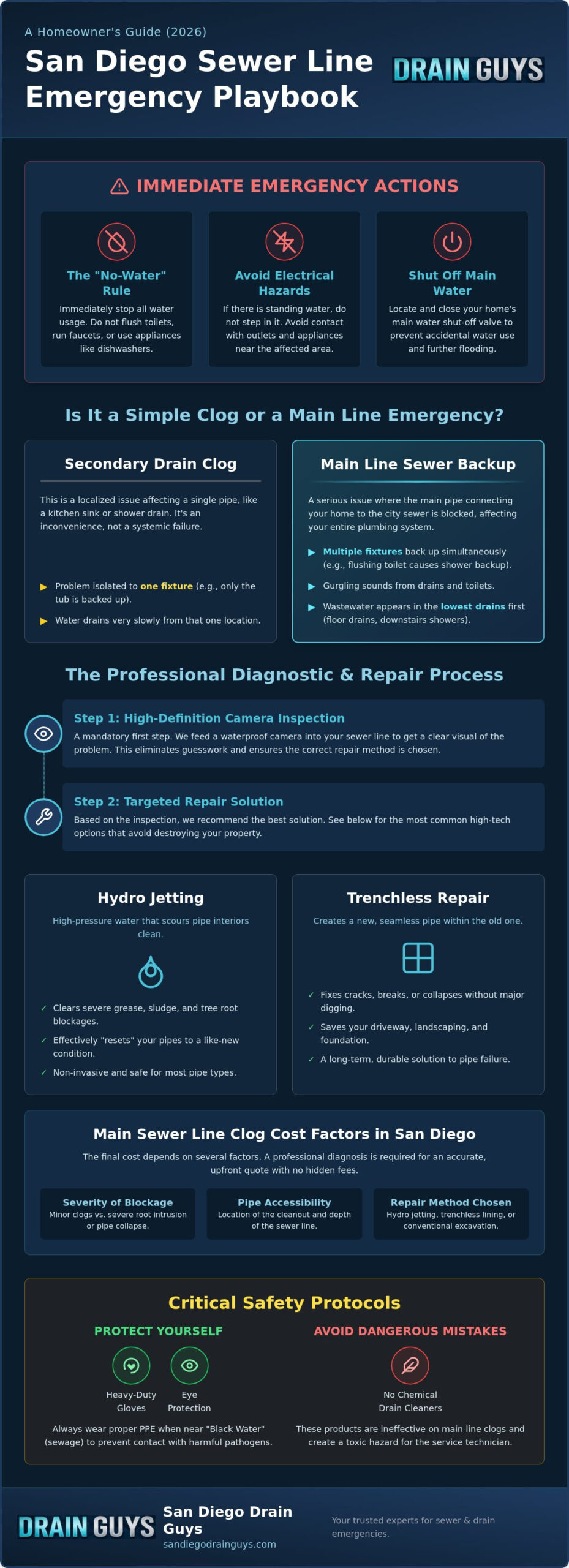
The second you notice water rising in your tub or hear your toilet gurgling, time is your most valuable asset. You need to stop all water usage immediately. This is our absolute “No-Water” rule. Every gallon you send down a drain right now will only end up on your bathroom floor. Sanitary sewer overflows are often caused by these internal blockages, and continuing to flush or run the faucet only increases the pressure on your already compromised plumbing system.
Safety is our first priority. If you see standing water in your basement or crawlspace, don’t step into it. Electrical outlets and appliances near floor level can turn that puddle into a lethal hazard. We recommend keeping children and pets far away from any area where sewage has surfaced. This isn’t just dirty water; it’s a biohazard that requires professional handling and sanitization to protect your family’s health.
To prevent accidental water use, locate your main water shut-off valve. In many San Diego homes, this is found near the front of the house or inside the garage. Closing this valve ensures no one accidentally runs the dishwasher or takes a shower while you’re investigating the problem. While you’re managing this crisis, you might be worried about the main sewer line clog cost in San Diego, but taking these steps now can prevent thousands of dollars in secondary water damage and mold remediation later.
Critical Safety Protocols for San Diego Homeowners
When dealing with “Black Water,” standard kitchen gloves won’t cut it. You need heavy-duty rubber gloves, eye protection, and waterproof boots to prevent skin contact with harmful pathogens. We also strongly advise against using chemical drain cleaners during a total backup. These products are highly corrosive and won’t clear a main line blockage. Instead, they’ll sit in the pipes, creating a dangerous chemical hazard for the technician who arrives to help you. Evacuating the affected areas is the best way to keep your household safe until we can perform a proper diagnostic.
Locating Your Main Sewer Cleanout
Your best defense against an interior flood is your outdoor sewer cleanout. In San Diego, these are typically 3 or 4-inch pipes with a square or slotted cap, located in the front yard, near the foundation, or even by the sidewalk. Carefully unscrewing this cap allows the built-up pressure to escape outside rather than inside your home. If your home was built before the 1970s, you might not have a cleanout installed. In that case, don’t try to force access through a vent. We can help you locate the best entry point once we arrive. Understanding these logistics and acting quickly is a key part of managing the main sewer line clog cost in San Diego effectively while protecting your property’s privacy and value.
Is it a Simple Clog or a Main Sewer Line Emergency?
Distinguishing between a stubborn kitchen sink and a full-scale sewer crisis is vital for protecting your property. The most reliable way to tell the difference is the “Multi-Fixture Test.” If you flush the toilet and see water bubbling up in the shower, or if running the washing machine causes a backup in the floor drain, you aren’t dealing with a simple clog. You have a main line issue. Because all your drains eventually meet at the main lateral pipe, a blockage there forces wastewater back up through every available opening. Understanding whether you’re dealing with a single fixture or a systemic failure is the first step in estimating the potential main sewer line clog cost in San Diego for your specific situation.
Plumbing follows the path of least resistance and the law of gravity. This is why we use the “Lowest Point Rule” during a diagnosis. In most San Diego homes, the first signs of a backup appear in downstairs tubs, showers, or basement floor drains. You might hear a distinct gurgling or whistling sound as air pockets struggle to move past the obstruction. If you see dark, brackish water or solid waste surfacing in these low-level drains, treat it as a biohazard emergency. These visual cues indicate that the main line is completely capped, leaving the sewage nowhere to go but back into your living space.
Main Line Backup vs. Secondary Drain Clog
A secondary clog is typically a maintenance issue limited to one pipe, like a hair-clogged shower or a grease-filled kitchen line. These are inconvenient but rarely threaten the structural integrity of your home. A main line backup, however, involves the “Main Lateral,” the large pipe that connects your home to the city’s sewer main. When this pipe fails, your entire plumbing system becomes unusable. If you’re seeing these signs across multiple rooms, it’s time to have a professional Sewer Camera Inspection to see exactly what’s happening underground before the pressure causes a pipe burst.
Common Causes Found in San Diego Pipes
San Diego’s unique environment presents specific challenges for underground pipes. In older neighborhoods like North Park, South Park, and Hillcrest, tree root intrusion is the leading cause of main line failure. Mature trees send microscopic root feelers into pipe joints in search of moisture, eventually creating a solid “root ball” that snags debris. We also frequently see heavy Fats, Oils, and Grease (FOG) buildup in coastal communities where older plumbing has seen decades of use. Finally, structural issues like “bellies” (sagging sections) or the failure of old Orangeburg pipes, common in post-war housing tracts, can lead to frequent blockages. These factors significantly influence the main sewer line clog cost in San Diego, as a simple cleaning might not fix a collapsed or root-infested pipe.
Professional Diagnostics: Why a Sewer Camera Inspection is Mandatory
Our cameras reveal the true story of your pipes in real time. We often find that what looks like a total collapse is actually just a heavy root intrusion that can be cleared without invasive surgery. Conversely, we might discover a “belly” or a sagging section of pipe that will continue to cause backups regardless of how many times it’s snaked. By showing you the footage on-site, we move the conversation from speculation to a clear, data-driven plan. This visual evidence is also essential for determining who is responsible for the bill, a common point of confusion in our local neighborhoods.
The Value of a Sewer Scope
Investing in a professional sewer scope near me is one of the most cost-effective decisions you can make during a plumbing crisis. Beyond just finding the current blockage, a full scope allows us to identify “pre-fail” conditions in other sections of the line. We can spot hairline cracks or minor offsets before they turn into midnight emergencies. Furthermore, if you need to file an insurance claim, having high-definition video footage provides the undeniable justification your adjuster requires to approve coverage for the main sewer line clog cost in San Diego.
San Diego City vs. Homeowner Responsibility
In the City of San Diego, responsibility for the sewer line is divided into two sections: the “Upper Lateral” and the “Lower Lateral.” The Upper Lateral is the portion of the pipe that runs from your home to the property line or curb. This section is always the homeowner’s responsibility to maintain and repair. The Lower Lateral connects the property line to the city’s main sewer pipe under the street. While the city often handles issues in the main, the homeowner is frequently responsible for the maintenance of the entire lateral up to the connection point. We help you document the exact location of the break or blockage so you can determine if you need to contact the San Diego Public Utilities Department to initiate a city-side repair claim.
Repair Options & Cost Factors: Hydro Jetting to Trenchless
Once the camera inspection has identified the culprit, we move into the resolution phase. Choosing the right method is the biggest factor in determining the total main sewer line clog cost in San Diego. For many homeowners, the goal is a permanent fix that doesn’t involve excavating the front yard. We specialize in high-tech rehabilitation that prioritizes your property’s privacy and your peace of mind. Whether you need a heavy-duty cleaning or a complete structural restoration, we focus on methods that minimize disruption to your daily life.
For severe blockages that haven’t yet compromised the pipe’s structure, Hydro Jetting is the gold standard. This process uses specialized nozzles to deliver high-pressure water that scrubs the interior of the pipe. It removes years of grease buildup and scours away stubborn tree roots. If the pipe is actually broken or collapsed, we turn to trenchless solutions. CIPP (Cured-In-Place Pipe) lining allows us to create a brand-new, seamless pipe inside your existing one. For pipes that are too damaged for lining, pipe bursting allows us to pull a new HDPE pipe through the old one, effectively replacing it without a backhoe.
Why Hydro Jetting Beats Traditional Snaking
Traditional plumbing snakes are often a temporary band-aid for a deep-seated problem. A snake’s metal cable typically just pokes a small hole through a blockage to get water moving again, but it leaves the majority of the debris behind. Our hydro jetting services san diego clear the entire diameter of the pipe. This is especially important for tree roots. A snake merely trims the roots, which encourages them to grow back thicker and faster. Jetting removes them entirely, providing a long-term cost benefit by extending the time between service calls.
The Trenchless Advantage for San Diego Homes
The traditional “dig and replace” method is often the most expensive part of a main sewer line clog cost in San Diego because of the restoration required afterward. Trenchless sewer repair san diego saves your expensive landscaping, driveways, and patios from destruction. Most of these repairs can be completed in a single day. Modern CIPP solutions carry a 50-year life expectancy, meaning this is likely the last time you’ll ever have to worry about that specific section of your sewer line. If you’re ready to stop the cycle of recurring backups with a permanent, flat-rate solution, contact our team for a professional consultation today.
Cleanup, Insurance, and Preventing Future Backups
The mess left behind after a sewer backup is more than just an eyesore. It is a serious health hazard. Professional biohazard cleanup is necessary because wastewater, often referred to as “Black Water,” contains pathogens, bacteria, and viruses that standard household cleaners cannot neutralize. Hiring a certified sanitization team ensures that your living space is safe for your family and pets. While the cleanup process adds to the immediate main sewer line clog cost in San Diego, it prevents much more expensive mold remediation and long-term property damage later on.
We also recommend installing a backwater valve as a mechanical defense against future issues. This device acts like a one-way gate, allowing wastewater to leave your home but blocking it from flowing back in if the city’s main line becomes overwhelmed. It is a proactive step that provides significant peace of mind during San Diego’s heavy rain events. Coupled with a consistent maintenance schedule, these measures protect your investment and keep your plumbing system running smoothly for decades.
How to Handle the Insurance Claim
Successfully navigating an insurance claim requires meticulous documentation. Start by taking high-quality photos and videos of the damage before any cleanup begins. We provide high-definition camera reports that serve as undeniable evidence of the cause and location of the blockage. It is vital to understand that standard homeowner’s insurance often excludes sewer backups unless you have a specific “Sewer Backup Rider.” This is distinct from “Flood Insurance,” which typically covers water entering from the outside rather than through the drains. When you engage our plumbing services san diego, we work alongside your restoration company to provide the technical data needed to justify your claim and help manage the main sewer line clog cost in San Diego.
Preventive Steps for a Backup-Free Home
Prevention is always more affordable than an emergency repair. Adopting the “Trash, Not Toilet” rule is the simplest way to protect your pipes. Never flush “flushable” wipes, paper towels, or feminine hygiene products, as these are the primary culprits behind modern clogs. In neighborhoods with mature landscaping, managing roots with annual inspections and foaming root killers can stop intrusions before they become structural failures. We recommend a professional drain cleaning san diego every two years to clear out grease and debris. This small investment functions as the best insurance against the stress and expense of a midnight plumbing emergency.
Take Control of Your Home’s Sewer Health Today
Sewer backups are high-pressure situations, but you now have the tools to navigate them with confidence. By following the “No-Water” rule and prioritizing advanced camera diagnostics, you’ve already taken the most important steps to protect your property and manage the main sewer line clog cost in San Diego. Whether your issue stems from aggressive tree roots in North Park or decades of grease buildup, remember that a precise diagnosis is the only way to ensure a permanent, cost-effective fix. Modern trenchless technology means you no longer have to choose between a working sewer and a beautiful landscape.
We are here to help you move past the stress of a plumbing emergency and into a state of informed confidence. Our team of local San Diego specialists provides advanced camera diagnostics with every call to eliminate guesswork from the start. We believe in total transparency, which is why we use a flat-rate pricing model to ensure you never face hidden surprises or emergency surcharges. As a locally owned business, we take pride in serving our neighbors with the same respect we’d show our own families. If you’re ready to secure your property against future backups with a permanent solution, Get Emergency Sewer Relief with San Diego Drain Guys. You don’t have to handle this crisis alone; expert help is just a call away.
Frequently Asked Questions
Is a sewer backup covered by standard homeowner’s insurance?
No, standard homeowner’s insurance policies typically exclude sewer backups unless you have specifically added a “Sewer Backup and Sump Pump Overflow” rider. We recommend reviewing your policy’s declarations page to check for this endorsement. Documentation is vital for these claims, so we provide high-definition camera footage to help you justify the repair if you have the proper coverage in place.
Can I stay in my house if the sewer backs up?
We advise against staying in the home if the backup has affected living areas or multiple fixtures. Sewage is classified as “Black Water,” which contains harmful bacteria and pathogens that pose serious health risks. If you cannot use your toilets or showers without causing further flooding, it’s safer to stay elsewhere until we clear the line and a professional sanitization team has finished the cleanup.
How much does it typically cost to fix a main sewer line backup in San Diego?
The total main sewer line clog cost in San Diego depends on the severity of the blockage and the technology used to clear it. A simple snaking is generally the most affordable option, while high-tech solutions like Hydro Jetting or trenchless repairs involve a higher initial investment but provide long-term protection. We use a transparent flat-rate pricing model to ensure you understand all costs before we begin any work.
What is the difference between a city sewer backup and a residential one?
A residential backup occurs in your “Upper Lateral,” the pipe running from your house to the property line. A city backup happens in the “Lower Lateral” or the main municipal line under the street. We use specialized cameras to find the exact location of the blockage. If the issue is on the city’s side, we can help you document the evidence needed to file a claim with the San Diego Public Utilities Department.
Will pouring bleach down the drain help a sewer backup?
No, bleach will not clear a main sewer line blockage. While bleach is a disinfectant, it cannot break through solid obstructions like tree roots, grease, or heavy scale buildup. In fact, pouring chemicals down a backed-up drain can damage your pipes and create a hazardous environment for the technician who eventually has to clear the line. It’s always best to stop using water and call for a professional diagnostic.
How do I know if tree roots are causing my sewer backup?
The only way to confirm tree root intrusion is through a Sewer Camera Inspection. Roots are the leading cause of backups in older San Diego neighborhoods because they enter through tiny cracks in search of moisture. If you notice recurring clogs or hear gurgling sounds coming from your drains, it’s a strong sign that roots have established a “root ball” inside your main lateral pipe that needs professional removal.
What is a backwater prevention valve and do I need one?
A backwater prevention valve is a mechanical device installed in your sewer line that allows wastewater to flow out but prevents it from flowing back in. We highly recommend these for homes where the lowest drain is below the level of the nearest city manhole. It acts as a final fail-safe against municipal sewer overflows, protecting your home from catastrophic damage during heavy storms or city-side blockages.
How long does it take to clean up after a sewage backup?
Professional cleanup and sanitization typically take between 24 and 48 hours depending on the extent of the overflow. The process involves removing contaminated materials, disinfecting all surfaces with industrial-grade antimicrobial agents, and using high-powered air movers to dry the area. Acting quickly is essential to prevent mold growth, which can begin to develop within just 24 hours of the initial backup event.