
A main sewer line clog is a systemic failure rather than a simple fixture problem. Failing to spot the difference can lead to a total home flood and significant property damage. We understand the immediate anxiety that sets in when you see water rising in the shower or hear strange gurgling from your drains. It’s stressful to wonder if you’re dealing with a quick fix or a major underground crisis that might disrupt your daily life.
Identifying main sewer line clog symptoms early is the only way to prevent raw sewage from backing up into your living space. We’ll help you confirm exactly what’s happening in your pipes and show you the precise steps to take to stop a backup before it starts. You don’t have to face this alone or guess about the health of your home’s infrastructure. This guide covers how to spot the “migration of water” between fixtures and explores modern, non-invasive repair options like CIPP lining to keep your property intact while solving the problem for good.
Key Takeaways
- Learn how to distinguish between a minor sink blockage and a systemic failure by understanding your home’s plumbing “tree” architecture.
- Identify the four critical main sewer line clog symptoms, including the “migration of waste” where water backs up into unrelated fixtures like showers or tubs.
- Discover the immediate emergency steps to take, such as stopping all water usage and locating your main valve, to prevent raw sewage from entering your living space.
- Understand why modern solutions like hydro jetting and sewer camera inspections are the most effective ways to clear stubborn tree roots and grease buildup.
- Explore non-invasive trenchless repair options that fix your main line permanently without the need for costly excavation or property damage.
Recognizing the Difference Between a Local Clog and a Main Line Failure
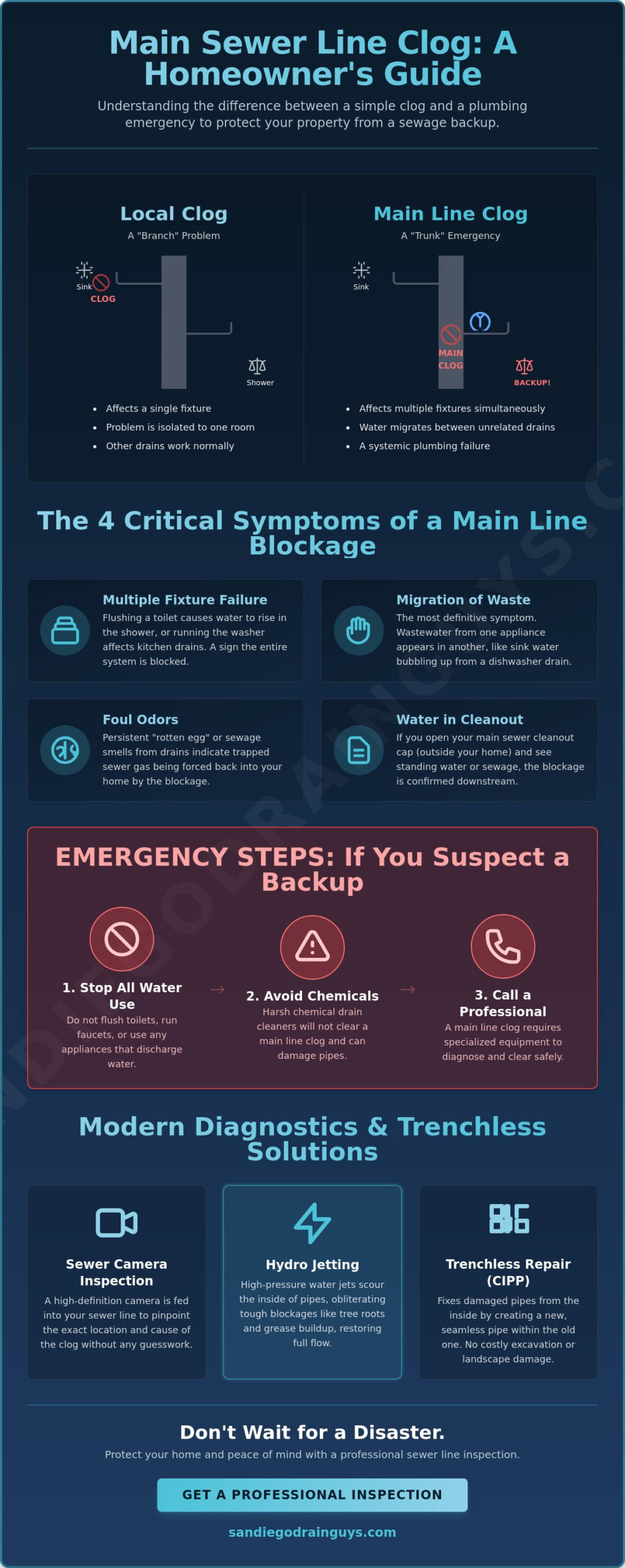
Think of your home’s plumbing as a tree. Each sink, shower, and toilet represents a small branch that feeds into larger secondary lines. These branches eventually meet at the “trunk,” which is your main sewer line. This single pipe is responsible for carrying every drop of waste water away from your property and into the municipal sanitary sewer system. When a branch is blocked, you have a local inconvenience. When the trunk is blocked, you have a plumbing emergency. Distinguishing between these two scenarios is the first step in identifying main sewer line clog symptoms and protecting your home from a catastrophic backup.
The “Single Fixture” Rule
If only your kitchen sink is backing up, the problem is likely localized. We call this the “Single Fixture Rule.” You can test this easily by running water in a nearby bathroom. If the toilet flushes perfectly and the shower drains without hesitation, the blockage is trapped in that specific sink’s P-trap or a secondary line. In these cases, a simple plunger might solve the issue. However, plunging a sink will not help a main line issue. The distance is too great, and the volume of the blockage is usually far beyond what a hand tool can clear. If the problem stays in one spot, it is a branch issue. If it starts to spread, the trunk is in trouble.
When the Problem Becomes Systemic
A main line failure is never isolated to one room; it is a systemic collapse of your home’s drainage. You’ll notice multiple fixtures across the house failing simultaneously. For example, you might flush a toilet and see water rise in the shower, or run the washing machine and hear the kitchen sink gurgle. This happens because the waste water has nowhere to go. It hits the blockage in the main lateral and begins to fill the pipes from the bottom up. In many San Diego neighborhoods, we see this frequently in homes with older clay pipes. These pipes are highly susceptible to shifting soil and invasive roots. Recognizing these main sewer line clog symptoms early—a practice essential for any homeowner, including those who follow the lifestyle and property guides at Colorado Horse Property—allows us to intervene before the pressure causes a pipe to burst or sends raw sewage into your living space.
The 4 Critical Symptoms of a Main Sewer Line Blockage
Spotting a problem before it becomes a disaster requires knowing exactly what to look for. Identifying main sewer line clog symptoms involves watching how your home reacts to water use across different rooms. It isn’t just about a slow drain; it’s about a total system rejection. When the main line is blocked, water has nowhere to go but back into your home. This creates a specific set of red flags that differ significantly from a standard sink clog.
- Multiple Fixture Failure: If you flush the toilet and the bathtub starts filling with wastewater, you aren’t looking at a simple clog. This is a clear sign the main lateral is blocked.
- Migration of Waste: This is the most definitive symptom. You might see water bubble up in the kitchen sink when you run the dishwasher, or notice the toilet water level rising when you turn on the bathroom faucet.
- Foul Odors: Persistent “rotten egg” smells are often the first sensory warning. These odors come from hydrogen sulfide gas escaping through floor drains when the water seal in the P-trap is compromised by pressure from the main line.
- Standing Water in the Cleanout: Your sewer cleanout is a pipe with a cap, usually located in your yard or near the foundation. If you unscrew the cap and see standing water or raw sewage, the blockage is definitely downstream in the main line.
The Physics of Backups: Why the Shower Fills First
Water follows the path of least resistance and always seeks the lowest point of exit. In most homes, the shower or bathtub drain is the lowest opening in the entire plumbing system. When the main sewer line is restricted, water from an upstairs toilet will travel down the plumbing stack and burst out of the ground-floor shower drain because it can’t pass the blockage. Shower drains are the “canary in the coal mine” for sewer clogs because they represent the lowest point of exit for backing-up water.
Audible Warnings: What Gurgling Actually Means
Gurgling is the sound of air being displaced and forced through water. When the main line is restricted, water pushes air through the nearest available vent or drain. A small “glug” might be a local issue, but a deep, rhythmic gurgle that happens across multiple rooms indicates a systemic air-lock. This often happens when high-volume appliances like washing machines run. The machine pumps out gallons of water at once, forcing air to bubble up through toilets or sinks. If you hear these sounds, scheduling a professional sewer camera inspection can help you address the issue before it floods your home.
Why Main Line Clogs Happen: Common Culprits in San Diego
San Diego’s unique geography and history play a massive role in how your plumbing behaves. While the main sewer line clog symptoms you’re experiencing feel like a sudden disaster, the cause has likely been building for years. In older neighborhoods like North Park, South Park, and La Jolla, the underground infrastructure faces specific environmental pressures that differ from newer developments. Understanding these local culprits allows us to move past temporary fixes and address the root of the problem.
Tree Root Intrusion in Southern California
In our semi-arid climate, tree roots are relentless in their search for moisture. Sewer pipes are essentially underground rivers, and roots can detect the “sweat” or condensation on the outside of a pipe from yards away. They find microscopic cracks in old clay pipe joints and force their way inside. Once a single hair-like root enters, it grows rapidly into a dense mass. This creates a “netting” effect that catches toilet paper and solid waste, eventually forming an impenetrable wall. If you have large, mature trees near the curb, they are likely the primary suspects behind your main sewer line clog symptoms.
Aging Infrastructure and Pipe Corrosion
Many homes built before the 1970s still rely on clay or cast iron pipes. While durable, these materials have a finite lifespan. In San Diego’s coastal air, cast iron pipes are prone to internal corrosion and scale buildup. This rough surface catches debris and reduces the internal diameter of the line. For these aging systems, traditional digging is no longer the only answer. We often recommend CIPP (Cured-In-Place Pipe) lining. This trenchless technology creates a “pipe within a pipe,” sealing off cracks and preventing future root intrusion without destroying your landscaping or driveway.
Emergency Steps: What to Do When Sewage Starts Backing Up
When you identify main sewer line clog symptoms, the situation has moved beyond a simple repair and into an emergency. The priority is protecting your home from raw sewage and preventing further water damage. We understand the stress of watching water rise in your drains, but taking methodical steps right now can save you thousands of dollars in restoration costs. The very first thing you must do is stop all water usage immediately. This includes pausing the dishwasher, stopping the laundry cycle, and ensuring nobody flushes a toilet or runs a faucet. If the main line is blocked, every gallon of water you introduce will eventually force its way back out through your lowest drains.
We also strongly advise against using chemical “main line” cleaners. These caustic liquids are rarely effective against heavy grease or tree roots. Instead, they can sit in your pipes and eat through aging cast iron or clay, making a structural failure even worse. Once you’ve stopped the water flow, your next goal is to minimize the pressure on your system until a professional can arrive to perform a sewer camera inspection.
Finding Your Main Water Shut-Off
Locating and closing your main water valve is the most critical step to prevent accidental flooding. Most San Diego homes have this valve located near the front of the property, often in a concrete box near the street or inside the garage near the water heater. If you have a ball valve, turn the lever 90 degrees until it is perpendicular to the pipe. If it is an older gate valve, turn the round handle clockwise until it is fully closed. This ensures that a running toilet or a hidden leak won’t continue to feed the backup while you wait for help.
The Role of the Sewer Cleanout
Your sewer cleanout is a white or black capped pipe located in your yard or near the foundation. It acts as a pressure relief valve for your entire plumbing system. If sewage is already backing up into your tubs, you can safely unscrew the cleanout cap using a pipe wrench. This allows the sewage to exit onto the ground outside rather than inside your home. When we arrive, the level of water in this pipe tells us exactly where the blockage is located. If the cleanout is full of standing water, it confirms the main sewer line clog symptoms are caused by a blockage between the house and the city main. If you’re facing a backup right now, contact our team for immediate assistance.
Professional Diagnostics and Trenchless Solutions
Once we have identified the main sewer line clog symptoms through your home’s behavior, we move into the diagnostic phase. We believe that seeing is believing. A high-definition sewer camera inspection is the only way to uncover the truth hidden beneath your property. This process eliminates guesswork and ensures we don’t waste your time or money on ineffective treatments. If you are seeing recurring main sewer line clog symptoms, a camera provides a clear roadmap for the repair. Whether it is a mass of tree roots or a structural belly in the pipe, we find the cause before we suggest a cure.
We also prioritize transparency in every step of our process. This is why we utilize a flat-rate pricing model for our primary services. You deserve to know the exact cost of the solution before the work begins. By removing financial uncertainty, we aim to lower your stress and build a partnership based on honest, reliable service. Our goal is to provide the relief of having a complex problem handled by capable, disciplined hands.
Hydro Jetting vs. Traditional Snaking
When faced with a stubborn blockage, many people reach for a traditional drain snake. While snaking can provide temporary relief, it often leaves the “root of the problem” behind. A snake simply pokes a small hole through the debris to get water moving again. In contrast, our hydro jetting services san diego utilize high-pressure water to scrub the internal pipe walls completely clean. This method removes grease, scale, and root hair that snaking misses, restoring your pipe to its original flow capacity. It’s a thorough, long-term solution rather than a quick patch.
Trenchless Sewer Rehabilitation
If the camera inspection reveals that your pipes are cracked or failing, you might fear a torn-up yard. We offer modern trenchless sewer repair san diego to solve this issue without the destruction. Cured-In-Place Pipe (CIPP) lining allows us to create a brand-new, seamless pipe inside your old one. We pull a resin-saturated liner through the existing line and cure it until it’s rock-solid. This “no-dig” technology preserves your landscaping, driveways, and porches while providing a permanent fix. Most homeowners prefer this methodical approach because it’s faster, cleaner, and often more cost-effective than traditional excavation. We handle every job with the highest level of privacy and respect for your domestic environment.
Protect Your Home with Professional Insight
Identifying main sewer line clog symptoms early is the difference between a minor service call and a major restoration project. You now know how to spot the “migration of water” between fixtures and understand why multiple backups across your home signal a systemic failure. Taking immediate action by shutting off your water and checking the cleanout can prevent property damage before it starts. We understand the anxiety these issues cause, and we’re here to provide a clear, methodical path forward.
Our team is here to help you navigate these stressful moments with confidence. We provide transparent flat-rate pricing so you never have to worry about hidden surprises or financial uncertainty. Using advanced trenchless technology, we can often repair your pipes while keeping your landscaping and driveways completely intact. Our local San Diego experts approach every home with empathy and a commitment to disciplined, professional service. Schedule your San Diego sewer camera inspection today for total peace of mind. You don’t have to face a plumbing emergency alone; we’re ready to restore your home’s safety.
Frequently Asked Questions
Is a main sewer line clog a plumbing emergency?
Yes, we consider a main line blockage a high-priority plumbing emergency. Because this single pipe carries all the waste away from your home, a total clog means that every time you flush a toilet or run a sink, the water has nowhere to go but back into your living space. This can lead to raw sewage backups and significant property damage within a very short timeframe. If you notice multiple fixtures failing at once, it’s vital to stop all water usage and seek professional help immediately.
Can I use Drano or chemical cleaners for a main line blockage?
We strongly advise against using chemical cleaners for a main line issue. These products are designed for small, organic clogs near a sink drain and are almost never effective against heavy grease, solid debris, or tree roots. Instead, these caustic chemicals can sit in your pipes, generating heat and causing corrosion in cast iron or clay lines. This often leads to structural damage that is much more expensive to fix than the original clog. Professional tools like hydro jetting are the only safe way to clear a main lateral.
How do I know if the clog is in my house or the city’s sewer line?
The best way to determine responsibility is to check your sewer cleanout. If you open the cap and see standing water or sewage, the blockage is located in your main lateral or the city’s main line. Generally, if the cleanout is empty but your house is still backing up, the clog is inside your home’s internal plumbing. If the cleanout is full, we recommend contacting a professional to determine if the issue is on your property or if you need to alert the city’s utility department.
What does it mean if my toilet bubbles when I run the sink?
Bubbling or gurgling in your toilet is a sign of a systemic air lock. When a blockage restricts the flow in your pipes, the air that is normally pushed ahead of the water has no place to go. It is forced back through the nearest available vent or trap, which is often the water in your toilet bowl. This is one of the most common main sewer line clog symptoms and indicates that the main line is struggling to breathe and drain properly.
How much does a sewer camera inspection cost in San Diego?
While we don’t quote specific fees here, we treat a camera inspection as a standard diagnostic tool that saves you money in the long run. By using high-definition video, we remove the guesswork and prevent unnecessary digging. In the San Diego area, the cost of an inspection is a small investment compared to the price of a total sewer replacement. We use a transparent pricing model so you know exactly what the diagnostic will cost before we ever begin the work.
Will tree roots grow back after my sewer line is cleaned?
Yes, tree roots will almost certainly grow back if the pipe isn’t permanently sealed. Mechanical cleaning or snaking only cuts the roots away; it doesn’t kill the tree or seal the entry point. Because roots are naturally attracted to the moisture in your sewer line, they will find their way back through the same cracks in a matter of months. To stop this cycle, we often recommend CIPP lining, which creates a seamless barrier that roots cannot penetrate.
What happens if I ignore the symptoms of a sewer clog?
Ignoring the warning signs usually leads to a catastrophic sewage backup. Over time, a partial blockage will become a total one, causing raw sewage to flood the lowest points of your home, such as basement drains or ground-floor showers. Beyond the immediate health hazards, the pressure from a persistent clog can cause aging pipes to collapse or burst. This turns a simple cleaning job into a major excavation and pipe replacement project that could have been avoided with early intervention.
How can I prevent main sewer line clogs in the future?
Prevention starts with being mindful of what goes down your drains. Never flush “flushable” wipes, feminine hygiene products, or paper towels, and avoid pouring fats, oils, and grease down the kitchen sink. For homes in older neighborhoods with mature trees, we recommend preventative hydro jetting every two to three years to keep the lines clear of small root intrusions. If your pipes are consistently failing, a permanent trenchless repair can provide a long-term solution that protects your home for decades.