
The cheapest trenchless method isn’t necessarily the one with the lowest initial quote; it’s the one that eliminates the most restoration and future maintenance costs. When you’re comparing pipe bursting vs pipe lining cost, looking only at the bottom line of a bid can lead to expensive surprises later. We know that facing a sewer failure is stressful, especially when you’re worried about hidden fees or the potential for your yard to be torn apart. You want a permanent fix that respects your property and provides a clear price to value ratio.
You deserve a solution that offers peace of mind without the technical confusion. In this 2026 comparison guide, we’ll break down the structural differences and long-term value of both pipe bursting and pipe lining. You’ll learn how each method handles specific issues like root intrusion and pipe diameter, helping you decide which trenchless technology provides the best protection for your property. We’ll walk through the factors that influence your total investment so you can move forward with a clear, honest understanding of what’s best for your home’s infrastructure.
Key Takeaways
- Learn the mechanical differences between CIPP epoxy lining and pipe bursting to identify the most reliable fix for your sewer system.
- Compare the total pipe bursting vs pipe lining cost by factoring in the massive savings on restoring landscaping, patios, and hardscapes.
- Determine if your pipe’s condition allows for a “pipe within a pipe” or if a full replacement is necessary to maintain proper drainage flow.
- Understand how San Diego’s expansive clay soils and hillside stability influence the success and permitting of your trenchless project.
- Find out how transparent, flat-rate pricing models protect you from hidden fees and ensure a smooth, professional repair process.
What Are Pipe Bursting and Pipe Lining?
When your sewer line fails, you need a solution that doesn’t involve destroying your hard-earned landscaping or expensive hardscapes. Trenchless technology offers a way to fix underground utilities with minimal surface disruption. While both methods fall under this category, they operate on very different mechanical principles. Understanding these differences is the first step in accurately analyzing the pipe bursting vs pipe lining cost for your specific property.
The primary distinction lies in whether we are rehabilitating the existing pipe or replacing it entirely. Pipe lining uses the old pipe as a structural host, whereas pipe bursting destroys the old line to make room for a new one. Both are considered “trenchless” because they require only small access points rather than a continuous, deep trench through your yard, driveway, or patio.
The Pipe Lining (CIPP) Process
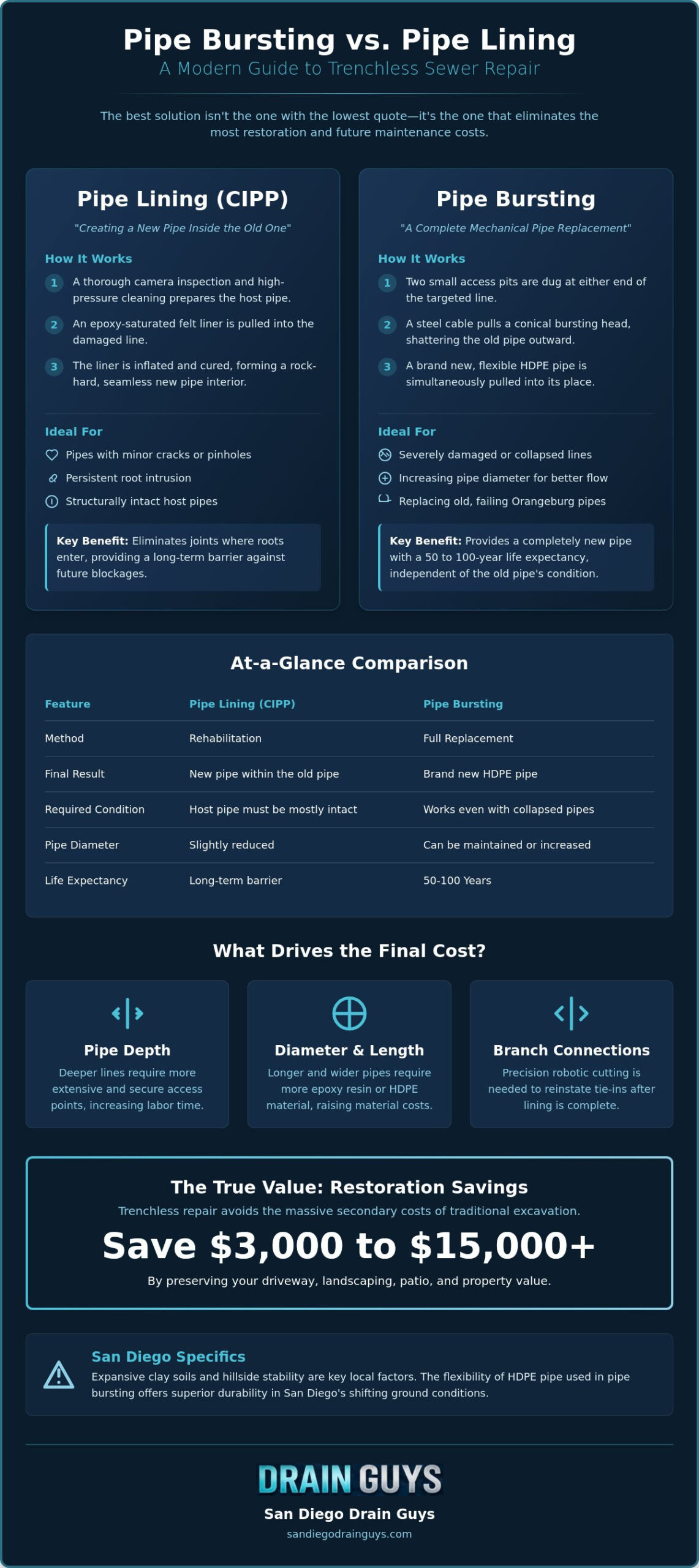
Cured-In-Place Pipe (CIPP) lining involves a disciplined, multi-step approach. Our team begins with a thorough sewer camera inspection and high-pressure cleaning to ensure the host pipe is stable and clear of debris. We then saturate a felt liner with a specialized epoxy resin and pull it into the damaged line. Once positioned, the liner is inflated and cured using heat or ambient air, creating a rock-hard, smooth interior surface. CIPP is a seamless, jointless rehabilitation method that essentially creates a new pipe inside your old one.
- Ideal scenarios: This method works best for pipes with minor cracks, pinholes, or persistent root intrusion where the structural shape is still mostly intact.
- Benefit: It eliminates joints where roots typically enter, providing a long-term barrier against future blockages.
The Pipe Bursting Process
Pipe bursting is a more aggressive, mechanical replacement method. We dig two small insertion pits at either end of the targeted line. A heavy-duty steel cable pulls a conical bursting head through the old pipe, which shatters the existing material into the surrounding soil. As the head moves forward, it simultaneously pulls a brand-new High-Density Polyethylene (HDPE) pipe behind it. This HDPE pipe offers superior flexibility in shifting soil, which is a significant factor when weighing the pipe bursting vs pipe lining cost and long-term durability.
- Ideal scenarios: We recommend this for collapsed lines, old Orangeburg pipes, or situations where you need to increase the pipe’s diameter to handle higher flow volumes.
- Benefit: It provides a completely new pipe with a 50 to 100-year life expectancy without the need for the original pipe to be structurally sound.
Comparing the Costs: Upfront Price vs. Long-Term Value
When you evaluate the total pipe bursting vs pipe lining cost, it’s vital to look beyond the plumbing quote itself. Traditional excavation often carries a lower initial plumbing price, but it triggers massive secondary expenses. Replacing a concrete driveway, restoring a custom flagstone patio, or replanting a mature garden can add $3,000 to $15,000 to your final bill. Trenchless methods eliminate these “hidden” costs by keeping the work underground and preserving your property’s surface.
Pipe lining relies heavily on high-quality epoxy resins. These materials are specialized and require precision during the saturation process. On the other hand, pipe bursting involves significant equipment overhead. It requires heavy-duty hydraulic pulling units and high-density polyethylene (HDPE) piping. While lining often requires less onsite time and labor, bursting provides a completely new physical pipe. This is a crucial distinction when you’re weighing the long-term value of your investment.
Factors That Drive Trenchless Quotes
Three main variables dictate the final price of a trenchless project. First is the depth of your sewer line. Deeper pipes require larger, more secure access pits, which increases labor time. Second is the pipe’s diameter and total footage. Larger pipes use more resin or HDPE material, impacting the raw material cost. Finally, our team must account for branch connections. If other drain lines tie into your main sewer, we must use robotic cutters to reinstate those openings after the lining process is complete. This precision work ensures your entire system functions perfectly.
The Restoration Savings Factor
In neighborhoods across San Diego, the value of your property’s exterior often matches the importance of its interior. Choosing a “no-dig” solution preserves your curb appeal and prevents the stress of a major construction site in your front yard. The benefits of trenchless technology extend into long-term savings as well. Because both HDPE and epoxy liners are jointless, they are virtually immune to root intrusion. This means you’ll spend less on routine maintenance in the decades to come. If you’re unsure which method fits your budget, a detailed sewer camera inspection is the best way to get a transparent, flat-rate quote that covers the full scope of the pipe bursting vs pipe lining cost for your home.
Pipe Bursting vs. Lining: Which Is Right for Your Property?
Choosing between these two technologies requires a methodical assessment of your sewer line’s current structural state. We don’t just look at the pipe bursting vs pipe lining cost; we look at the physics of your plumbing. If your pipe has completely collapsed or has a significant “belly” where water pools, lining won’t fix the underlying slope issue. In those cases, bursting is often the only viable trenchless alternative to traditional digging. Conversely, if your pipe is structurally sound but leaking at the joints, lining offers a faster, less invasive path to a permanent fix.
The material of your existing pipes also dictates our strategy. Cast iron pipes often suffer from internal scaling, which we can clean before lining. Clay pipes are prone to root intrusion at every joint. PVC is generally durable but can crack under extreme soil pressure. Our team uses high-resolution cameras to determine if your specific material can withstand the mechanical pressure of a bursting head or if the smooth application of an epoxy liner is the safer choice for your home’s foundation.
Choosing Pipe Lining for Structural Repairs
We recommend CIPP when the existing pipe walls are mostly intact. This method seals off every joint and crack, creating a single, continuous tube that roots cannot penetrate. It’s an excellent choice for preventing future blockages without the need for heavy machinery. Because it uses the host pipe as a mold, it’s often the fastest way to restore service to your household. However, it does slightly reduce the internal diameter of the pipe. While this is usually negligible for residential flow, it’s a factor we calculate carefully before beginning work to ensure your drainage remains efficient.
Choosing Pipe Bursting for Full Replacement
When you’re dealing with “legacy” materials like Orangeburg (bituminous fiber) or pipes that have lost their shape entirely, pipe bursting is the superior option. This method allows us to physically replace the old line with a brand-new HDPE pipe. One of the biggest advantages here is solving the “Diameter Dilemma.” Unlike lining, bursting allows us to “upsize” your sewer line. If you have a high-occupancy home or are planning to add an ADU, we can replace a 4-inch line with a 6-inch line during the process. This added capacity often justifies the pipe bursting vs pipe lining cost by future-proofing your property against increased demand and preventing future backups.
San Diego Specific Considerations for Trenchless Repair
San Diego’s unique geography creates specific challenges that directly influence the pipe bursting vs pipe lining cost for local homeowners. Our region is famous for its canyon topography, which often means sewer laterals are buried much deeper than in other parts of the country. When a pipe is 10 or 15 feet underground, the cost of digging a traditional trench becomes astronomical. Even for trenchless methods, the depth of the required access pits for pipe bursting can shift the budget. This is why a local sewer camera inspection is an absolute necessity before we provide a flat-rate quote.
The soil itself plays a major role in pipe failure. San Diego is home to expansive clay soils that behave like a sponge. During our intense drought cycles, the soil dries out and shrinks, putting immense tension on old clay and cast iron joints. When the rains finally return, the soil expands, often shifting the pipes and causing offsets or “bellies.” San Diego’s semi-arid climate and long dry spells force tree roots to aggressively seek out moisture, which they find inside the condensation-rich environment of older clay sewer pipes.
Soil Conditions and Pipe Integrity
In neighborhoods with significant elevation changes or hillside lots, HDPE (High-Density Polyethylene) pipe used in the bursting process is often the preferred choice. HDPE is incredibly resilient and can flex slightly with soil movement without cracking or losing its seal. This flexibility provides a layer of protection against the “ebb and flow” of our local clay. While pipe lining is excellent for sealing out roots, bursting with HDPE offers a structural advantage in areas prone to shifting canyon walls or unstable hillsides. We’ve found that this durability is a key factor when homeowners weigh the long-term pipe bursting vs pipe lining cost in hillside communities.
Local Regulations and Inspections
Navigating the San Diego Development Services Department (DSD) is a critical part of any trenchless project. A plumbing permit is required for any main sewer line repair or replacement in the city. While a standard plumbing permit is approximately $114.66, additional fees such as the General Plan Maintenance Fee or Mapping Fee can apply to larger projects. We handle this entire permitting process to ensure your repair meets all California Title 24 standards and local municipal codes.
San Diego inspectors are particularly focused on ensuring that trenchless rehabilitations don’t encroach on city-owned “right-of-ways” or interfere with other underground utilities. Working with a licensed contractor who understands these local setbacks protects you from legal headaches and ensures your project is signed off correctly. If you’re ready to see which method fits your property’s unique landscape, schedule a professional sewer camera inspection with our team today to get an honest, transparent assessment.
Why San Diego Drain Guys for Your Trenchless Project?
Choosing a contractor for a major sewer repair is a high-stress decision. We understand the anxiety that comes with potential property damage and financial uncertainty. Our team is dedicated to alleviating that stress through a professional approach that prioritizes reliability and immediate trust. We aren’t just a faceless corporation; we’re a locally owned and operated specialist with deep roots in the San Diego community. This local focus means we’re already familiar with the specific soil conditions and municipal requirements that affect the pipe bursting vs pipe lining cost in your neighborhood.
We believe in absolute honesty regarding our fee structure. Our commitment to transparent, flat-rate pricing serves as our core identity marker. You won’t find hidden surcharges or last-minute complications added to your bill. Instead, we provide a clear, methodical breakdown of the work required. This ensures you understand the value of your investment before any work begins. Whether your property requires the structural replacement of pipe bursting or the jointless rehabilitation of CIPP lining, we have the specialized expertise to handle the job correctly the first time.
The San Diego Drain Guys Process
Our methodology is designed to minimize disruption to your personal environment. We treat your home with a high degree of privacy and empathy. The process often begins with professional hydro jetting to clear the line for a pristine diagnostic view. We then use advanced robotic cameras to map the exact location of the failure. This precision allows us to plan the most efficient entry and exit points, preserving your landscaping and hardscaping. Once the repair is complete, we perform a final camera verification to prove the integrity of the new line, giving you documented peace of mind.
Ready for a Permanent Sewer Solution?
Don’t let sewer issues linger and cause further damage to your property. Taking the first step toward a permanent fix is as simple as scheduling a professional sewer camera inspection. During your consultation, we’ll walk you through the technical details of the pipe bursting vs pipe lining cost for your specific layout. We’ll explain the methodology behind our recommendation and justify the choice with clear, logical reasoning. Our goal is to move you from a state of concern to a state of informed confidence. Contact us today to secure your property’s infrastructure with a dependable, long-term solution.
Secure Your Property with the Right Trenchless Solution
Navigating a sewer failure is a significant challenge, but choosing the right repair method provides a path to long-term relief. As we have explored, the most effective choice depends on your pipe’s current condition and your goals for future capacity. Whether you opt for the jointless rehabilitation of CIPP lining or the full physical replacement of pipe bursting, you are investing in a technology that preserves your landscaping and hardscaping. Understanding the variables behind the pipe bursting vs pipe lining cost empowers you to make a decision that protects your property and your budget for decades to come.
Since 2018, our team has served as locally owned and operated specialists in both CIPP and pipe bursting methods. We take pride in our transparent, flat-rate pricing model, which eliminates financial uncertainty and builds trust from the very first consultation. We are here to handle the technical complexities and permitting so you can focus on getting your home back to normal. Schedule Your San Diego Sewer Camera Inspection Today to receive an honest assessment from a team that respects your home. You don’t have to face this complex problem alone; we are ready to help you find the permanent fix you deserve.
Frequently Asked Questions
Is pipe bursting cheaper than pipe lining?
The upfront pipe bursting vs pipe lining cost is generally comparable, with the final invoice usually determined by your pipe’s depth and material. Pipe lining often requires less onsite labor since it doesn’t require digging access pits, while pipe bursting uses more affordable HDPE materials but requires heavier machinery. We provide a flat-rate quote after an inspection to ensure you understand which method offers the best long-term value for your specific property.
How long do trenchless sewer repairs last?
Modern trenchless repairs are designed to last between 50 and 100 years. Both the epoxy resins used in CIPP lining and the High-Density Polyethylene (HDPE) used in pipe bursting are incredibly durable and resistant to chemical corrosion. Because these materials are jointless, they also eliminate the primary entry points for tree roots, which significantly extends the life of your sewer system compared to traditional clay or cast iron pipes.
Will my insurance cover the cost of pipe bursting or lining?
Insurance coverage depends entirely on your specific policy and the cause of the pipe failure. Standard homeowners insurance typically covers sudden, accidental damage like a burst pipe, but it often excludes gradual wear or root intrusion. We recommend checking if you have a “service line coverage” rider on your policy. This optional coverage is specifically designed to help homeowners manage the costs of repairing underground utility lines between the house and the street.
Can pipe lining fix a collapsed sewer pipe?
No, pipe lining cannot be used if the host pipe has already collapsed or lost its structural shape. Lining requires the old pipe to act as a mold for the new epoxy sleeve. If the line is flattened or severely offset, the liner cannot pass through or cure correctly. In these situations, pipe bursting or traditional excavation are the only viable solutions to restore your sewer’s functionality and flow.
Do I need a permit for trenchless sewer repair in San Diego?
Yes, the City of San Diego requires a plumbing permit for any significant repair or replacement of a main sewer lateral. A standard plumbing permit through the Development Services Department is approximately $114.66, though additional mapping and maintenance fees often apply to larger projects. Our team manages the entire permitting process for you, ensuring that all work is performed to code and properly documented for your property records.
What happens if there are roots in the line during a lining project?
We must completely remove all root mass and debris before the lining process begins. Our team uses professional hydro jetting and specialized mechanical cutters to scrub the interior walls of the pipe. This ensures the epoxy resin can bond directly to the host pipe without any obstructions. This thorough cleaning is a standard part of our disciplined operational steps and is essential for a permanent, leak-proof seal.
Can I upsize my sewer line using pipe lining?
No, pipe lining actually reduces the internal diameter of your pipe by a very small margin. While this reduction is usually negligible for standard residential drainage, it cannot increase your system’s capacity. If you need to increase your pipe size to accommodate an ADU or a growing household, pipe bursting is the better choice. Bursting allows us to pull a larger HDPE pipe through the space occupied by the old, smaller line.
How long does the average trenchless project take to complete?
Most trenchless projects are completed in just one to two days. This efficiency is a major factor when weighing the pipe bursting vs pipe lining cost, as it significantly reduces the labor hours required for the job. While traditional excavation can leave your yard a construction zone for a week or more, our trenchless methods allow us to restore your sewer service quickly with minimal disruption to your daily routine.