
If you think monthly grease trap pumping is enough to keep your San Diego restaurant compliant, you might be one inspection away from a heavy fine. We understand the high-pressure environment of running a kitchen in busy areas like Little Italy or the Gaslamp Quarter. You’re already managing staff and inventory—and perhaps utilizing resources like DSD Route Sales Connections to ensure your delivery logistics are covered—so the last thing you need is a foul odor driving away guests or a sudden sewer backup during the dinner rush. It’s frustrating when you pay for regular service but still face recurring clogs that just won’t quit.
In this 2026 guide, we’ll show you how to move beyond basic waste removal and implement a maintenance strategy that ensures you pass every health inspection. You’ll learn how commercial hydro jetting san diego technology provides a deeper level of protection for your main sewer lateral, keeping your pipes clear and your business odor-free. We’ll break down the current FEWD regulations, including the 25% FOGS rule, and explain why advanced jetting is the most reliable way to protect your infrastructure and your bottom line.
Key Takeaways
- Master the City of San Diego’s 25% FOGS rule to ensure your kitchen remains compliant and avoids heavy municipal fines.
- See how commercial hydro jetting san diego uses 4,000 PSI of water pressure to scour pipe walls, offering a deeper clean than standard grease trap pumping.
- Identify the critical warning signs of an impending backup, like slow-clearing drains and anaerobic odors, to catch problems before they disrupt your service.
- Establish a reliable maintenance schedule based on your kitchen’s volume to protect your main sewer lateral from catastrophic failure.
- Learn simple daily habits that reduce your fats, oils, and grease load, helping you pass health inspections with zero issues.
Understanding Grease Trap Management in San Diego Kitchens
A Grease trap is the primary defense between your commercial kitchen and the public sewer system. In a culinary hub like San Diego, these devices prevent fats, oils, and grease (FOG) from entering the municipal lines where they can solidify and cause major blockages. For restaurants in the Gaslamp Quarter or Downtown San Diego, the stakes are significantly higher. These areas often rely on aging pipe infrastructure that’s more susceptible to grease-related failures. The city monitors these high-density zones closely because a single backup can impact multiple neighboring businesses and lead to costly street repairs.
We distinguish between two main types of equipment. Small hydromechanical grease interceptors (HGIs) are usually found under sinks or in floors, while larger gravity grease interceptors (GGIs) sit underground outside. In San Diego, about 4,500 facilities use the smaller traps, while over 1,400 utilize the larger outdoor units. We don’t just see these as boxes to be emptied; we view them as part of your total pipe health. This is why we recommend commercial hydro jetting san diego to ensure the lines leading into and out of these traps remain clear of residual buildup that standard pumping misses.
How Grease Traps Work (and Why They Fail)
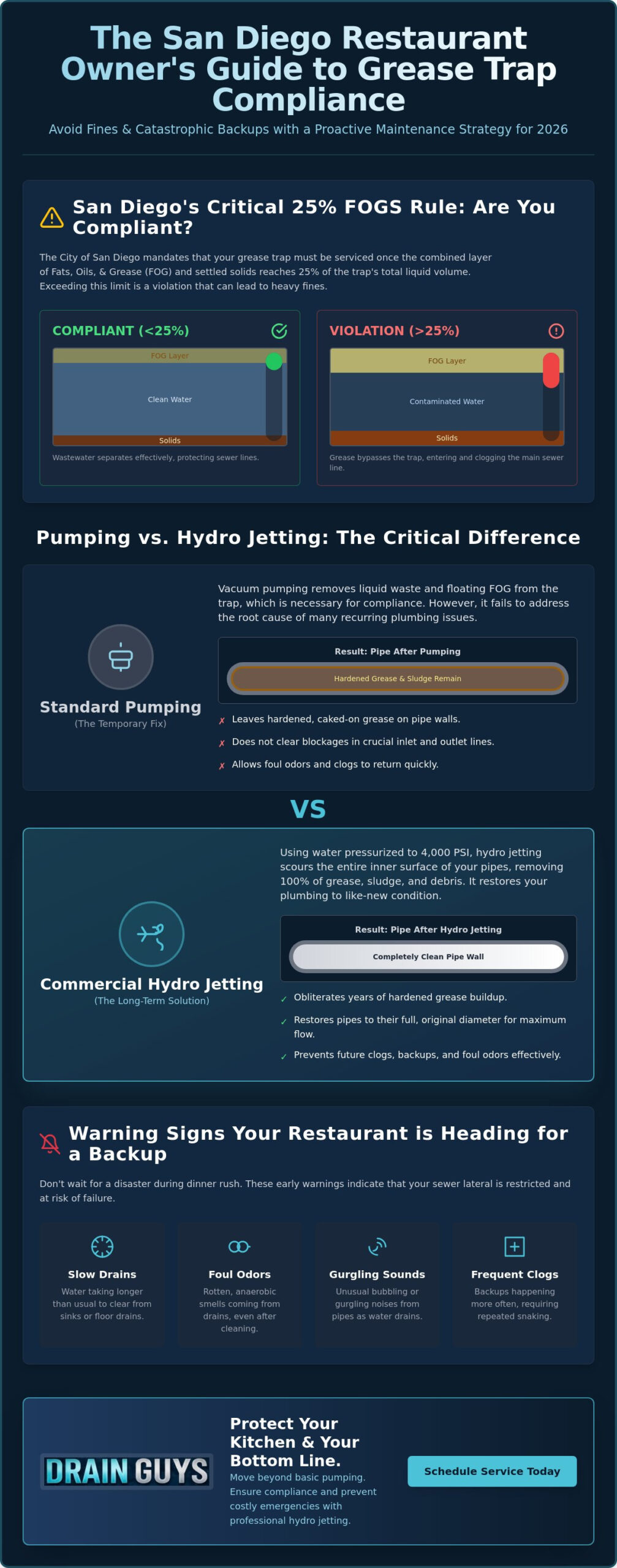
These systems use a series of internal baffles to slow down incoming wastewater. This pause allows lighter grease to float to the top and heavier solids to sink, letting relatively clean water exit through the middle. However, the 25% Rule is a non-negotiable regulation in San Diego. Once the combined FOG and solids reach 25% of the trap’s volume, the separation process fails. Grease starts bypassing the baffles and entering the main sewer line. Common failures we see include rotted seals and baffles that have been corroded by acidic food waste, which prevents the trap from doing its job even if it looks empty.
The San Diego FOG Program: What You Need to Know
The City of San Diego Public Utilities Department manages the Food Establishment Wastewater Discharge (FEWD) Program to keep our coastal waters clean. Since FOG is the leading cause of sewer overflows in the county, the FEWD program requires all 5,000 plus permitted facilities to maintain a localized FOG Log. This record must document every cleaning and inspection. If a health inspector visits your kitchen and your log is incomplete, you’re facing immediate compliance issues. Proper commercial hydro jetting san diego helps you maintain a clean record by ensuring your pipes meet the city’s strict discharge standards and preventing the solidified grease logs that trigger municipal red flags.
Pumping vs. Commercial Hydro Jetting San Diego: The Critical Difference
Many San Diego restaurateurs assume that as long as a truck shows up to pump their grease trap, their pipes are safe. This is a dangerous misconception. Pumping is simply the process of vacuuming out the liquid and floating solids from the center of the trap. It’s essentially a surface-level fix. While it satisfies the immediate need to empty the tank, it does nothing to address the hardened grease clinging to your pipe walls. This leftover residue, often called a grease ring, begins to decompose immediately. This is why you might notice foul odors returning just days after a service call. Beyond the smell, poorly maintained systems contribute to the environmental effects of grease pollution, which can lead to hefty municipal fines if grease escapes into the city main.
The difference between a cleared pipe and a clean pipe is the difference between a temporary fix and a permanent solution. When we use commercial hydro jetting san diego, we aren’t just moving the blockage further down the line. We’re stripping away the layers of accumulated waste that act like a magnet for more debris. This thoroughness is what protects your business from the sudden, catastrophic failures that disrupt service and damage your reputation. By maintaining your lines this way, you significantly reduce the risk of structural damage that eventually requires trenchless sewer repair San Diego.
The Limitations of Vacuum Pumping
Vacuum trucks are powerful, but their hoses can’t reach the grease stuck deep inside your inlet and outlet lines. When these lines stay restricted, your trap suffers from “short-circuiting.” This means new wastewater doesn’t have time to settle and instead rushes through a dirty, un-jetted trap and straight into the sewer. We often see kitchens facing recurring clogs every 30 days because they only rely on pumping, never actually cleaning the infrastructure itself. This cycle of neglect puts unnecessary stress on your plumbing, eventually leading to cracks or collapses that threaten your business continuity.
The Power of High-Pressure Hydro Jetting
This is where commercial hydro jetting san diego becomes essential. We use 4,000 PSI of water pressure to emulsify grease and scour the entire line all the way to the city main. Unlike a snake that just pokes a hole in a clog, jetting restores the pipe interior to a like-new state. This process removes the source of the odors and the cause of the clogs in one visit. Hydro jetting is the only way to remove hardened brown grease from internal baffles. Taking a proactive approach ensures your kitchen stays operational without the stress of emergency backups. We believe in providing solutions that last, which is why we recommend a professional sewer camera inspection to verify that your lines are completely clear and structurally sound.
San Diego Grease Trap Compliance and Maintenance Checklist
Staying compliant with San Diego’s Food Establishment Wastewater Discharge (FEWD) Program requires more than just luck. It’s about having a disciplined system in place. Most kitchens need professional service every 30 to 90 days, but your specific volume dictates the real schedule. We recommend a proactive approach that combines daily staff habits with advanced commercial hydro jetting san diego to ensure your lines never reach the breaking point. By focusing on prevention, you protect your business from the sudden closures that follow a major sewage backup.
Your staff is your first line of defense. Simple actions like scraping plates thoroughly into the trash and using high-quality sink strainers drastically reduce the FOG load on your interceptor. You should also perform a weekly visual check of your system. If you see “grease capping,” where the top layer has hardened into a solid crust, or notice slow drains during peak hours, your system is struggling. These are clear indicators that surface pumping isn’t enough. You likely need commercial hydro jetting san diego to clear the lateral lines and restore full flow capacity.
Determining Your Service Frequency
Not all kitchens are created equal. A high-volume Mexican restaurant or a fried chicken shop produces significantly more grease than a local bakery or coffee shop. To avoid guesswork, we use a “sludge judge” to measure the exact thickness of the grease and solid layers. Remember, the 25% rule isn’t just a suggestion; it’s the legal standard in San Diego. If your combined FOG and solids exceed one-quarter of the trap’s capacity, you’re technically out of compliance and at risk for fines.
Preparing for a San Diego Health Inspection
When an inspector from the Public Utilities Department walks through your door, they want to see your paperwork first. You’re required by local law to keep disposal manifests for at least three years. These documents prove that your waste was handled by a licensed hauler and disposed of at an approved facility. Beyond the logs, inspectors often check the “Baffle T” to ensure it’s not missing or corroded. If you want absolute peace of mind before an inspection, scheduling sewer camera inspections is the best way to prove your infrastructure is in top shape. It provides visual evidence that your pipes are clear and your business is operating responsibly.
Warning Signs Your Restaurant is Heading for a Backup
Plumbing failures rarely happen without warning. For a busy kitchen, the most common red flag is “Slow Drain Syndrome.” If your prep sinks or floor drains take several minutes to clear after a rush, you aren’t just dealing with a minor clog. This delay indicates that grease has narrowed the diameter of your pipes, leaving only a small opening for water to pass through. When you ignore these delays, you’re essentially waiting for a total blockage to occur at the worst possible moment. If you recognize these symptoms, it’s time to consider commercial hydro jetting san diego before the health department does it for you.
Persistent odors are another unmistakable sign of trouble. If a rotten egg or sour smell permeates your kitchen despite regular cleaning, your grease trap has likely gone anaerobic. This happens when the trap is so full that oxygen can no longer reach the bottom layers, allowing foul-smelling bacteria to flourish. You might also hear gurgling sounds from your floor drains. These noises are the “death rattle” of your plumbing system; they occur when air is struggling to displace water around a massive grease obstruction. You can schedule a full system evaluation to identify these hidden hazards before they reach your dining room.
The Danger of Grease Glaciers in Your Main Line
While your grease trap catches much of the waste, it cannot stop everything. As hot, greasy water travels 30 or 50 feet away from your kitchen sinks, it begins to cool and solidify. This creates “grease glaciers” in your main sewer lateral. These deposits are incredibly sticky and act like a magnet for hair, wet wipes, and food debris. This snowball effect can lead to a massive backup in your guest restrooms even if your kitchen sinks seem to be flowing. Standard snaking only pokes a hole through these glaciers, but commercial hydro jetting san diego is the only method that emulsifies the entire mass and flushes it out of your system for good.
Emergency vs. Preventative Maintenance
The financial impact of a sewage backup during a Friday night rush in La Jolla or Little Italy is staggering. Beyond the immediate repair costs, you face lost revenue, potential health department closures, and a damaged reputation that’s hard to rebuild. Investing in professional drain cleaning San Diego costs significantly less than a single day of lost business. Preventative maintenance is the strategy of servicing a system based on time rather than failure. By being proactive, you ensure your kitchen remains a safe, productive, and odor-free environment for your staff and customers alike.
San Diego Drain Guys: Your Commercial Hydro Jetting Experts
We’ve spent years refining our approach to the high-pressure demands of San Diego’s toughest commercial kitchens. Since 2018, we’ve provided specialized drainage solutions for businesses from Chula Vista all the way up to Oceanside. We know that in the restaurant industry, your reputation is built on reliability and cleanliness. That’s why we don’t just offer a quick fix. Our team focuses on the “Drain Guys Difference,” which means we don’t simply vacuum out your trap and leave. We use commercial hydro jetting san diego to restore your entire drainage system to its optimal state. By choosing a partner who understands the local regulatory landscape, you ensure your business stays open and compliant without the stress of unexpected backups.
Transparency is the foundation of our business. We believe you should never have to guess what your maintenance costs will be. We utilize a clear, flat-rate pricing model that eliminates hidden disposal fees, surcharges, or surprise hourly rates. This honesty allows you to budget effectively for your preventative maintenance without worrying about financial uncertainty. When we arrive at your facility, our goal is to provide a premium service experience that exceeds standard utility work. We treat your kitchen with the same respect and consideration we would a private home, ensuring our presence is professional, methodical, and discreet. If you are also looking for a similar level of care for your overall facility in the Sacramento region, we suggest you visit Cleanit Maintenance Systems for expert janitorial services.
Advanced Equipment for Superior Results
Our team uses industrial-grade jetters designed specifically to handle the heavy grease loads found in high-volume San Diego establishments. These aren’t standard residential tools; they’re high-output machines capable of emulsifying years of hardened buildup. To ensure the job is done right, we perform post-cleaning camera verification. We show you the clean pipe walls before we pack up our gear so you have total peace of mind. We also understand the rhythm of a commercial kitchen. We work around your specific schedule to minimize downtime, ensuring our commercial hydro jetting san diego services happen when they’re least disruptive to your staff and guests.
Beyond the Trap: Total Sewer Solutions
Sometimes, years of grease accumulation and corrosive waste can cause structural damage to your pipes that simple cleaning can’t fix. If our camera inspection reveals cracks, root intrusion, or leaks, we provide advanced repair options that don’t involve tearing up your flooring or disrupting your dining room. We offer CIPP sewer lining to fix these issues from the inside out using trenchless technology. This saves you time and money while reinforcing your infrastructure for the long term. Whether you need help with floor drains, grease traps, or main sewer laterals, we are your dependable partner for total pipe health. Contact San Diego Drain Guys today for a flat-rate commercial quote.
Protect Your Business with a Professional Maintenance Strategy
Running a successful restaurant in San Diego means staying ahead of municipal regulations and operational hazards. We’ve explored why simple grease trap pumping often falls short of the City’s 25% FOGS rule. It leaves your pipes vulnerable to massive grease glaciers that cause sudden backups. By choosing commercial hydro jetting san diego, you’re investing in a deep clean that restores your plumbing to like-new condition. This ensures you pass every health inspection with confidence and keep your kitchen running smoothly.
Our team at San Diego Drain Guys provides the peace of mind you deserve. As a locally owned and operated company since 2018, we understand the unique pressures of our local culinary scene. We use industrial-grade equipment and provide post-service camera verification so you can see the results for yourself. Our commitment to flat-rate, transparent pricing means you’ll never deal with hidden fees or surprise surcharges. Don’t wait for a backup to disrupt your dinner rush and damage your reputation. Schedule Your Commercial Hydro Jetting Service with San Diego Drain Guys today. We’re ready to help your kitchen stay clear, compliant, and odor-free.
Frequently Asked Questions
How often does a restaurant grease trap need to be cleaned in San Diego?
The City of San Diego requires grease traps to be cleaned whenever the combined amount of fats, oils, grease, and solids reaches 25% of the trap’s total volume. This is known as the “25% FOGS rule.” For most high-volume kitchens, this means scheduling a professional cleaning every 30 to 90 days to stay compliant with the FEWD program.
What is the difference between a grease trap and a grease interceptor?
The primary difference is the size and location of the unit. A grease trap, technically called a Hydromechanical Grease Interceptor (HGI), is a smaller device usually installed indoors under a sink or in the floor. A grease interceptor, or Gravity Grease Interceptor (GGI), is a much larger tank buried underground outside the facility that handles higher flow rates.
Can I clean my own restaurant grease trap to save money?
You can technically clean a small indoor trap yourself, but it’s rarely a practical solution for a busy business. You’re still legally required to transport the waste to a licensed disposal facility and maintain a manifest for health inspectors. Most owners prefer commercial hydro jetting san diego because it cleans the connecting lines that manual scooping simply cannot reach.
Why does my kitchen still smell after the grease trap was pumped?
Pumping only removes the liquid and floating waste from the center of the tank. It doesn’t remove the “grease ring” of decomposing solids stuck to the walls or the buildup inside your inlet and outlet pipes. These leftover residues continue to rot and produce foul odors until the entire system is scoured clean with high-pressure water.
What happens if my restaurant fails a San Diego FOG inspection?
Failing an inspection from the Food Establishment Wastewater Discharge (FEWD) program can lead to significant fines and mandatory re-inspections. If your facility is found to be the cause of a municipal sewer overflow, you could be held liable for the cleanup costs. The city may also suspend your permit if you don’t keep an accurate FOG log of your maintenance activities.
Is commercial hydro jetting safe for older pipes in Downtown San Diego buildings?
Hydro jetting is actually safer for older pipes than traditional mechanical snaking. We use a sewer camera to inspect the pipe’s integrity before we begin, allowing us to adjust the pressure to suit the material. This process removes clogs without the aggressive scraping or “knocking” that can damage fragile clay or cast iron lines in historic buildings.
Does San Diego Drain Guys provide the compliance paperwork for the health department?
We provide all the necessary disposal manifests and service documentation required by the City of San Diego. Our team makes sure you have a clear, physical record of your maintenance to keep in your FOG log. This documentation is vital for proving to inspectors that you are following the 25% rule and disposing of waste responsibly.
What should I do if my floor drains are backing up during a busy service?
Stop using all water-consuming appliances immediately to prevent the backup from flooding your kitchen or dining area. You should clear the area and call for professional assistance to locate the blockage. A backup during peak hours often indicates a deep clog in the main lateral line that requires commercial hydro jetting san diego to clear the obstruction and restore full flow.