
What if the “protection plan” you’re paying for is actually waiting for your home to flood before it offers any help? Many San Diego homeowners confuse sewer insurance with a technical sewer line maintenance plan, but there’s a vital difference between paying for the cleanup and preventing the disaster. With San Diego sewer rates set to increase by 6% in 2026, the financial stakes of home ownership are rising, especially in older neighborhoods where invasive tree roots and aging clay pipes are constant threats.
We understand the anxiety that comes with a slow drain or a gurgling toilet. It’s a heavy burden to worry about sudden, messy backups that could cost thousands in emergency repairs. This guide will show you how a proactive approach can provide total peace of mind and extend the lifespan of your plumbing. We’ll explore the specific components of a professional maintenance strategy, provide a clear annual checklist for pipe care, and help you navigate the 2026 landscape of local regulations and rising utility costs.
Key Takeaways
- Learn why you are legally responsible for the sewer lateral under your yard and how to manage it effectively to protect your property value.
- Understand the critical difference between insurance policies that cover damage and a technical sewer line maintenance plan that prevents the damage from occurring.
- Discover how professional services like hydro jetting and sewer camera inspections serve as the primary defense against invasive roots and debris.
- Identify San Diego-specific environmental risks, including aggressive Ficus tree roots and shifting canyon soils, that require specialized pipe care.
- Follow a clear, two-step implementation strategy to establish a health baseline for your pipes and avoid the high costs of emergency repairs.
What is a Sewer Line Maintenance Plan?
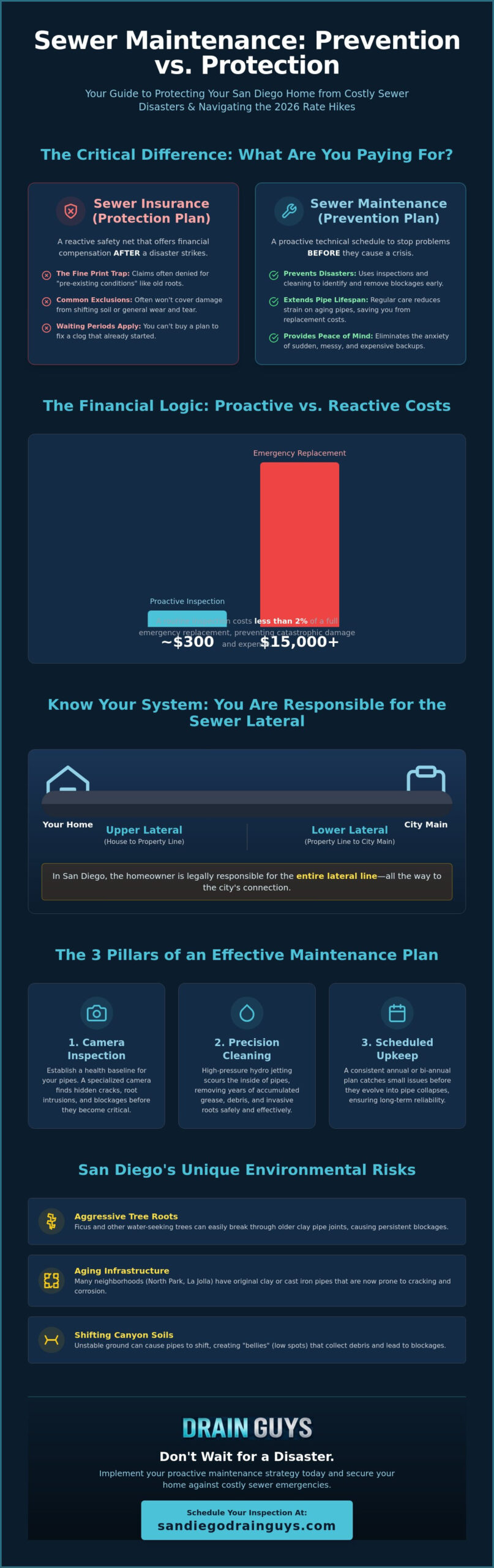
A sewer line maintenance plan is a proactive technical schedule designed to keep your home’s waste disposal system running without interruption. Instead of waiting for a backup to occur, this plan uses scheduled inspections and precision cleaning to identify and remove obstructions before they cause a crisis. It’s the difference between a controlled, affordable service call and an emergency excavation that tears up your driveway. We see many homeowners mistake a maintenance plan for a simple insurance policy, but a true plan focuses on the physical health of your pipes through active care.
In the sanitary sewer system, the homeowner is responsible for the “lateral” line. This is the pipe that connects your home to the city’s main line. Many people believe the municipal government takes over once the pipe leaves the house, but in San Diego, the homeowner typically owns the entire lateral right up to the connection point at the street. If that pipe fails under your yard or sidewalk, the repair bill belongs to you.
The financial logic of being proactive is clear. A professional inspection might cost around $300, while a total emergency pipe replacement can easily reach $15,000 or more depending on the depth and location. As we move into 2026, auditing your pipes is more critical than ever. San Diego’s infrastructure is aging; the clay or cast iron pipes installed decades ago in neighborhoods like North Park or La Jolla are reaching the end of their functional life and require a steady hand to maintain.
The Anatomy of Your Sewer System
Your system is divided into the upper lateral and the lower lateral. The upper lateral runs from your house to your property line, while the lower lateral extends from the property line to the city main. We find that most San Diego homes utilize one of three materials:
- Clay: Found in older neighborhoods; it’s prone to root intrusion and cracking at the joints.
- Cast Iron: Durable but susceptible to internal scaling and corrosion that catches debris.
- PVC: The modern standard; it’s resistant to roots but can still suffer from ground shifting or “bellies.”
Why ‘Wait and See’ is a Failing Strategy
Sewer issues are inherently hidden. Because these pipes are buried deep underground, degradation happens out of sight and often without any early warning signs. A minor root intrusion today doesn’t just stay minor; it acts as a net, catching grease and solid waste. Within 12 to 24 months, these small intrusions can cause a total pipe collapse. The sewer lateral is the most overlooked asset in home maintenance. We believe in catching these issues while they’re still manageable through a consistent sewer line maintenance plan, ensuring your home remains a safe and functional environment.
Protection Plans vs. Preventive Maintenance: Which is Better?
A check in the mail is small comfort when raw sewage is ruining your new hardwood floors. This is the fundamental gap between financial protection plans and a technical sewer line maintenance plan. While insurance policies act as a safety net after a disaster occurs, physical maintenance ensures the disaster never happens in the first place. For San Diego residents, choosing between the two requires a look at the fine print that often hides unpleasant surprises. We’ve seen too many homeowners pay monthly fees for years, only to have their claims denied when they need help the most.
The “fine print trap” is a common reality in the service industry. Many protection plans specifically exclude pre-existing conditions, which is a major hurdle for older properties. In neighborhoods with mature landscaping, tree roots have often been working their way into pipe joints for a decade or more. If a provider determines those roots were present before you signed up, they might deny your claim entirely. This leaves you with a monthly bill and a broken pipe. We believe a hybrid approach is the smartest path: start with physical maintenance to clear the line and document its health, then use insurance as a secondary backup for unpredictable events.
The Limits of Sewer Insurance Policies
Most sewer insurance policies come with strict exclusions. Common deal-breakers include “Acts of God,” shifting soil, and general wear and tear. Furthermore, these plans almost always have a waiting period. You can’t buy a plan today to fix a clog that started yesterday. Because of these limitations, we recommend a professional sewer camera inspection to establish a baseline of health. Knowing the actual state of your pipes is always more valuable than a promise on a piece of paper.
The ROI of Physical Maintenance
Physical maintenance offers a tangible return on investment that insurance cannot match. For homes that have already undergone trenchless repairs, regular cleaning is essential to protect that investment. Cured-In-Place Pipe (CIPP) lining has a 50-year lifespan, but only if it’s kept free of debris and scale that can cause premature wear.
- Preventing Backflow: Regular hydro jetting removes grease and sludge before they cause a backflow event that damages drywall and flooring.
- Increasing Resale Value: A documented history of annual maintenance is a powerful tool when selling your home, proving to buyers that the “hidden” infrastructure is in top condition.
- Extending Pipe Life: Removing minor root intrusions early prevents the structural cracks that eventually lead to total pipe collapse.
By focusing on the physical integrity of your drainage, you’re not just buying a safety net; you’re actively preventing the fall.
The 3 Pillars of an Effective Maintenance Plan
Building a reliable sewer line maintenance plan requires more than just crossing your fingers and hoping for the best. We focus on a disciplined, three-pronged approach that addresses the physical health of your pipes from every angle. By combining diagnostic technology with high-pressure cleaning and targeted chemical treatments, we can effectively reset your pipe’s clock. This methodology moves your home away from the risk of sudden failure and toward a state of long-term stability.
Sewer Camera Inspections: The Diagnostic Gold Standard
Precision begins with sight. A sewer scope near me in San Diego is the first pillar of any professional plan because it removes the guesswork. These high-definition inspections reveal the specific internal conditions of your lateral line, such as hairline cracks, pipe offsets caused by shifting soil, and “bellies” where water pools and collects debris. This video evidence is vital; it provides a clear record for insurance claims or real estate disclosures. We believe you should never authorize a major repair without seeing the raw footage first. Transparency is the foundation of trust in our industry.
Hydro Jetting: More Than Just a Cleaning
While traditional snaking simply pokes a hole through a clog to get water moving, hydro jetting services san diego homeowners rely on actually restore the pipe’s full diameter. This process uses specialized nozzles to blast away years of grease buildup, hard water scale, and stubborn root masses. It’s also the essential preparation step for future cipp applications, ensuring the new lining bonds perfectly to the host pipe. While a busy San Diego restaurant might need this quarterly, most residential homes only require a deep hydro jetting every two to three years to maintain peak performance.
Root Management and Foaming Inhibitors
The final pillar involves managing the biological threats to your system. In Southern California, roots are a year-round problem. We utilize foaming root killers like RootX, which expand to reach the very top of the pipe where roots usually enter through joints. The timing is important; applying these inhibitors during the growing season ensures the chemical is absorbed by the root tips for maximum effect. Mechanical removal of roots must be followed by chemical inhibition to prevent rapid regrowth. This combined effort ensures that once the line is clear, it stays clear, protecting your property from the invasive vegetation common in our older neighborhoods.
San Diego Challenges: Why Local Plans Differ
San Diego’s unique environment is beautiful, but it presents specific challenges that a generic sewer line maintenance plan simply cannot address. We don’t deal with the deep freezes that plague the Midwest; instead, we face aggressive local vegetation and a geological landscape that is constantly in motion. These variables mean that a home in North Park or La Jolla requires a different level of vigilance than a home in a more stable climate. Understanding these local nuances is the first step toward building a truly protective maintenance strategy for your property.
Aging infrastructure is a primary concern in our historic neighborhoods. Many homes built in the 1950s still rely on original cast iron pipes. While durable, these pipes are now reaching a critical age where internal corrosion and salt air exposure lead to significant thinning of the pipe walls. This makes them especially vulnerable to the heavy weight of San Diego’s mesa soils. We’ve found that coastal proximity can also accelerate the degradation of any exposed fittings, making regular professional audits essential for long-term pipe integrity.
Invasive Species and Your Lateral
The “Ficus Factor” is a reality every San Diego homeowner should understand. Ficus, Eucalyptus, and Brazilian Pepper trees are staples of our local landscape, but their root systems are incredibly aggressive. These roots sense the moisture and nutrients inside your sewer joints and will exert immense pressure to gain entry. Root intrusion is the leading cause of trenchless sewer repair san diego calls. You can identify “warning trees” by looking for large, established canopies within 20 feet of your sewer lateral path. If your neighbor has a massive Ficus near your property line, your pipes are likely already at risk.
Geological Impact on San Diego Pipes
San Diego’s “expansive clay” soil creates a cycle of stress for buried infrastructure. During our long dry spells, the soil shrinks and pulls away from the pipes. When heavy rains finally arrive, the clay swells rapidly. This movement causes pipe “offsets,” where sections of the line no longer align, creating a ledge that catches debris. In severe cases, especially along canyon rims, the soil shift is so significant that it can crush aging clay or cast iron lines. When pipes have moved too far to be repaired with a simple liner, we often utilize pipe bursting to install a brand-new line without digging up your entire yard. If you’re concerned about how local soil conditions are affecting your drainage, contact the experts at San Diego Drain Guys to schedule a comprehensive evaluation.
Implementing Your 2026 Maintenance Strategy
Taking control of your home’s infrastructure starts with a clear, actionable sewer line maintenance plan. Moving from a state of “emergency-only” repairs to a structured maintenance schedule is the most effective way to protect your property’s value and your bank account. In San Diego, where utility rates and repair costs continue to climb, a disciplined approach ensures you’re never caught off guard by a sudden backup. We’ve simplified this transition into four manageable steps that any homeowner can follow to secure their drainage system for 2026 and beyond.
- Step 1: The Baseline Sewer Scope: You can’t manage what you can’t see. We start by performing a comprehensive camera inspection to identify the current health of your pipes, noting any existing root intrusion or structural offsets.
- Step 2: The Deep Clean: Once we have a baseline, we use hydro jetting to clear out years of accumulated scale, grease, and debris. This restores the pipe to its original diameter and provides a clean slate for future monitoring.
- Step 3: Biennial Check-ups: For most residential properties, a recurring check-up every two years is sufficient to monitor changes in soil movement or root growth. This prevents small issues from turning into catastrophic failures.
- Step 4: The Sewer Diary: We encourage you to keep a digital folder of all inspection videos and invoices. Having this history in one place is invaluable for insurance claims or proving the health of your system to a potential home buyer.
DIY vs. Professional Maintenance
There are parts of your plumbing you can manage yourself, such as the proper disposal of FOG (Fats, Oils, and Grease). Never pour cooking grease down the drain; it acts like glue for other debris inside your lateral. However, you should avoid store-bought chemical drain cleaners at all costs. These caustic liquids are a temporary and dangerous fix that can actually accelerate the corrosion of aging cast iron pipes. We believe in a more transparent approach. Our team utilizes a flat-rate pricing structure, so you’ll always know the cost of your maintenance before the work begins. This eliminates the financial uncertainty that often prevents homeowners from seeking professional help.
The San Diego Drain Guys Approach
Our philosophy is built on “calm expertise” and a deep respect for your domestic environment. We understand that sewer work can be stressful, so we prioritize privacy and empathy in every home we visit. We use localized data from plumbing services san diego homeowners trust to build custom plans that reflect the specific needs of your neighborhood’s soil and vegetation. By combining technical skill with honest communication, we help you transition from worry to informed confidence. Schedule your baseline sewer camera inspection today and take the first step toward total peace of mind regarding your home’s drainage.
Secure Your Home’s Future with Proactive Care
Protecting your property starts with moving past the “out of sight, out of mind” mentality. We’ve explored how a technical sewer line maintenance plan provides a level of security that insurance policies simply cannot match by stopping backups before they occur. In a landscape of rising utility costs and aggressive local tree roots, your sewer lateral remains one of your most valuable, yet vulnerable, assets. This same proactive approach is essential for other systems; for instance, homeowners should explore Chimney Sweeping to ensure their fireplace and chimney are safe and efficient. By prioritizing annual inspections and precision cleaning, you ensure that San Diego’s shifting soils and aging infrastructure don’t lead to a financial crisis under your front yard.
Since 2018, our team has specialized in trenchless repairs and hydro jetting, bringing a disciplined and methodical approach to every home. We believe in building trust through transparency, which is why we utilize a flat-rate pricing model that eliminates surprises. You deserve the relief of knowing your home’s drainage is in capable hands. Take the first step toward long-term reliability by getting a clear picture of what’s happening underground.
Book Your San Diego Sewer Camera Inspection for Peace of Mind today. It’s time to trade plumbing anxiety for the confidence of a professional maintenance strategy.
Frequently Asked Questions
Is a sewer line maintenance plan worth the cost?
A sewer line maintenance plan is absolutely worth the investment because it prevents the catastrophic expense of emergency pipe replacement. By identifying issues like root intrusion early, you avoid the thousands of dollars required for yard excavation and interior water damage restoration. It’s a small price to pay for the peace of mind that your home’s most critical infrastructure is functioning correctly.
Does standard San Diego homeowners insurance cover sewer line repair?
Most standard San Diego homeowners insurance policies don’t cover the repair of the sewer lateral line. Coverage is usually limited to the damage caused by a backup inside the home, leaving the homeowner responsible for the actual pipe repair. We recommend checking with your agent about specific service line endorsements that can be added to your existing policy for better protection.
How often should I have my sewer line hydro jetted?
We generally recommend hydro jetting every 24 to 36 months for a standard residential property. If your yard has mature trees with invasive root systems, you may need a more aggressive schedule. Regular cleaning prevents grease and scale from hardening into a solid mass that eventually causes a total blockage and requires more invasive repair methods.
What are the early warning signs that my sewer line is failing?
Gurgling toilets and slow-moving drains across different areas of the house are primary indicators of a looming failure. You might also notice sewage odors or wet spots in your yard that don’t go away. These symptoms suggest that your sewer line maintenance plan should be activated immediately to prevent a full-scale backup into your living space.
Can tree roots be permanently removed from a sewer line?
Roots can be cleared, but they’ll grow back unless you install a trenchless liner or replace the pipe. Hydro jetting effectively cuts the roots out of the line, but the tiny cracks they entered through still remain. To extend the results of a cleaning, we use foaming chemical inhibitors that kill root tips and discourage them from returning quickly.
What is the difference between a sewer scope and a standard plumbing inspection?
A sewer scope is a specialized camera inspection of the buried lateral line, whereas a standard inspection only looks at visible fixtures. The scope travels deep into the ground to find structural defects that a normal plumber’s check would miss. This diagnostic tool is essential for seeing the actual condition of clay or cast iron pipes before they fail.
How much does a professional sewer maintenance plan cost in San Diego?
The cost of a maintenance strategy depends on the specific services your property requires, such as annual camera scopes or biennial cleaning. Because every home in San Diego has different pipe materials and environmental risks, we provide transparent, flat-rate pricing for each component. This ensures you only pay for what your system actually needs without any hidden surprises or financial uncertainty. For those looking for similar transparency in the UK, We are a trusted plumbing & Heating company providing reliable, high-quality services across London and Kent.
What happens if a maintenance inspection finds a major break?
Discovering a major break during a routine inspection allows you to plan a repair on your own terms. We’ll show you the camera footage and explain modern trenchless solutions like CIPP lining or pipe bursting. These methods fix the structural issue without destroying your landscaping, turning a potential disaster into a manageable home improvement project that protects your property value.