
What if the only thing standing between your finished basement and thousands of dollars in water damage is a battery that died three months ago? We understand the deep anxiety that sets in when San Diego weather reports start predicting another intense atmospheric river. It’s hard to find peace of mind when you’re constantly wondering if an aging pump will hold up or if a simple power outage will lead to a catastrophe. A reliable sump pump failure alarm serves as your critical last line of defense, giving you the early warning you need before a small leak becomes a major disaster.
We want to help you protect your home from catastrophic flooding by choosing the right technology and professional maintenance strategy. In this 2026 guide, we’ll explore the different types of alarm systems available, including smart home integrations that send alerts directly to your phone. We also cover the latest local building standards and how our professional sump pump services ensure your equipment remains dependable through every storm season. You’ll gain a clear understanding of which features matter most for your specific property and how to keep your system ready for the next big rain event.
Key Takeaways
- Learn why a sump pump failure alarm acts as an essential, independent safety net during San Diego’s increasingly frequent atmospheric river events.
- Evaluate the pros and cons of Wi-Fi, cellular, and local alarm systems to ensure you receive alerts even if your home’s power or internet goes out.
- Identify the primary mechanical and environmental factors, such as motor wear and local power outages, that most often trigger emergency warnings.
- Discover the step-by-step process for selecting a sensor and power configuration that matches your specific basement layout and connectivity levels.
- Understand why regular professional inspections are the only way to turn your alarm from a reactive warning into a proactive maintenance tool.
What is a Sump Pump Failure Alarm and Why is it Essential?
A sump pump failure alarm is a specialized, secondary sensor designed to act as your home’s early warning system. Unlike the integrated float switch that tells your pump when to run, this alarm operates entirely on its own. We often see homeowners confuse the two, but the distinction is vital. While a Sump pump is responsible for removing water, the alarm is responsible for telling you when that process has stopped. In San Diego, where our atmospheric river events can dump several inches of rain in a single day, this device is no longer a luxury. It is a non-negotiable safeguard for your property.
Without early detection, a failed pump can lead to catastrophic flooding in a matter of hours. We’ve seen local homeowners face five-figure water damage claims for structural repairs, mold remediation, and ruined personal belongings. These costs far outweigh the investment in a simple notification system. A high-quality alarm prevents these surprises by giving you the time needed to intervene before the water crests the pit and enters your living space.
The Role of the Alarm in Flood Prevention
The primary job of a sump pump failure alarm is to monitor water levels that rise above the normal “on” point of your primary pump. If the water reaches this critical height, it triggers a loud siren or a digital notification. Because these alarms typically use independent power sources, like long-lasting batteries, they remain active even if a circuit breaker trips or your home loses power. This independence provides essential peace of mind during San Diego’s winter storm season. You can rest easy knowing that if your mechanical system falters, your electronic watchdog will speak up immediately.
When a Backup Pump Isn’t Enough
Many homeowners believe a battery backup pump is the ultimate solution. While we highly recommend backup pumps, they aren’t foolproof. There are scenarios where both the primary and backup pumps fail simultaneously. This happens if a shared discharge pipe becomes blocked by debris or if a catastrophic float switch failure occurs on both units. In these rare but devastating moments, the alarm serves as the final safety net. By introducing a “human-in-the-loop” notification, it ensures you aren’t walking into a flooded basement the next morning. It gives you the chance to call for professional sump pump services before structural damage occurs.
Types of Sump Pump Alarms: Comparing Your Options
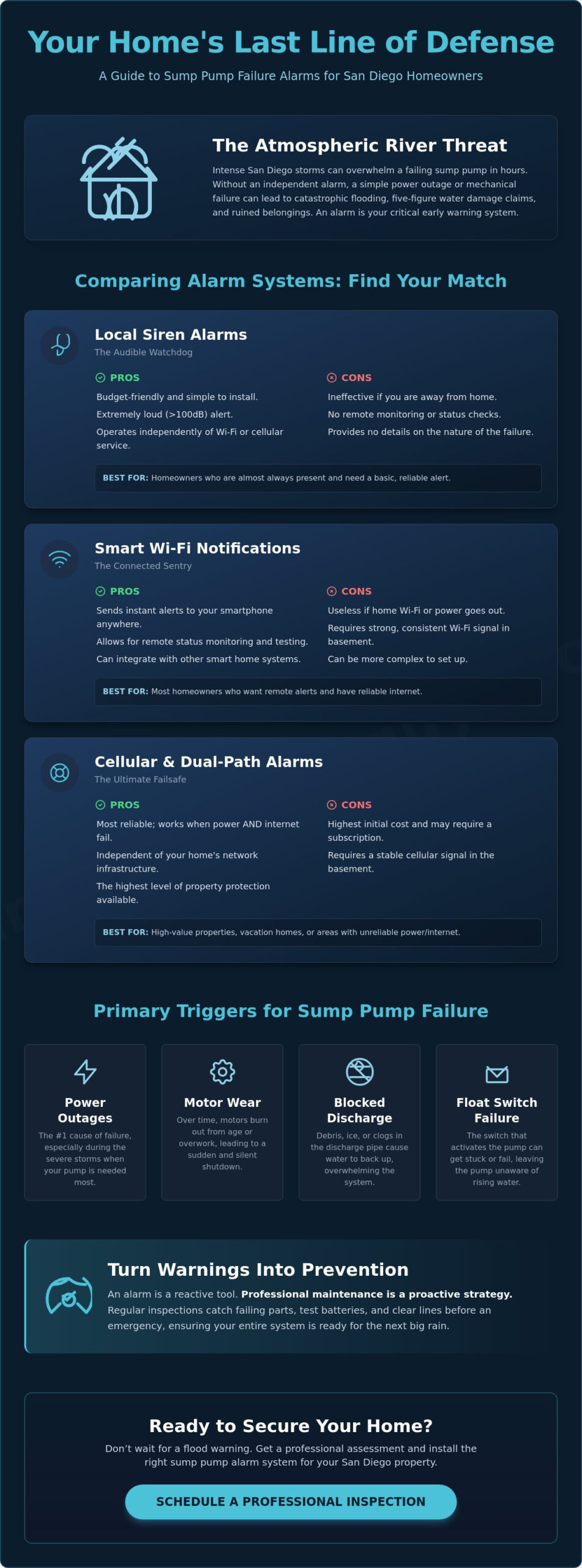
Selecting the right sump pump failure alarm depends on how you use your home and the specific risks of your property. While every alarm aims to prevent flooding, the technology they use to reach you varies significantly. We categorize these devices into three main types: local, Wi-Fi, and cellular. Each has a specific role in a home protection plan, and choosing the wrong one can leave you vulnerable when San Diego’s weather turns volatile. If you’re unsure which setup fits your home’s layout, our team can provide a professional assessment as part of our comprehensive sump pump services.
You also need to consider how the device is powered. Plug-in models are convenient, but they’re useless during the power outages that often accompany Southern California thunderstorms. We always recommend models with a dedicated battery backup. Additionally, you’ll choose between float-switch sensors, which trigger when water physically lifts a buoy, and moisture probes that detect water through electrical conductivity. Float switches are generally more durable for the turbulent environment inside a sump pit.
Local Siren Alarms vs. Smart Wi-Fi Notifications
Local siren alarms are the most budget-friendly option. These devices emit a piercing sound, often exceeding 100dB, the moment water levels rise too high. They’re excellent for homeowners who are almost always present. However, their main weakness is silence when you’re away. If you’re at work or running errands, a siren won’t save your basement. Smart Wi-Fi notifications solve this by sending alerts directly to your smartphone. These systems allow for remote status monitoring and even let you test the alarm from your office. They’re slightly more complex to install, as they require a consistent, strong signal in your basement or crawlspace.
Cellular and Dual-Path Communication
For high-value estates or secondary vacation properties, Wi-Fi might not be reliable enough. San Diego’s canyons and coastal bluffs often create “dead zones” where home internet can be spotty. Cellular alarms use independent data networks to send alerts, meaning they work even if your home’s router loses power or your internet service provider goes offline. Dual-path systems are the gold standard, using both Wi-Fi and cellular signals to ensure a message always gets through. This level of redundancy is essential for anyone who travels frequently or owns property in areas prone to infrastructure failure during heavy rain.
Common Causes of Sump Pump Failure in San Diego
A sump pump failure alarm provides the warning, but identifying the root cause is the first step toward a permanent solution. In our experience working with San Diego properties, mechanical failure remains the most frequent reason an alarm sounds. These systems are hardworking machines with moving parts that eventually wear out. When a motor burnouts or a switch fails, the alarm is often the only thing standing between a dry home and a costly flood. We see these failures most often during the intense rain cycles that follow our long dry seasons.
Power outages are another major culprit. Heavy Southern California thunderstorms can knock out local grids, leaving your primary pump useless if it lacks a dedicated backup. Additionally, the “stuck float switch” is a common phenomenon. This happens when the pump vibrates against the side of the pit or debris entangles the float, preventing it from rising with the water level. Without a functioning switch, the pump never receives the signal to start, even if the motor is in perfect condition. We also find that discharge pipe blockages, often caused by invasive tree roots or accumulated debris, can lead to a backup that triggers your high-water alert.
Mechanical and Electrical Breakdowns
Motor burnout is a reality for any pump approaching the end of its typical 7 to 10 year lifespan. As internal components age, they become less efficient and more prone to seizing during the heavy workloads of an atmospheric river. We also frequently find that a tripped circuit breaker has disabled a perfectly good pump. This is a silent killer because you won’t realize the power is out until the water starts rising. We recommend checking your GFCI outlets regularly. These outlets protect you from electrical shocks in wet environments, but they can be sensitive and trip unexpectedly, cutting power to your entire system.
External Blockages and Environmental Factors
San Diego’s specific soil types often lead to silt and sediment buildup in the sump pit. Over time, this fine material can be sucked into the intake screen, choking the pump and causing it to overheat. While rare, homeowners in inland San Diego areas like Ramona or Alpine should also be aware of frozen discharge lines during winter cold snaps. A blocked pipe means the water has nowhere to go but back into your basement. For a complete system evaluation, it’s wise to consult professional plumbing services in San Diego to ensure your drainage lines are clear and your equipment is sized correctly for your home’s specific needs.
How to Choose and Install Your Failure Alarm
Selecting the right sump pump failure alarm requires a clear understanding of your home’s infrastructure. We recommend starting with a thorough assessment of your connectivity. If your basement or crawlspace has thick concrete walls, a standard Wi-Fi signal might struggle to reach your router. In these cases, you’ll need to decide between a cellular model or installing a Wi-Fi range extender before you commit to a specific device. Once you’ve confirmed your signal strength, select a sensor type that fits your pit configuration. Float-style sensors work well in large, open pits, while vertical probes are often better for cramped spaces where a float might get snagged on the pump housing.
Installation is a straightforward process, but precision is required to ensure the system works when you need it most. You must determine the optimal mounting height for the sensor so it doesn’t interfere with the pump’s normal cycle. After mounting, you should manually test the alarm by lifting the float or wetting the probe with a small cup of water. Finally, for smart models, take the time to set up multiple notification contacts. We suggest including a trusted neighbor or a family member who lives nearby, ensuring someone is alerted even if you’re unreachable. If you are uncomfortable working inside the pit, our team can handle the entire setup as part of our specialized sump pump services.
Positioning the Sensor for Maximum Lead Time
We often talk about the “Goldilocks Zone” for sensor placement. If you place the sensor too low, you’ll deal with “nuisance tripping,” where the alarm sounds during a normal heavy rain because the water hasn’t had time to drain yet. If you place it too high, you won’t have enough time to react before the water overflows. The ideal sensor height is 2-3 inches above the primary turn-on point. This specific gap provides a buffer that accounts for the pump’s natural delay while still giving you a critical head start to address the issue.
Testing and Maintenance Routine
A sump pump failure alarm is only useful if it’s functional. We suggest a quarterly testing schedule to verify the health of your backup batteries. Batteries in these devices are often neglected, yet they’re the most likely point of failure during a storm. You should also take a moment to wipe down sensor probes with a damp cloth. Over time, the mineral-rich water in San Diego can leave behind deposits that insulate the probe, leading to false readings or total failure. Lastly, don’t forget to update your device settings if you change your home Wi-Fi password, as a disconnected smart alarm is no better than a “dumb” one.
Professional Sump Pump Maintenance with San Diego Drain Guys
We view a sump pump failure alarm as a vital messenger, but it’s not a solution for a mechanical breakdown. While the alert tells you there’s a problem, our team provides the expert diagnosis and repair needed to keep your home dry. We believe in total transparency, which is why we utilize a specific, flat-rate pricing model for our sump pump diagnostics. You’ll know the cost upfront, removing the financial uncertainty that often comes with emergency plumbing. Scheduling a professional inspection before the rainy season allows us to catch small issues before they trigger a midnight alarm. Our goal is to move you from a state of concern to a state of informed confidence in your home’s defenses.
Our comprehensive flood prevention services go beyond simple repairs. We evaluate the entire environment of your sump pit, checking for sediment buildup, discharge pipe integrity, and electrical safety. By handling the technical details, we ensure your equipment operates at peak efficiency when San Diego’s weather is at its worst. This methodical approach is designed for homeowners who value competence and want the job done correctly without any hidden surprises or unnecessary complications.
Why DIY Installation Can Sometimes Fail
Improper tethering of float switches is a common mistake we see in DIY setups. If a sensor or its wiring is not secured correctly, it can actually drift into the path of the pump’s mechanical parts. This can cause the pump to jam, creating the very failure you were trying to prevent. Our professional plumbers ensure that your sump pump failure alarm is calibrated and positioned so it never interferes with the pump’s operation. This certified installation provides the peace of mind that comes from knowing a “calm expert” has verified every component of your safety net.
Beyond the Alarm: Comprehensive Flood Protection
A multi-layered defense is the only way to truly protect a high-value property. Integrating a reliable alarm with healthy main lines, often maintained through trenchless sewer repair, creates a robust drainage system that handles heavy runoff with ease. We help San Diego homeowners look at the big picture, from the pit in the basement to the pipes leading to the street. We encourage you to schedule a pre-storm check-up to ensure your entire system is ready. Taking proactive steps today prevents the stress of a flooded home tomorrow and ensures your property remains a safe, dry environment for your family.
Secure Your Home’s Future Against Flood Damage
Protecting your property from San Diego’s unpredictable atmospheric rivers requires more than just a functioning pump. We’ve seen how a sump pump failure alarm acts as a critical secondary defense, providing the early warning needed to prevent five-figure repair bills. By choosing the right technology and maintaining a strict testing schedule, you can replace storm-season anxiety with lasting peace of mind.
Our team has been locally owned and operated since 2018, and we bring specialized expertise in high-water table drainage unique to our coastal and canyon communities. We believe in complete honesty, which is why we offer transparent, flat-rate pricing for all our diagnostic and maintenance services. You don’t have to face the next rainy season alone or wonder if your equipment will hold up under pressure.
Get Professional Sump Pump Protection in San Diego Today
We are ready to help you build a multi-layered defense that keeps your basement dry and your home safe. Reach out to us to schedule your pre-storm inspection and rest easy knowing your flood protection is in capable hands.
Frequently Asked Questions
Will a sump pump alarm work if the power goes out?
Yes, most dedicated alarms are designed to operate during power outages using internal battery backups. Since intense storms often cause local grid failures in San Diego, having a battery-powered sump pump failure alarm is essential for continuous protection. We recommend checking your batteries every six months to ensure the device remains ready. This redundancy ensures you receive an alert even when your primary pump loses its power source.
How loud are most sump pump failure alarms?
Most dedicated alarms produce a sound between 80 and 120 decibels. For context, 100 decibels is roughly equivalent to the volume of a lawnmower or a handheld drill. This piercing tone is designed to be heard through basement doors and floorboards. If you have a large home or sleep soundly, we suggest a model that also sends digital notifications to your phone for extra security and peace of mind.
Can I connect my sump pump alarm to my smart home system?
Yes, many modern alarms are compatible with popular smart home ecosystems. You can find models that connect via Wi-Fi or Zigbee to integrate with platforms like Amazon Alexa or Google Home. These systems allow you to receive push notifications and monitor the status of your pit remotely. This connectivity is particularly helpful for San Diego homeowners who travel frequently or own secondary properties in the area.
What is the difference between a water leak detector and a sump alarm?
A water leak detector is a passive sensor that sits on the floor to detect puddles from burst pipes or leaking water heaters. In contrast, a sump pump failure alarm uses a specialized sensor mounted inside the pit to monitor rising water levels. It provides an earlier warning by alerting you before the water ever reaches your floor, giving you more time to react to a mechanical failure.
How often should I replace the batteries in my pump alarm?
You should replace the batteries in your alarm at least once per year. Even if the alarm hasn’t sounded, batteries can lose their charge over time in the damp environment of a basement or crawlspace. Many smart models include a low-battery notification feature, but we still suggest a manual check before the winter rainy season begins. This simple step ensures your watchdog stays awake when you need it most.
Does a sump pump alarm prevent my basement from flooding?
No, an alarm is purely a notification device and does not move water on its own. Its job is to tell you that your pump has failed so you can take action, such as starting a backup pump or calling for professional help. To actually prevent flooding, you must pair your alarm with a well-maintained primary pump and, ideally, a reliable battery-powered backup system.
Where is the best place to mount the alarm sensor in the pit?
The sensor should be mounted approximately two to three inches above the point where your primary pump normally turns on. This placement ensures the alarm only sounds if the pump fails to keep up with the water level. If you mount it too high, you lose valuable reaction time before an overflow. If it’s too low, you’ll deal with annoying false alarms every time it rains heavily.
Are there sump pump alarms that don’t require a monthly subscription?
Yes, many high-quality alarms do not require any ongoing subscription fees. Local siren models are a one-time purchase, and many Wi-Fi-enabled devices offer free app-based alerts without recurring costs. While some cellular models require a small data plan for the SIM card, there are plenty of reliable options that provide excellent protection without adding a recurring monthly expense to your household budget.