
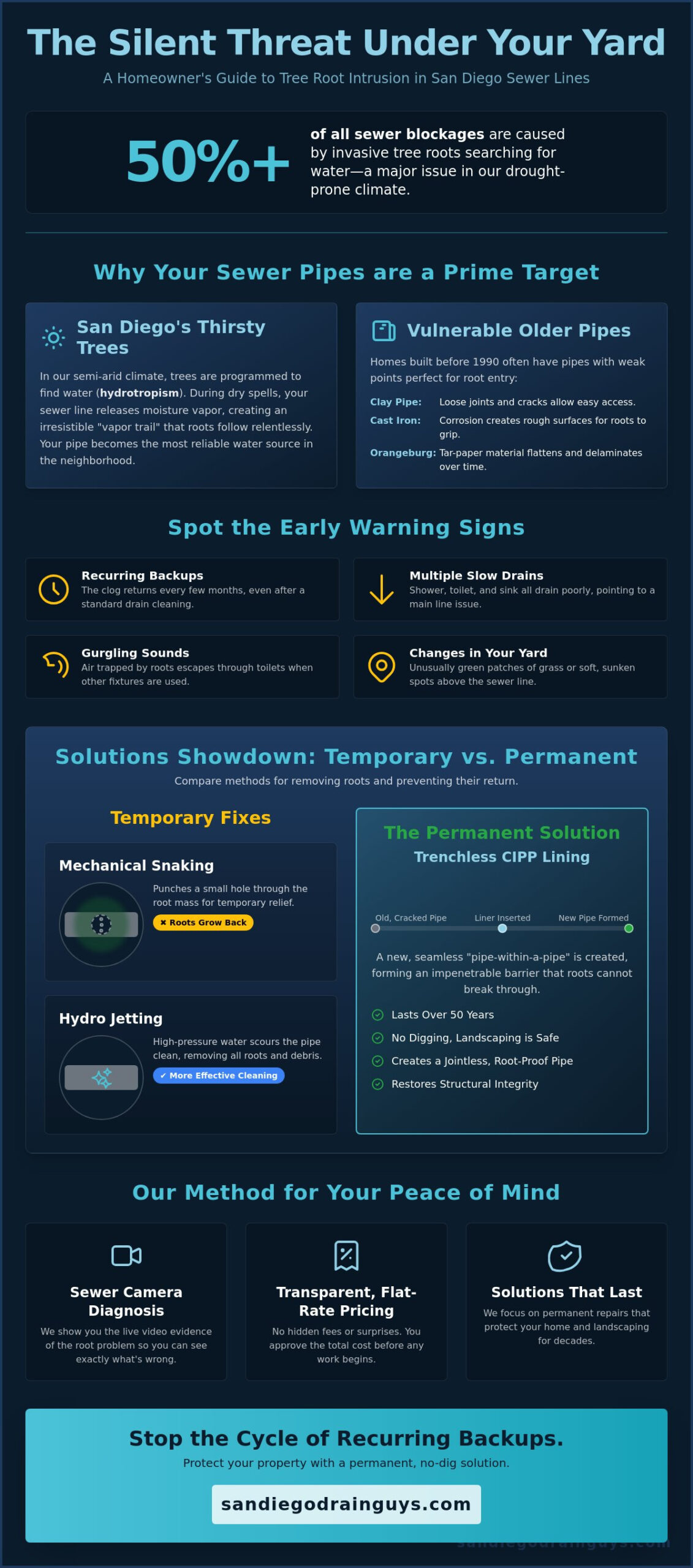
Did you know that root intrusion is responsible for over 50% of all sewer blockages? In our drought-prone climate, thirsty trees are naturally programmed to seek out the moisture hidden inside your plumbing. If you’re struggling with tree roots in sewer line San Diego properties, you aren’t just fighting a simple clog; you’re fighting a biological search for survival. It’s exhausting to pay for a plumber to snake your line only to have the same backup return a few months later.
We understand the anxiety that comes with every slow drain and the fear that a permanent fix requires destroying your carefully maintained landscaping. You shouldn’t have to choose between your garden and a functioning sewer. This 2026 guide reveals how we use advanced trenchless technology to stop root intrusion for good without digging up your yard. We’ll explain why San Diego homes built before 1990 are at such high risk, the diagnostic proof needed to identify the breach, and how modern pipe lining offers a solution designed to last for over 50 years.
Key Takeaways
- Understand how San Diego’s semi-arid climate and “hydrotropic” root behavior turn your sewer lines into a primary target for local trees.
- Identify the critical warning signs of tree roots in sewer line San Diego properties, such as recurring backups and gurgling toilets, before they lead to a sewage emergency.
- Compare temporary fixes like mechanical snaking against high-pressure hydro jetting to determine which method best clears your immediate blockage.
- Explore how trenchless CIPP lining creates a permanent, jointless barrier that roots cannot penetrate, protecting your landscaping from invasive excavation.
- Learn why a methodical diagnostic approach and transparent, flat-rate pricing are essential for managing high-stress plumbing repairs with total peace of mind.
Why Tree Roots Invade San Diego Sewer Lines
Roots don’t enter your plumbing by accident. They’re biologically programmed to find water through a process called hydrotropism. This scientific phenomenon describes how plant roots invade pipes by sensing moisture gradients in the soil and growing toward them. When you have tree roots in sewer line San Diego systems, the tree has essentially discovered a 24/7 irrigation source. Your sewer line doesn’t just carry water; it carries a constant flow of warm, nutrient-rich waste. To a tree, this is the perfect fertilizer, packed with nitrogen and phosphorus that fuel rapid growth once the first tiny hair-root breaks through a seal.
The Role of San Diego Drought Conditions
Our semi-arid climate in Southern California plays a major role in this struggle. During extended dry spells, the upper layers of soil lose all moisture. Trees respond by sending their root systems deeper and wider to survive. This creates a “vapor trail” effect. Tiny cracks or loose joints in your sewer line release warm moisture vapor into the surrounding dry earth. Thirsty roots follow this trail with pinpoint accuracy. We often see cases where a tree in a neighbor’s yard, or even a street tree two houses down, has traveled dozens of feet to reach a resident’s main line. Managing tree roots in sewer line San Diego properties requires understanding that the lack of rainfall makes your sewer pipe the most reliable water source in the neighborhood.
Vulnerable Pipe Materials in Older SD Neighborhoods
The age of your home often dictates your level of risk. In historic San Diego neighborhoods like North Park, Hillcrest, and Kensington, many properties still rely on original clay pipes. These pipes were installed in short sections, creating a joint every few feet. Over time, the soil shifts, these joints settle, and gaps open up just wide enough for a root tendril to enter.
Cast iron pipes, common in mid-century builds, present a different challenge. As they age, they develop internal corrosion and “scale.” This rough surface provides a perfect anchor for roots to latch onto once they find a way in through a rusted-out section. Perhaps most at risk are homes with Orangeburg pipes, which are made of bituminized fiber (essentially tar-soaked wood pulp). These pipes are known to flatten and delaminate, making it incredibly easy for invasive roots to penetrate and destroy the structure. Identifying these materials is the first step in our professional diagnostic process.
Warning Signs of Root Intrusion in Your Plumbing
Recognizing the early signs of tree roots in a sewer line can save you from a catastrophic backup and the stress of an emergency repair. When homeowners deal with tree roots in sewer line San Diego properties, the most common symptom is a recurring backup that happens every few months. You might pay for a standard drain cleaning, only for the line to stop up again 90 days later. This frustrating cycle occurs because mechanical snaking often just punches a small hole through the root mass rather than removing it entirely. If you notice slow drainage across multiple fixtures simultaneously, such as your shower and kitchen sink both draining poorly, the blockage is likely in the main sewer lateral rather than a single branch pipe.
Your yard often tells a story that your indoor plumbing hasn’t finished yet. Because roots seek moisture and nutrients, a leaking sewer line acts like a localized irrigation system. You might notice a patch of grass that is significantly greener or grows faster than the rest of your lawn. In more advanced cases, as the roots expand and displace soil, or as water leaks out and erodes the ground, small soft spots or even minor sinkholes can appear directly above the path of your sewer line. These exterior warnings are clear indicators that the structural integrity of your pipe is compromised and requires professional attention.
The Gurgle Test: Identifying Early Warning Signs
Have you ever heard a strange gurgling sound coming from your toilet while the washing machine is running or after you finish a shower? This happens because the root mass creates a partial obstruction that traps air bubbles. As water tries to force its way past the “root ball,” the displaced air escapes through the nearest vent, which is often your toilet. We consider this gurgle a critical warning sign. It often precedes a total main line stoppage by just a few days or weeks. Differentiating this from a local clog is simple: if the gurgle happens in one room while water is running in another, it’s almost certainly a main line issue.
Confirming the Problem with a Sewer Camera Inspection
Guessing about the condition of your pipes is the most expensive way to handle a plumbing problem. We use high-definition technology to provide absolute certainty before any work begins. When you schedule a sewer scope near me, we insert a waterproof camera into the line to see exactly what’s happening in real time. This reveals the precise entry points of the roots and the specific extent of the damage. Seeing the proof on a monitor allows us to move from speculation to a methodical repair plan. If you suspect tree roots in sewer line San Diego issues are affecting your property, we recommend you start with a professional diagnostic to get the facts.
Removing Tree Roots: Hydro Jetting vs. Traditional Snaking
Once you’ve confirmed the presence of tree roots in sewer line San Diego systems using a high-definition camera, you’re faced with a choice. Most homeowners are familiar with the “drain snake” or mechanical auger. While this is a common first response, it rarely solves the underlying problem. A snake uses a rotating blade to cut through the center of a root mass. We often call this a “temporary haircut.” It restores flow by punching a hole through the blockage, but it leaves the root stubs firmly embedded in the pipe joints. These remaining fragments don’t just stay there; they’re biologically triggered to grow back.
Much like pruning a hedge in your garden, cutting the roots can cause them to grow back more aggressively. This “root rebound” often leads to a thicker, more stubborn blockage within just a few months. To stop this cycle, we need a method that cleans the entire circumference of the pipe rather than just the center. Dealing with tree roots in sewer line San Diego properties requires a shift from temporary clearing to total decontamination of the pipe walls.
How Hydro Jetting Clears the Path
We utilize hydro jetting services san diego residents trust because it’s the only way to achieve a surgical-level clean. This process uses specialized nozzles to blast water at 4,000 PSI. Instead of just poking a hole, the water scrubs the pipe walls, shearing roots off flush with the entry point. This high-pressure stream also flushes away years of accumulated grease, sludge, and mineral scale. It’s surprisingly safe for older clay or cast iron pipes because it doesn’t rely on the physical impact of a metal blade. By removing the biological material entirely, we eliminate the immediate food source that encourages rapid regrowth.
Comparing Costs and Longevity
While snaking might seem cheaper upfront, the long-term ROI is poor when you consider the frequency of service. Homeowners often find themselves calling a plumber three or four times a year to clear the same line. Hydro jetting provides a much longer window of relief. Most importantly, thorough cleaning is an absolute prerequisite for any permanent repair. If you plan to install a trenchless liner, the pipe must be completely free of debris so the epoxy can bond correctly. We view hydro jetting not just as a cleaning tool, but as the essential foundation for a 50-year solution. It transitions your plumbing from a state of constant emergency to a state of prepared stability.
Permanent Solutions: Trenchless Sewer Lining and Repair
Once your pipes are cleaned of debris, we move to the final stage of permanent removal. For residents dealing with tree roots in sewer line San Diego systems, the goal isn’t just to clear the path, but to seal the entry points forever. Modern trenchless technology allows us to rehabilitate your sewer line from the inside out. This approach eliminates the need for massive trenches that destroy your landscaping, driveway, or sidewalk. We focus on two primary methods: Cured-In-Place Pipe (CIPP) lining and pipe bursting.
CIPP lining involves inserting a flexible tube saturated with a specialized epoxy resin into your existing pipe. Once in place, the tube is inflated and cured, creating a brand new, structural pipe within the old one. The most significant benefit for root prevention is that the new pipe is entirely seamless. Roots generally enter through joints and cracks; by creating a jointless barrier, we remove the opportunity for intrusion. The high-strength epoxy resin is chemically engineered to be impenetrable to even the most aggressive Southern California root systems.
The Science of CIPP for Root Prevention
The seamless design of cipp is what makes it the gold standard for root-prone neighborhoods like North Park and La Jolla. Because the material bonds to the host pipe and hardens into a solid sleeve, it leaves no gaps for moisture vapor to escape. As we discussed earlier, roots follow vapor trails. By eliminating these signals and the physical openings, we provide a solution with a documented 50-year lifespan. It’s a methodical way to protect your property value while ensuring your plumbing remains reliable for decades.
Pipe Bursting for Severely Compromised Lines
Sometimes, tree roots in sewer line San Diego properties have caused so much damage that the original pipe is collapsed or too misshapen for a liner. In these cases, we utilize pipe bursting. This technique involves pulling a high-density polyethylene (HDPE) pipe through the old line using a powerful bursting head. The head breaks apart the old pipe while simultaneously pulling the new, jointless HDPE pipe into place. This trenchless sewer repair san diego homeowners prefer is ideal for lines that have suffered structural failure but still require a no-dig solution.
If you’re tired of temporary fixes and want to secure your home’s infrastructure, contact us for a professional trenchless sewer repair consultation today.
Professional Root Removal in San Diego: The Drain Guys Difference
We approach every sewer emergency with a calm, methodical mindset. When you’re facing tree roots in sewer line San Diego properties, the last thing you need is a high-pressure sales pitch or a confusing list of hourly charges. Our team acts as a protective partner, providing you with the technical expertise and high-definition diagnostic proof required to make an informed decision. We take pride in our local roots; we understand how San Diego’s specific soil conditions and invasive species, like thirsty Ficus and Eucalyptus trees, interact with our city’s aging infrastructure. This local knowledge allows us to anticipate challenges that national franchises might overlook.
Our pricing model is a core part of our identity. We use a transparent, flat-rate fee structure that eliminates the “hidden fee” anxiety often associated with major plumbing repairs. You’ll know the scope of work and the final cost before we ever begin the physical labor. This honesty allows us to build immediate trust, ensuring you feel confident that your home is in capable hands. We don’t just clear a clog; we provide a premium service experience that prioritizes long-term stability over a quick, temporary fix.
Respecting Your Home and Privacy
Plumbing issues are personal and often sensitive. We recognize that our workspace is your sanctuary, so we maintain a disciplined, clean workspace from start to finish. Our commitment to empathy means we prioritize trenchless methods whenever possible to minimize the footprint of our work. By avoiding massive excavation, we protect your personal environment and maintain the privacy of your domestic life. During a consultation, we walk you through our standardized operational steps. This ensures you understand how we intend to restore your peace of mind with minimal disruption to your landscaping or daily routine.
Next Steps: Scheduling Your Inspection
Taking the first step toward a permanent solution shouldn’t be stressful. We follow a steady, logical methodology that begins with a comprehensive camera inspection. This allows you to see the tree roots in sewer line San Diego pipes for yourself and verify the exact condition of your infrastructure. From there, we move from diagnosis to a tailored plan for permanent lining or replacement. If you’re ready to stop the cycle of recurring backups, contact our team for a transparent quote on drain cleaning san diego services. We’re here to provide the relief of a job done correctly the first time, backed by the honesty and skill your home deserves.
Restore Your Peace of Mind with Permanent Sewer Protection
San Diego’s unique climate means your plumbing is always a target for thirsty trees. We’ve seen how temporary fixes like snaking lead to a cycle of recurring clogs and anxiety. By choosing advanced trenchless technology, you aren’t just clearing a blockage; you’re installing a jointless, 50-year barrier that roots simply cannot penetrate. We believe every homeowner deserves a solution that protects their landscaping and their wallet. Our goal is to move your home from a state of constant emergency to one of long-term stability.
As 5-star rated San Diego sewer experts, we specialize in high-definition camera inspections and transparent, flat-rate pricing. We eliminate the guesswork and hidden fees, ensuring you have the diagnostic proof needed to move forward with confidence. If you’re tired of fighting tree roots in sewer line San Diego systems, it’s time to partner with a team that values your property’s integrity as much as you do. We are proud to be the advanced trenchless technology specialists you can depend on for lasting results.
Get a Permanent Solution for Sewer Roots—Schedule Your Inspection Today. We’re ready to help you stop the backups and reclaim your yard with a professional, no-nonsense approach.
Frequently Asked Questions
How much does it cost to remove tree roots from a sewer line in San Diego?
The cost for removing tree roots in sewer line San Diego homes depends on the severity of the intrusion and the chosen removal method. While basic mechanical clearing is often the least expensive upfront option, it typically requires multiple visits per year to keep the line open. We provide transparent, flat-rate pricing after a diagnostic inspection so you know the exact total before we start. This approach prevents financial surprises and ensures you’re paying for a lasting solution rather than a temporary fix.
Can I use chemical root killers like RootX to solve the problem myself?
Chemical root killers like RootX are generally effective only as a preventative measure rather than a solution for established blockages. While these products can help inhibit new growth, they cannot remove thick root masses that have already compromised the pipe’s structure. Additionally, pouring chemicals down the drain doesn’t address the cracks or gaps where the roots entered. For a permanent fix, we recommend professional mechanical removal followed by a structural liner to seal the entry points for good.
Will insurance cover the cost of tree root removal in my sewer line?
Standard homeowners insurance policies typically don’t cover the cost of removing tree roots because they view it as a maintenance responsibility. However, if the root intrusion causes a sudden and accidental sewage backup that damages your home’s interior, that specific damage might be covered. We recommend reviewing your policy for a “Sewer Backup Endorsement” for more comprehensive protection. We can provide the high-definition diagnostic proof your adjuster may need during a claim process.
How long does a trenchless sewer lining last against future root growth?
Trenchless sewer lining is engineered to last for 50 years or more. The epoxy resin used in CIPP lining creates a structural, jointless pipe within your old one that is virtually impenetrable to future root growth. Because there are no joints or seams for moisture vapor to escape, trees are no longer attracted to the line. This long-term durability makes trenchless repair a superior investment compared to the recurring costs and stress of annual root cutting.
Which trees in San Diego are most likely to damage my sewer pipes?
Ficus, Eucalyptus, and Willow trees are the species most likely to cause sewer pipe damage in San Diego. These trees have aggressive, wide-reaching root systems that can travel dozens of feet to find a water source during our dry spells. Even native species can become a threat when they sense the moisture vapor escaping from a small crack in your plumbing. If you have these mature trees near your sewer lateral, regular monitoring is essential to catch intrusion early.
Is it better to cut down the tree or repair the sewer line?
Repairing the sewer line is almost always better than cutting down the tree. Removing a tree rarely solves the problem because the root system can remain active or leave behind hollow channels that continue to leak moisture. Additionally, the existing damage to your pipe remains, leaving it vulnerable to other trees or structural failure. We prioritize repairing the sewer line with trenchless technology. This allows you to keep your beautiful San Diego landscaping while ensuring your plumbing infrastructure is secure.
What happens if I ignore the tree roots in my sewer line?
Ignoring tree roots in sewer line San Diego properties leads to total pipe failure and potential legal penalties from the City of San Diego. As roots grow, they exert immense pressure that eventually collapses the pipe. This results in costly sinkholes in your yard or illegal sewage discharge into the storm drain system. Property owners are responsible for their sewer laterals all the way to the city main and can face fines of up to $10,000 per day for incident-related pollutants.
How often should I have my sewer line inspected for roots?
We recommend having your sewer line inspected every one to two years if your property has mature trees. For older homes in historic neighborhoods, annual checks are a wise preventative measure. Regular inspections allow us to identify hairline cracks and early root tendrils before they turn into high-stress emergencies. Catching these issues early often means simpler, more affordable maintenance rather than major structural repairs. Our high-definition camera inspections provide the clarity needed to make the right choice for your home.