
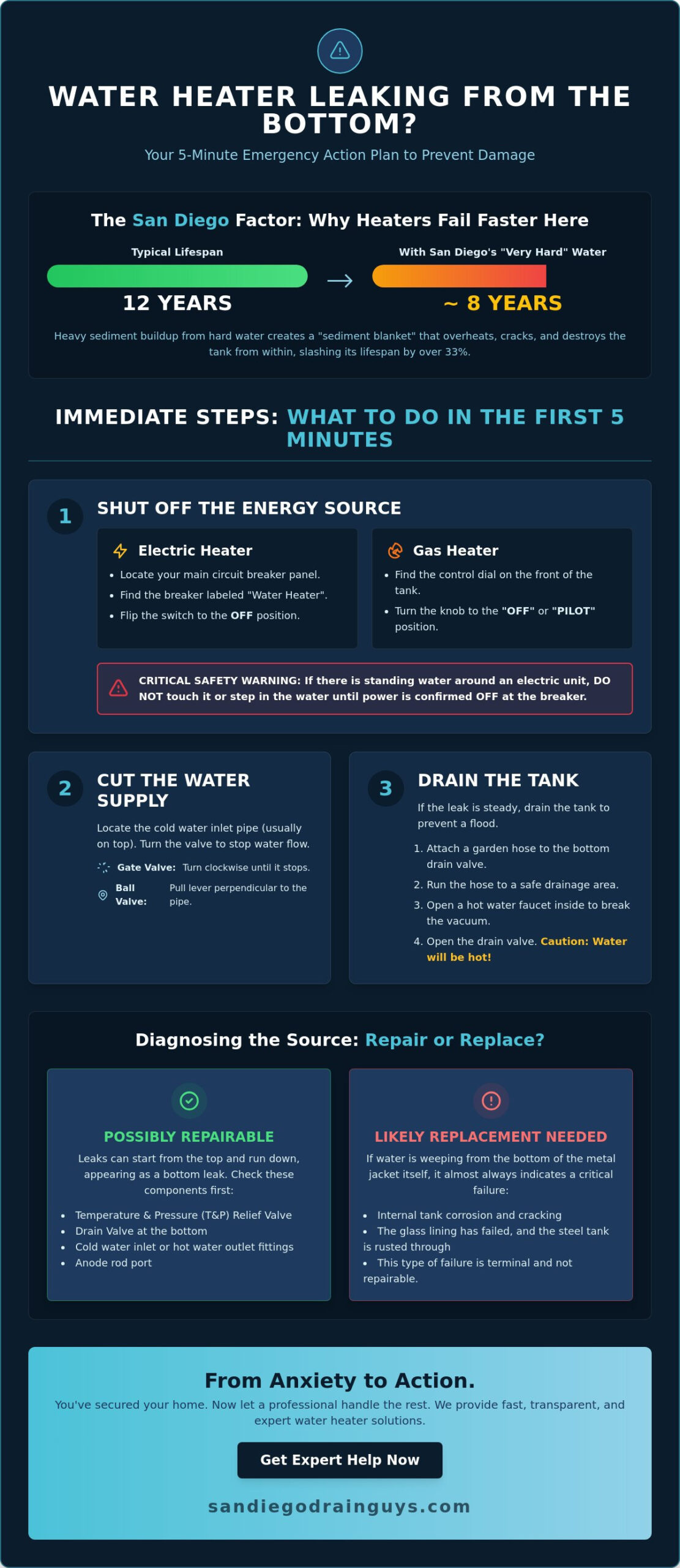
Did you know that San Diego’s “very hard” water can slash a typical water heater’s lifespan from 12 years down to just 8? If you just walked into your garage to find a growing puddle, you are likely searching for a water heater leaking from bottom what to do before your home suffers expensive damage. We know how unsettling it is to face an unexpected plumbing crisis; the anxiety over potential replacement costs and technical confusion can feel overwhelming when your floor is wet.
Our team is here to provide you with immediate peace of mind and a clear, methodical path forward. We will teach you the essential safety steps to take right now to stop the leak and help you determine if your unit needs a simple component fix or a complete installation. We’ll explore how local factors like heavy sediment buildup and California’s specific seismic strapping codes impact your situation. By the end of this guide, you will have the expert perspective needed to handle this headache with confidence and protect your home’s integrity.
Key Takeaways
- Secure your home immediately by following our step-by-step guide to shutting down your gas or electric power source within the first five minutes of a leak.
- Distinguish between a terminal tank failure and a repairable component by identifying common culprits like the Temperature and Pressure (T&P) Relief Valve.
- Discover the professional criteria for a water heater leaking from bottom what to do, including the “50% Rule” for deciding between a simple repair and a full replacement.
- Learn how San Diego’s very hard water creates a “sediment blanket” that causes tanks to overheat, crack, and fail years before their expected lifespan.
- Move from anxiety to informed confidence with a methodical diagnostic approach that prioritizes price transparency and respect for your domestic environment.
Immediate Emergency Steps: What to Do in the First 5 Minutes
Finding a puddle under your appliance is a high-stress moment. Our first priority is to stabilize the situation and prevent water damage from escalating further. If you are staring at a water heater leaking from bottom what to do, don’t panic. Follow these methodical steps to secure your home. We recommend acting quickly but deliberately. Before you grab a mop, you must address the energy and water sources that are fueling the problem.
Shutting Off the Energy Source Safely
Safety is our absolute priority. You must disable the power or fuel source before attempting any diagnosis. For electric water heaters, locate your home’s main circuit breaker panel. Find the breaker labeled “Water Heater” and flip it to the off position. This is vital because if the water level drops while the power is still on, the upper heating element will burn out in seconds. Most importantly, if there is standing water around an electric unit, don’t step in it or touch the heater until the power is confirmed off at the breaker.
For gas units, the process is slightly different. Look for the control dial on the front of the tank. Turn the knob to the “Off” or “Pilot” position to prevent the burner from igniting. Understanding how storage water heaters work helps you realize that even with the heat off, the tank remains under pressure until the water supply is cut. By neutralizing the energy source, you eliminate the risk of fire or electrical shock while you work on the unit.
Cutting the Water Supply and Draining the Tank
Once the energy source is neutralized, you must stop more water from entering the tank. Look for the cold water inlet pipe, which is usually located at the top of the unit. You will find either a round gate valve or a lever-style ball valve. Turn the gate valve clockwise until it stops, or pull the ball valve lever perpendicular to the pipe. This halts the pressure and should slow the leak significantly. If the valve is stuck, you may need to shut off the main water supply to the entire house.
If the water heater leaking from bottom what to do involves a steady stream of water, you should drain the tank to prevent a flood. Follow these steps:
- Attach a standard garden hose to the drain valve at the bottom of the tank.
- Run the other end of the hose to a safe drainage area, like a driveway or a floor drain.
- Open a hot water faucet elsewhere in the house. This breaks the vacuum inside the pipes and allows the tank to drain smoothly.
- Carefully open the drain valve on the heater. Be cautious, as the water exiting the hose will still be very hot.
By following these steps, you have successfully moved from a state of emergency to a state of controlled observation. You’ve protected your home from immediate catastrophe, and now you can focus on identifying exactly where the water is coming from.
Diagnosing the Source: Is It the Tank or a Component?
Once you have secured the area, the next step in determining your water heater leaking from bottom what to do is to find the actual origin of the moisture. It’s a common misconception that water on the floor always indicates a hole in the bottom of the tank. Gravity is a deceptive force. Water often escapes from the top fittings, the cold water inlet, or the anode rod port and travels invisibly behind the outer metal jacket. It eventually pools at the base, making a minor loose connection look like a catastrophic tank failure. We find that many “bottom leaks” are actually top-side issues that are easily fixable.
Testing the T&P Relief Valve and Drain Valve
Check the Temperature and Pressure (T&P) Relief Valve first. This safety device is designed to release water if the internal pressure or temperature exceeds safe limits. If the valve is faulty or if your home’s water pressure is too high, it may drip constantly. Look at the discharge pipe connected to this valve. If the end of the pipe is wet, the leak is likely the valve itself, not the tank. You can also perform a simple “paper towel test” by drying the area thoroughly and wrapping a fresh towel around the drain valve at the bottom. If the towel stays dry while the floor gets wet, the water is likely weeping from inside the jacket. If the drain valve itself is dripping, it may just need a replacement washer or a quick tightening with a wrench.
The “Invisible” Culprit: Internal Tank Corrosion
Internal tank failure is a more serious issue. Most traditional units use a steel tank with a thin glass lining to prevent rust. Over time, the constant thermal expansion and contraction can cause this lining to crack. Once the steel is exposed to water, corrosion begins immediately. If you notice rust-colored water or small flakes of metal in the puddle, it’s a definitive sign that the tank has reached the end of its life. While you might be looking for ways to reduce your water heating bills through better efficiency, a corroded tank cannot be repaired. It must be replaced to avoid a sudden, high-pressure burst that could flood your home.
If the source of the water remains elusive despite your best efforts, professional leak detection can pinpoint the exact failure point without the guesswork. Identifying the specific leaking part is the only way to make an informed decision on whether a repair is viable or if a full replacement is the more responsible choice for your home’s safety.
The Repair vs. Replace Decision Framework
Deciding how to handle a water heater leaking from bottom what to do often leads to a difficult financial crossroad. You want to save money, but you also want to avoid a flooded garage or basement next month. We help homeowners navigate this by applying a logical decision framework. It’s about looking at the total cost of ownership rather than just the immediate price of a service call. Our goal is to provide you with the transparency needed to make a choice you won’t regret in six months.
This level of expert consultation is essential for any major plumbing decision; for instance, Alberto Pro Plumbing provides similar diagnostic support for residents in Central Florida, ensuring they understand the long-term value of their repair or replacement options.
The primary metric we use is the 50% Rule. If a repair costs more than half the price of a new unit, the investment rarely pays off. This logic is tied closely to the age of your system. While a standard storage tank might last 12 years in some regions, San Diego’s hard water often pushes units into the critical “danger zone” by year eight. If your heater is approaching a decade of service, every repair is essentially a temporary bandage on a failing system. We also recommend checking your original manufacturer’s warranty. Many tanks are covered for 6 to 10 years, which could significantly change your financial outlook.
When a Repair Makes Financial Sense
Repairs are excellent for young systems that are otherwise in good health. If your unit is under six years old, replacing a faulty T&P valve or a burnt-out heating element is a cost-effective fix. Sometimes, the problem is simply a loose supply line connection or a worn-out gasket. Utilizing professional leak detection can save you from replacing a perfectly healthy tank by identifying these external issues. We believe in being honest about these simple fixes; there’s no reason to buy a new unit if a minor adjustment can restore your hot water safely.
When Replacement is the Only Safe Option
If the tank itself is weeping, there is no safe way to patch it. A structural leak indicates the internal steel has corroded through. According to a U.S. Department of Energy guide, once a tank begins to leak from the body, replacement is the only viable path. Keeping a “zombie” heater alive with constant patchwork is a gamble. You risk a sudden, high-pressure burst and extensive property damage. Modern units offer significant energy efficiency gains that help offset the upfront cost of a new water heater installation. You will likely notice the benefit in your monthly utility bills immediately, especially if you move to a high-efficiency or tankless model.
The San Diego Factor: Hard Water and Sediment Buildup
If you live in San Diego, your plumbing faces a unique challenge. Our local water averages 270 parts per million (ppm) of mineral content, which is classified as “very hard” by industry standards. This high concentration of calcium and magnesium creates a thick “sediment blanket” at the base of your tank over time. When residents search for a water heater leaking from bottom what to do, the answer is often rooted in this mineral accumulation. This layer of rock-like scale acts as an insulator between the burner and the water, forcing the unit to work much harder than intended.
This insulation leads to a phenomenon known as “hotspots.” Because the heat can’t transfer efficiently through the sediment, the bottom of the steel tank becomes dangerously overheated. Eventually, the protective glass lining fractures under the stress, allowing water to reach the raw steel and cause a leak. You might hear a distinct popping or rumbling sound coming from your garage; this is steam bubbles escaping from beneath the sediment layer. It’s a clear warning that your tank is struggling. In San Diego, these conditions can shorten a unit’s lifespan from the national average of 12 years down to just 8 years or less.
Preventative Maintenance for San Diego Homeowners
We recommend a methodical maintenance schedule to combat our local water conditions. An annual tank flush is the most effective way to remove calcium buildup before it solidifies. You should also check your anode rod every two to three years. This “sacrificial lamb” is designed to corrode so your tank doesn’t have to, but it dissolves much faster in hard water. Many of our neighbors also choose to install whole-house water softeners to protect their investment and extend the life of their plumbing appliances.
San Diego Regulations and Safety Standards
Local building codes are strict because of our regional seismic activity. California requires water heaters to be strapped at two points: one in the upper third and one in the lower third of the tank. If your unit is in a garage, it must be raised 18 inches off the floor to prevent the ignition of spilled gasoline vapors. Additionally, San Diego County Measure E-1.2 now requires many new installations to be alternatively powered, such as electric or tankless systems. Navigating these specific permits and safety requirements is why we prioritize professional oversight for every project.
If your unit has already succumbed to sediment damage, we provide expert water heater installation that ensures full compliance with all California seismic and efficiency codes.
Professional Solutions: Why San Diego Drain Guys is the Right Call
When you are faced with a water heater leaking from bottom what to do, the situation often feels like a race against time. We understand the anxiety that comes with potential water damage and the frustration of unexpected costs. Our team approaches every service call as a “calm expert,” focusing on de-escalating the crisis through methodical action and clear communication. We don’t just look at the heater; we ensure your entire drainage system is functioning correctly to handle any future issues. This comprehensive perspective is what distinguishes our neighborly service from generic corporate providers. We take pride in being a dependable partner for San Diego homeowners during high-stress plumbing events.
Our Methodical Diagnostic Process
We believe that an accurate diagnosis is the foundation of an honest repair. Our technicians use professional leak detection equipment, such as thermal imaging and high-sensitivity moisture meters, to verify the exact failure point. This eliminates the guesswork that often leads to unnecessary replacements. Throughout the process, we maintain a high level of respect for your domestic environment. We work with a degree of privacy and empathy that acknowledges we are guests in your home. Once we identify the source, we provide a written assessment that outlines your repair versus replacement options using our transparent fee structure. You’ll never encounter hidden surprises or shifting estimates during a crisis. This commitment to honesty is a core identity marker for us.
Seamless Installation and Long-Term Support
If a new unit is required, we handle every detail of the installation day. This includes hauling away your old, sediment-heavy unit for eco-friendly disposal and ensuring the new system meets all 2026 California plumbing codes. Whether you are opting for a traditional tank or a high-efficiency tankless model, our work is disciplined and methodical. We prioritize a clean workspace and a quiet, professional presence. Our goal is to move you from a state of concern to a state of informed confidence, knowing your hot water is restored and your home is protected. We don’t just install a product; we provide a premium service experience that exceeds standard industry levels. Schedule your expert water heater inspection with San Diego Drain Guys today to experience a higher level of service and reliability.
Restoring Your Home’s Safety and Comfort
Stabilizing a leaking water heater is about moving from panic to a plan. We have covered how to secure your energy and water sources, how to differentiate between a simple valve repair and a structural tank failure, and why San Diego’s hard water makes annual maintenance essential. Addressing a water heater leaking from bottom what to do requires a methodical approach that prioritizes your home’s long-term health over a quick, temporary fix.
At San Diego Drain Guys, we have been locally owned and operated since 2018. We specialize in high-stakes leak detection and precision water heater installation. Our team is committed to your privacy and provides an empathetic service experience that respects your personal environment. We offer a transparent, flat-rate pricing model so you can make decisions without financial uncertainty.
Contact San Diego Drain Guys for Transparent, Flat-Rate Water Heater Repair
You don’t have to navigate this plumbing crisis alone. With the right expert guidance and a clear understanding of your options, you can protect your property and get your hot water back today.
Frequently Asked Questions
Is a water heater leaking from the bottom an emergency?
Yes, any leak from the base of your unit should be treated with urgency. While a small puddle might seem manageable, it often signals that the internal tank is failing or a safety valve is malfunctioning. If you are unsure of a water heater leaking from bottom what to do, your first priority is to shut off the power and water supply. Ignoring these signs can lead to a sudden burst and significant property damage.
Can I still use hot water if my heater is leaking from the bottom?
We recommend that you stop using hot water immediately once a leak is detected. Using the hot water taps keeps the tank under pressure and causes the unit to cycle on and off to reheat. This added stress can turn a minor weep into a major flood. It is much safer to disable the system and leave the water off until a professional can verify the source of the failure.
How much does it typically cost to fix a leaking water heater in San Diego?
The cost to resolve a leak depends entirely on whether the issue is a repairable component or a total tank failure. Replacing a Temperature and Pressure relief valve or a heating element is a relatively affordable fix. However, if the tank itself is corroded, a full replacement is necessary. We provide a transparent fee structure during our consultation so you can make an informed decision without any hidden financial surprises.
What causes a water heater to leak from the bottom after only 5 years?
Premature failure is almost always linked to San Diego’s very hard water. When mineral sediment builds up, it creates hotspots that crack the glass lining of the tank. If you are researching a water heater leaking from bottom what to do on a newer unit, check your anode rod. If this sacrificial part isn’t replaced every few years, the water will begin to eat away at the steel tank walls instead.
Will my homeowners insurance cover a leaking water heater?
Most standard policies cover the “sudden and accidental” water damage caused by a leaking appliance, such as ruined flooring or drywall. However, insurance companies rarely pay for the replacement of the water heater itself if the leak was caused by age, rust, or lack of maintenance. We suggest reviewing your policy details to see if you have specific coverage for appliance failure or water backup issues.
Should I switch to a tankless water heater if my current tank is leaking?
Switching to a tankless model is an excellent option for many homeowners because these units don’t store water in a large steel tank that can corrode. They offer endless hot water and better energy efficiency. While the initial installation requires different venting and gas line configurations, the long-term benefit includes a lifespan that can be double that of a traditional tank, especially in hard water regions like ours.
How long do water heaters usually last in San Diego?
In our region, you can expect a traditional tank to last between 8 and 12 years. San Diego’s water has a high mineral content of approximately 270 parts per million, which is significantly higher than the national average. This “very hard” water accelerates sediment buildup and internal corrosion. Consistent annual maintenance, such as flushing the tank, is the only way to reach the upper end of that lifespan.
Can sediment buildup be cleaned out once the tank starts leaking?
No, once the tank is actually leaking from the body, flushing the sediment will not fix the problem. Flushing is a preventative maintenance step designed to remove loose minerals before they cause damage. Once a leak begins, it means the structural integrity of the steel has already been compromised by rust. At this stage, the only safe and reliable solution is a professional installation of a new unit.